
Selecting the right car seat is one of the most critical safety decisions you will make for your child. To find a Britax swivel car seat that fits perfectly, you must look beyond your child’s age and focus primarily on their current weight and height. While age serves as a helpful developmental milestone, physical measurements dictate how a car seat protects your child during a sudden stop or collision.
In Singapore, where road safety regulations are strictly enforced, ensuring your child passenger restraint complies with local laws is both a safety priority and a legal obligation. Swivel car seats have grown immensely popular because they combine robust safety engineering with a rotating base that simplifies daily transitions. By understanding how to match your child’s physical profile to the specific limits of these rotating models, you can ensure a secure fit and a comfortable ride for every journey.
Understanding Britax Swivel Seat Stages and Rotation Benefits
Car seats are engineered to protect children at specific stages of physical development, typically categorized as infant carriers, convertible seats, and all-in-one or multi-stage seats. Infant-specific seats are designed solely for rear-facing use and accommodate newborns up to a relatively low weight limit. Convertible seats transition from rear-facing to forward-facing as your child grows, while all-in-one models can further convert into booster seats. Each stage features distinct weight and height thresholds defined by the manufacturer, and transitioning too early can compromise your child’s safety.
Products mentioned in this guide
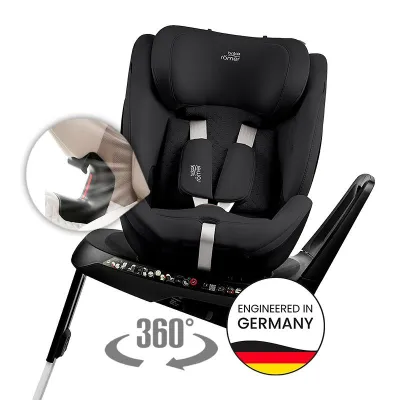
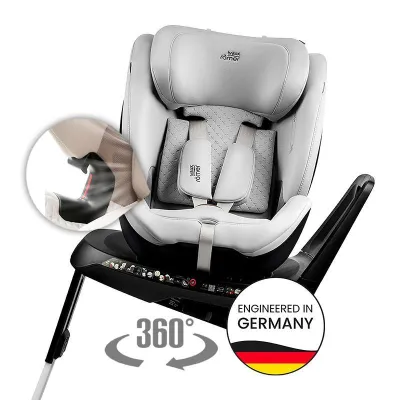
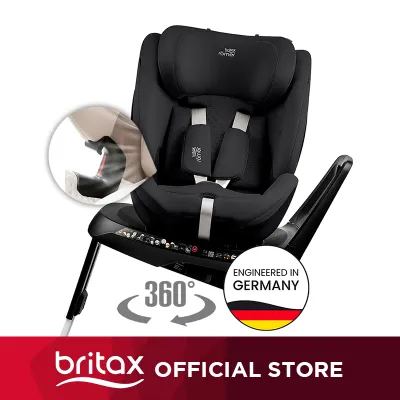

Prices are valid at publication and may change. Please refer to the product page for the latest price.
The defining feature of a swivel car seat is its rotating mechanism, which allows the seat shell to turn 90, 180, or a full 360 degrees on its base. For caregivers, this rotation is a major ergonomic advantage. Instead of twisting your body and bending at awkward angles to buckle your child into a rear-facing seat, you can rotate the seat to face the open vehicle door. This direct access makes it much easier to position your child correctly, tighten the harness snugly, and verify that the chest clip and straps are flat and twist-free.
Using a swivel base is particularly beneficial during the rear-facing stage, which safety experts recommend maintaining for as long as possible. Because loading a growing, heavier toddler into a rear-facing seat can cause significant back strain, the ability to spin the seat toward you minimizes physical effort. This convenience encourages parents to keep their children rear-facing up to the maximum limit allowed by the seat, rather than rushing to turn them forward-facing.
It is vital to remember that age is merely a secondary guideline when evaluating car seat stages. Children grow at highly individual rates, and two toddlers of the exact same age can have vastly different weights and heights. The structural integrity of a car seat and its harness system is tested and certified based on physical mass and stature. Consequently, you must always prioritize your child’s actual weight and height measurements over their age when determining if a specific Britax swivel model is still safe to use.
Matching Your Child's Measurements to Manufacturer Limits
To determine which Britax swivel model fits your child, you must obtain precise, up-to-date measurements of their weight and height. Weigh your child without heavy clothing or shoes using a reliable digital scale. For height, have your child stand straight against a flat wall, or measure infants flat on their backs on a firm surface, ensuring you measure from the very top of the head to the soles of the feet. Additionally, pay attention to their torso height—the distance from the seat surface to the top of their shoulders when sitting—as this determines where the shoulder straps will align.
Once you have these measurements, cross-reference them with the manufacturer’s specifications, which are clearly printed on the seat’s user manual and the orange approval labels affixed to the seat shell. These labels specify the minimum and maximum weight and height limits for each configuration. For example, a model might allow rear-facing installation from birth up to 18 kilograms, and forward-facing installation from 9 kilograms up to 18 kilograms. You must verify that your child falls comfortably within the allowed range for the specific mode you plan to use.
Beyond the numerical limits, you must also evaluate how your child’s body fits within the physical shell of the seat. For rear-facing installations, there must be adequate head clearance; typically, the top of your child’s head must sit at least 2.5 centimeters (one inch) below the top edge of the car seat shell or headrest. For the harness system, the shoulder straps must emerge from the slots at or slightly below your child’s shoulders when rear-facing, and at or slightly above their shoulders when forward-facing.
Never wait for your child to outgrow every single limit before planning your next step. A car seat is outgrown the moment your child reaches any single maximum threshold—whether that is the maximum weight, the maximum overall height, or the maximum head clearance. If your child reaches the weight limit but is still under the height limit, the seat is still considered outgrown in that configuration, and you must immediately transition them to the next stage or adjust the seat according to the manufacturer’s instructions.
Evaluating Swivel Features and Vehicle Compatibility
Before purchasing a swivel car seat, you must evaluate how the seat connects to your vehicle and whether your car’s cabin can accommodate its physical footprint. Most swivel car seats rely on ISOFIX anchor points to secure the base to the vehicle chassis. ISOFIX installation is highly favored because it reduces the risk of installation errors, featuring color indicators that turn green when the connectors are securely locked. However, you must check your vehicle’s owner’s manual to confirm that your rear seats are equipped with ISOFIX anchors, as some older or compact vehicle models may lack them.
The rotation range of swivel seats can vary between 180 degrees and 360 degrees. A 180-degree swivel seat typically rotates toward the vehicle door from a rear-facing position, which is excellent for infant stages but may not rotate once transitioned to forward-facing. A 360-degree swivel seat offers complete rotation in any direction, allowing you to turn the seat toward the door regardless of whether the seat is configured as rear-facing or forward-facing. Look for models that offer one-handed rotation triggers, which allow you to spin the seat easily while holding your child in your other arm.
To help you organize your options, use the following verification checklist when comparing different swivel models in retail stores or online:
| Feature to Verify | What to Look For | Why It Matters |
|---|---|---|
| Rotation Range | 180-degree vs. 360-degree | Determines if you can spin the seat in both rear- and forward-facing modes. |
| Installation Method | ISOFIX connectors and support leg | Ensures secure attachment; must match your vehicle's anchor points. |
| Recline Positions | Multiple adjustable angles | Crucial for newborn airway safety and passenger comfort during long rides. |
| Harness Adjustment | No-rethread harness and headrest | Allows you to adjust strap height easily as your child grows without uninstalling. |
Swivel car seats generally feature a larger, heavier footprint than standard stationary seats because of the integrated rotating mechanism and support leg (load leg). The support leg extends from the base to the vehicle floor to limit forward rotation during an impact, but it cannot be used in vehicles with underfloor storage compartments. Furthermore, the rotating shell requires a clear radius to spin smoothly without hitting the front vehicle seats. You should measure the depth of your vehicle’s backseat and, if possible, request a physical test fit at a local specialty baby store to ensure the seat rotates freely without forcing the front passenger seat too far forward.
Verifying Safety Certifications and Singapore Compliance
When shopping for a car seat in Singapore, safety certifications are non-negotiable. Look for the official European safety standard labels, such as ECE R129 (also known as i-Size) or ECE R44/04, which are typically printed on an orange sticker on the seat. The ECE R129 standard is the most current framework, classifying seats based on the child’s height rather than weight and requiring rigorous side-impact testing. Checking for these labels ensures the seat has undergone standardized crash testing and meets strict international safety benchmarks.
Under Singapore’s Road Traffic Act, all passengers in a motor vehicle who are under 1.35 meters in height must be properly secured with an approved child restraint appropriate for their height and weight. This law applies to all private motor vehicles and private hire cars (such as ride-hailing services), though public taxis are exempt (though using a restraint is still highly recommended for safety). Failing to secure your child not only carries legal penalties but also puts your child at severe risk in the event of an accident.
While it may be tempting to purchase a second-hand swivel car seat to save money, doing so introduces significant safety risks. Car seats have a strict lifespan—typically six to ten years from the date of manufacture—because the plastic shell and energy-absorbing foam degrade over time, especially when exposed to the high heat and humidity of Singapore’s tropical climate. Furthermore, a second-hand seat may have been involved in a minor collision, which can cause invisible hairline fractures in the plastic that compromise its structural integrity in a future crash. Always purchase new, or only accept a used seat if you know its entire history from a trusted source.
To ensure your selected Britax swivel seat is installed correctly, always read the official instruction manual cover-to-cover and follow the step-by-step guidance. Many installation errors go unnoticed by parents, such as leaving the support leg hovering slightly above the floor or failing to engage the ISOFIX connectors completely. If you are uncertain about the installation, consider consulting a certified Child Passenger Safety Technician (CPST) in Singapore who can inspect your setup and teach you how to secure your child safely every time.
Frequently Asked Questions (FAQ)
Can I use a Britax swivel car seat from birth?
Whether you can use a Britax swivel car seat from birth depends entirely on the specific model’s certified minimum weight and height limits. Many convertible swivel seats are approved for use from birth, provided they feature a specialized newborn insert. This insert is crucial because it reduces the interior volume of the seat, ensuring a snug fit for a tiny infant and preventing their head from slumping. Additionally, you must verify that the seat can achieve a sufficiently reclined angle when installed rear-facing; a deep recline is essential to keep a newborn’s airway open and prevent their heavy head from falling forward onto their chest.
When should I switch the swivel seat from rear-facing to forward-facing?
You should keep your child in the rear-facing position for as long as possible, up to the maximum rear-facing height or weight limit specified by the manufacturer. While some regulations permit forward-facing travel once a child reaches a certain age or weight, rear-facing remains the safest way for young children to travel because it supports the head, neck, and spine during a frontal collision. Do not rush to turn the seat forward-facing simply because your child’s legs are bent or touching the vehicle seat back. Only transition to forward-facing when your child has fully outgrown the rear-facing limits of your specific swivel seat.
Do swivel car seats fit in compact cars?
Swivel car seats can fit in compact cars, but they require careful measurement because their bases and rotating shells are typically bulkier than standard car seats. The rotation mechanism requires a clear path to spin, which can be restricted if the front vehicle seats are pushed far back. Before purchasing, measure the distance between your vehicle’s rear seat back and the back of the front seat when adjusted for a comfortable driving position. Testing the seat in your actual vehicle is the most reliable way to ensure that you can operate the swivel mechanism smoothly without scraping the door panels or front seats.

Community discussion
Share your experience or ask a question. Comments are reviewed before publication.