
Selecting the right diaper bag size is one of the most practical decisions you will make as a parent. The appropriate bag must accommodate your daily essentials without becoming a heavy burden during long walks or quick errands. Skip Hop offers a diverse range of diaper bags, from compact crossbody designs to spacious backpacks and classic totes, each tailored to different parenting styles and family sizes.
To find a suitable fit, you need to balance your typical outing duration with the number of children in your care. A bag that is too small will leave you stranded without critical supplies, while an oversized bag can cause physical strain and clutter your stroller. By evaluating your packing habits and understanding how different bag structures utilize their space, you can select a model that fits seamlessly into your daily routine.
Understanding Skip Hop Bag Styles and General Capacities
Diaper bags generally fall into three primary categories: backpacks, totes, and crossbody or shoulder bags. Backpacks are highly favored for their hands-free convenience and balanced weight distribution across both shoulders, making them excellent for active days. Totes offer a classic look with wide-open main compartments that allow you to see all your gear at a glance, though they carry weight on a single shoulder. Crossbody and smaller shoulder bags provide quick access and a lighter profile, ideal for parents who prefer to travel light.
Products mentioned in this guide
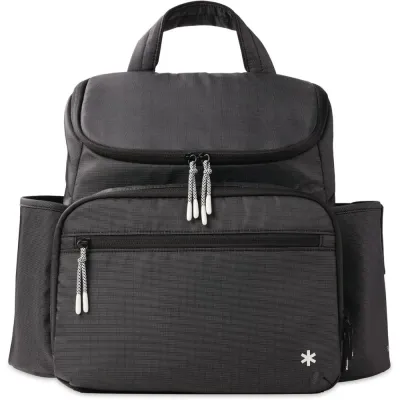
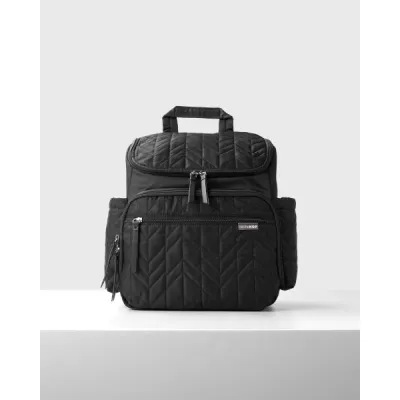
Prices are valid at publication and may change. Please refer to the product page for the latest price.
When shopping for a bag, it is crucial to check the manufacturer’s official dimensions and volume specifications rather than relying solely on product photos. Online images can be deceptive, as a bag may look larger or smaller depending on the model’s height or the camera angle. Look for the listed height, width, and depth measurements, and compare them to a bag you already own to get a realistic sense of its physical footprint.
Beyond external dimensions, the internal architecture of the bag plays a major role in how much you can actually pack. Built-in organization, such as dedicated insulated bottle pockets, padded tech sleeves, and zippered parent compartments, helps keep items tidy but also consumes physical space. If you plan to carry bulky items like thick blankets, large formula dispensers, or multiple toy sets, a bag with a large, open main cavity may serve you better than one with numerous rigid internal dividers.
Matching Bag Size to Your Outing Duration and Family Size
Your daily schedule and the age of your children are the most reliable indicators of the bag capacity you will require. For short trips, such as a quick run to the local supermarket or a brief visit to a nearby playground, a compact backpack or a streamlined crossbody bag is usually sufficient. These smaller styles are designed to hold just the essentials: two or three diapers, a travel-sized pack of wipes, a single change of clothes, and a bottle or sippy cup. Carrying a lighter load for short trips prevents unnecessary fatigue and keeps you agile.

Full-day outings, doctor appointments, or travel days demand a significant scale-up in capacity. For these scenarios, a large diaper backpack or a spacious dual-compartment tote is highly recommended. You will need enough room to pack multiple feeding supplies, a thermos of warm water, snacks, extra toys, and at least two complete changes of clothing to handle unexpected messes. A larger bag ensures you do not have to ration supplies when you are away from home for several hours.
The number of children you manage also dictates your capacity needs. If you are packing for a single infant, your focus will be on frequent diaper changes, feeding gear, and clean clothes. However, if you are managing both an infant and a toddler, your packing list doubles in complexity. You must accommodate different diaper sizes, potty-training supplies, distinct snack preferences, and separate entertainment items. In these multi-child scenarios, look for bags with expandable side panels or dual-compartment layouts that allow you to segregate items by child.
Design Features That Affect Usable Packing Space
The usability of a diaper bag’s capacity depends heavily on its structural design and built-in features. While a bag might advertise a high volume, the presence of specialized compartments can restrict how you distribute your gear. For instance, dedicated insulated pockets designed to keep bottles warm or cold are incredibly convenient, but they often push inward, reducing the flexible space available in the main compartment. Understanding this trade-off helps you pack more strategically.
Stroller compatibility is another critical feature to evaluate before making a purchase. Many diaper bags come equipped with integrated stroller straps or clips designed to attach the bag directly to your stroller’s handlebar. Before relying on this feature, you must check your stroller manufacturer’s guidelines regarding weight limits and handle widths. Hanging a heavily packed bag on a lightweight stroller can alter its center of gravity, creating a serious tipping hazard that compromises your child’s safety.
To maximize your carrying capacity without buying an excessively bulky bag, consider utilizing external accessories and modular add-ons. Attachable changing clutches, external pacifier pods, and clip-on sanitiser holders allow you to store frequently used items on the outside of the bag. This modular approach keeps the main compartment free for larger essentials while ensuring that quick-access items remain within arm’s reach during an emergency.
Common Sizing and Packing Mistakes to Avoid
One of the most common mistakes parents make is purchasing the largest diaper bag available under the assumption that more space is always better. While a massive bag ensures you never run out of room, it also encourages overpacking. Carrying an excessively heavy bag over one shoulder or even on both shoulders can lead to chronic muscle strain, poor posture, and back pain over time. It is generally wiser to choose a medium-sized bag and practice disciplined packing.
Another frequent oversight is ignoring the physical limits of your stroller’s frame. Even if your diaper bag fits securely on the stroller handles, overloading it can strain the stroller’s chassis or cause the entire unit to tip backward when you lift your child out of the seat. Always refer to your stroller’s user manual to verify the maximum allowable weight for handle attachments, and try to store heavier items in the under-seat basket instead of hanging them.
Finally, many parents forget to account for their own personal items when calculating the space they need. Your diaper bag often doubles as your personal handbag, meaning it must comfortably house your wallet, keys, mobile phone, water bottle, and personal care items. If your chosen bag lacks a dedicated, easily accessible “parent pocket,” these personal essentials can easily sink to the bottom of a deep main compartment, forcing you to rummage through baby gear just to find your keys.
Frequently Asked Questions (FAQ)
Can I use a standard Skip Hop backpack instead of a dedicated diaper bag?
While you can use a standard school or travel backpack, dedicated diaper bags offer several distinct advantages designed specifically for parenting. Diaper bags typically feature water-resistant, wipeable interior linings that make cleaning up spills simple, whereas standard backpacks often use absorbent fabrics. Additionally, dedicated diaper bags include specialized compartments like insulated bottle pockets, quick-access wipe pockets, and integrated stroller straps that are rarely found on standard lifestyle backpacks.
Does the included changing mat significantly reduce the main compartment space?
Most diaper bags are designed with a dedicated, slim pocket specifically intended to store the included changing mat. This pocket is usually located against the back panel of the bag, which keeps the mat flat and prevents it from consuming the central volume of the main compartment. If you choose to leave the changing mat at home or use a disposable alternative, this dedicated sleeve often doubles as an excellent storage space for a tablet, small laptop, or clean clothing.

Community discussion
Share your experience or ask a question. Comments are reviewed before publication.