
Quick Answer: Are Pigeon Laundry Capsules Safe for Baby Skin?
Yes, but safety is conditional and depends on selecting the correct product variant and verifying its claims on the packaging. While some formulations are designed with mild ingredients suitable for infant wear, others might be formulated for general household laundry. Parents must look for explicit “baby-safe,” “hypoallergenic,” or “dermatologically tested” labels on the box.
Additionally, check for the absence of harsh additives such as optical brighteners, synthetic dyes, and strong fragrances, which can trigger contact dermatitis on delicate skin. If your baby has a diagnosed skin condition, severe eczema, or highly reactive skin, always consult a pediatrician before introducing any new laundry detergent, even those marketed for infants.
How to Find and Read the Ingredient List on Pigeon Capsules
To ensure you know exactly what touches your baby’s skin, start by locating the ingredient list. This information is typically printed on the back or bottom of the physical product packaging. If the print is too small or if you are shopping online, check the official brand website or authorized online store listings. Avoid relying on third-party forum posts, as formulations can change over time or vary by region.
Products mentioned in this guide
![[2-Pack] Pigeon Baby Laundry Capsule 42Pcs](https://img.lazcdn.com/g/p/f764ebc514e9ff8b00a3be562f37422f.png_400x400q80.png_.webp)
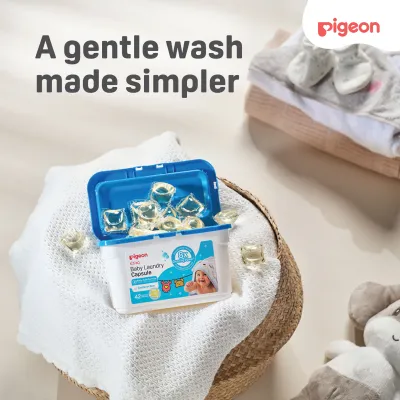
Prices are valid at publication and may change. Please refer to the product page for the latest price.

When reading the label, it is crucial to distinguish between actual chemical groups and marketing terms. Marketing terms like “natural plant power” or “gentle care” are designed to appeal to consumers, but the active ingredient list tells the real story. Look for the chemical names of surfactants, builders, and preservatives to understand what is actually in the product.
Pay close attention to specific “free-from” claims. For baby clothes, you want to verify that the product is phosphate-free, dye-free, and paraben-free. Phosphates can leave a harsh residue on fabrics, while artificial dyes serve no cleaning purpose and only increase the risk of skin irritation. Verifying these claims on the physical label is the most reliable way to protect your infant’s skin barrier.
Understanding Common Detergent Ingredients and Baby Skin Sensitivities
Laundry capsules are highly concentrated cleaning products. They contain a precise mix of cleaning agents, stain removers, water softeners, and stabilizers packed into a water-soluble film. Because baby skin is up to 30% thinner than adult skin, it absorbs substances more easily and is highly susceptible to chemical irritants left behind on fabric fibers. Understanding these ingredient categories helps parents make informed choices when evaluating Pigeon product labels.
Surfactants and Primary Cleaning Agents
Surfactants, or surface-active agents, are the primary cleaning components in any laundry detergent. Their main job is to lower the surface tension of water, allowing it to wet fabrics more effectively and lift away dirt, body oils, and stubborn milk stains from the fibers. Once lifted, the surfactants keep these soils suspended in the water so they can be rinsed away rather than redeposited onto the clothes.
For baby laundry, plant-derived surfactants (such as those derived from coconut or palm oil) or milder synthetic surfactants are highly preferred. These agents clean effectively without stripping the natural lipids from your baby’s skin barrier when they wear the washed clothes. Stronger anionic surfactants, commonly found in standard adult detergents, can remain in the fabric fibers and cause dryness or chafing.
If your baby has extreme skin sensitivities or a family history of atopic dermatitis, check the label for the specific types of surfactants used. Look for non-ionic or amphoteric surfactants, which are generally milder than traditional anionic varieties.
Enzymes, Fragrances, and Potential Irritants
Enzymes are biological catalysts added to detergents to target specific types of stains. For example, proteases break down protein stains like breast milk or formula, while amylases target starch-based residues. While enzymes are highly effective at keeping baby clothes clean, they can sometimes irritate compromised skin barriers if the detergent is not thoroughly rinsed from the fabric.
Fragrances and preservatives are the most common culprits behind contact allergies in infants. Even mild scents can cause respiratory or skin irritation in newborns. For this reason, fragrance-free and dye-free options are strongly recommended for the first few months of life. Preservatives are necessary to prevent bacterial growth in liquid-filled capsules, but parents should verify that the preservatives used are gentle and free from formaldehyde-releasers.
Always verify these specific inclusions or exclusions directly on the Pigeon product packaging before purchasing. Do not assume that all capsule variants from the same brand share the same fragrance or enzyme profile.
How to Verify Safety Claims and Labels on Baby Detergents
When shopping for baby detergents, you will encounter various safety claims on the packaging. One of the most common is “dermatologically tested.” It is important to understand that this claim indicates the product has undergone testing on human skin to assess its irritation potential. However, it is not an absolute guarantee against all allergic reactions, as every baby’s skin is unique.
Look for recognized local or international safety standard marks on the packaging. These certifications often verify that the product meets strict environmental and chemical safety guidelines. In humid climates, sweat can reactivate detergent residues trapped in clothing fibers, making safety standards even more critical to prevent heat rash and irritation.
Never assume a product is safe for a newborn solely based on the brand name. Brands often manufacture multiple product lines, including standard household detergents alongside specialized baby care items. Always verify the specific variant’s label to ensure it is formulated explicitly for infants or sensitive skin.
Best Practices for Washing and Storing Laundry Capsules Safely
Laundry capsules present unique safety considerations, especially in households with curious babies and toddlers. Because of their bright colors and squishy texture, capsules can easily be mistaken for toys or candy. It is critically important to store laundry capsules securely in their original packaging, completely out of reach and sight of children. Use high cabinets or childproof locks, and never leave a capsule sitting on top of the washing machine.
Proper dosing is another key factor in protecting your baby’s skin. Because capsules are highly concentrated, using too many for a small load can lead to excessive suds that do not rinse out completely. This leaves a concentrated chemical residue on the clothes, which can cause severe skin irritation when the baby sweats. Always follow the manufacturer’s dosing instructions based on the load size.
If your baby has highly reactive skin or if you are washing heavily soiled items like cloth diapers or bibs, consider running an extra rinse cycle. This helps ensure that every trace of surfactant and enzyme is thoroughly flushed from the fabric fibers. Additionally, always wash new baby clothes before their first wear to remove any manufacturing residues or chemical finishes.
Frequently Asked Questions (FAQ)
Can I use regular Pigeon laundry capsules for newborn clothes?
It is not recommended to use regular, non-baby-specific Pigeon laundry capsules for newborn clothes. Regular household capsules are often formulated with stronger enzymes, optical brighteners, and intense fragrances designed to tackle adult-level dirt and odors. These ingredients can easily overwhelm a newborn’s delicate and developing skin barrier, leading to redness, dryness, or allergic contact dermatitis. Instead, strictly choose variants that are explicitly labeled for babies or sensitive skin, and carefully verify the ingredient list on the packaging before use.
What should I do if my baby develops a rash after washing clothes with capsules?
If your baby develops a rash, immediately stop using the suspected laundry capsule and switch to a known, hypoallergenic, fragrance-free alternative. Re-wash all of the baby’s recently laundered clothes, bedding, and towels using the new detergent and run an extra rinse cycle to remove any lingering residues. Keep the baby’s skin clean and dry, and avoid applying heavily fragranced lotions. If the rash does not improve within a few days, spreads, or causes the baby obvious discomfort, consult a pediatrician promptly for a proper diagnosis and treatment plan.

Community discussion
Share your experience or ask a question. Comments are reviewed before publication.