
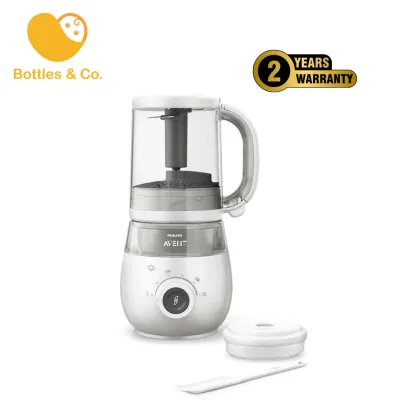
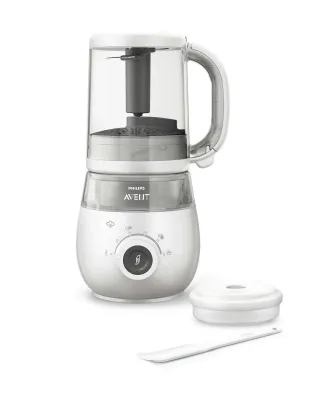
The choice between the Philips Avent 4-in-1 and alternative baby food makers comes down to how you prefer to manage your kitchen workflow, counter space, and meal prep volume. The Philips Avent 4-in-1 uses a unique single-jar system where you steam ingredients and then simply flip the jar over to blend, eliminating the need to transfer hot food. Other brands on the market often opt for multi-tier baskets, dual-jar setups, or digital presets that allow you to steam and blend simultaneously or handle larger batches.
In compact Singapore apartments where kitchen countertop space is at a premium, choosing an appliance that balances footprint with functional utility is essential. Preparing fresh purees for your baby during the weaning phase requires a reliable method to steam and blend ingredients safely. Before introducing solid foods, caregivers should consult a pediatrician to ensure the baby is developmentally ready, and always supervise the feeding process.
Evaluating these appliances requires looking beyond marketing claims to examine physical design, cleaning routines, and actual capacity limits. By understanding how different function combinations align with your daily schedule, you can select a tool that simplifies meal preparation rather than adding to your kitchen chores.
Products mentioned in this guide
Prices are valid at publication and may change. Please refer to the product page for the latest price.
Core Functions Compared: Steaming, Blending, Defrosting, and Reheating
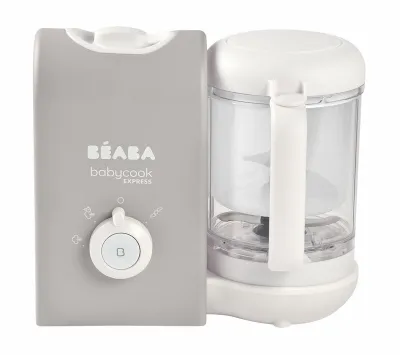
The primary appeal of a multi-function baby food maker is its ability to handle multiple stages of meal preparation in a single footprint. The Philips Avent 4-in-1 utilizes a single-jar design for both steaming and blending. You place raw ingredients into the jar, steam them, and once the cycle is complete, you lift the jar, flip it upside down, and lock it back onto the base to blend. This minimizes transfer mess and preserves nutrient-rich cooking liquids. In contrast, dual-jar or separate-basket systems use distinct compartments. You steam food in a basket or one jar, then pour or transfer it into a separate blending jug. While this requires an extra step, it often allows you to steam one batch of food while blending another, which can speed up multi-ingredient meal prep.
Defrosting and reheating functions offer significant utility for parents who prepare meals in advance. Many multi-function baby food makers, including the Philips Avent 4-in-1, feature dedicated defrosting and reheating settings that rely on gentle steam heat to warm up pre-frozen or refrigerated purees evenly. This is particularly useful for maintaining food safety, as uneven microwave heating can create dangerous hot spots in baby food. When using these functions, caregivers must verify the manufacturer’s instructions regarding acceptable container materials—such as specific glass jars or heat-resistant storage pots—to prevent cracking or chemical leaching.
Capacity trade-offs are a critical factor for parents planning to batch-cook and freeze meals. A single-jar system typically has a unified capacity limit (often around 800ml to 1000ml for steaming, and slightly less for blending to prevent overflow). If you prefer to prepare small, fresh meals daily, a compact single-jar unit is highly efficient. However, if you want to prepare a week’s worth of purees in one go, you may find the capacity of a single-jar system restrictive. Multi-basket or larger dual-jar systems often provide greater total volume, allowing you to steam different food groups (like vegetables and meats) in separate compartments simultaneously without mixing flavors prematurely.
Design, Footprint, and Cleaning Routines
In typical Singapore HDB flats or condominiums, kitchen space is highly optimized. A compact appliance with a small footprint is easier to store in cabinets or leave on the countertop for daily use. Single-jar designs generally feature a narrower base and fewer loose accessories, making them highly space-efficient. Multi-jar or wide-base models require more physical real estate and can make your kitchen feel cluttered, especially if they feature multiple cords or bulky attachments.

The ease of cleaning a baby food maker directly impacts how often you will use it. Single-jar models reduce the number of parts to wash, but you must look closely at the blade assembly and jar geometry. Food particles can easily become trapped in tight crevices around the blade seal or the lid’s steam pathways. Check if the manufacturer specifies that the jar, lid, and blades are dishwasher-safe, or if they require careful hand-washing. Removable blades are highly desirable as they allow you to clean the underside of the blade assembly safely without risking cuts.
The water tank is the heart of the steaming function, and it requires regular upkeep to prevent mineral buildup. In areas with hard water, limescale can quickly accumulate on the heating element, reducing steam efficiency and potentially harboring bacteria. Look for models with an easily accessible water tank that has a wide opening. Some designs feature narrow, enclosed tanks that are difficult to scrub or inspect visually, making descaling a tedious chore. Regular descaling with food-safe agents, such as white vinegar or citric acid, is necessary to maintain the appliance’s lifespan.
Decision Framework: Which Function Combination Fits Your Family?
You should consider the Philips Avent 4-in-1 if your primary goal is a streamlined, low-mess workflow for preparing moderate batches of baby food. The flip-to-blend mechanism is ideal for parents who want to minimize the number of dirty dishes and avoid transferring hot, steamed ingredients between containers. Its relatively compact footprint makes it an excellent fit for smaller kitchens where counter space is limited. It is best suited for those who prefer a straightforward, manual control style without overly complex digital menus.
A competing multi-function baby food maker may be a better fit if you plan to batch-cook large quantities of food to freeze for the week. Models with dual jars or multi-tiered steaming baskets allow you to cook different ingredients at different times or in larger volumes. Additionally, if you prefer automated, hands-off cooking, some competitors offer digital control panels with precise timers and pre-programmed settings for specific food types, such as fish, meat, or hard vegetables.
Neither option may be suitable if you already own a high-performance household blender and a standard stovetop steaming basket. If you prefer to prepare very large family-sized meals and simply blend a small portion for your baby, using your existing kitchen setup may be more practical. Furthermore, baby food makers are specialized appliances with motors optimized for soft, steamed ingredients; they are not designed for heavy-duty daily tasks like crushing ice, grinding nuts, or blending tough, fibrous raw ingredients for adult meals. Always stop using any appliance immediately if you notice unusual motor strain, burning smells, or electrical faults, and consult a qualified professional.
Specification and Feature Verification Checklist
Before purchasing any baby food maker, verify that all parts coming into direct contact with food are certified BPA-free. Check the manufacturer’s official documentation for the specific warranty coverage, paying close attention to whether the warranty covers both the motor and the heating element, and for how long. In Singapore, ensure the appliance comes with the appropriate safety mark and a compatible plug for local power outlets.
Review the product specifications for power consumption (typically ranging from 300W to 400W for steaming and 150W to 400W for blending). Noise levels during the blending cycle can vary significantly; checking user reviews or manufacturer decibel ratings can help you avoid a model that might startle a sleeping baby. Additionally, confirm the presence of essential safety features, such as an automatic shut-off when the water tank runs dry or a safety lock that prevents the blades from spinning if the jar is not securely locked onto the base.
Because baby food makers are subjected to daily heat and moisture, wear and tear on silicone sealing rings, blades, and water tank caps is inevitable. Before committing to a brand, check their official online store or local distributors to confirm that replacement parts are readily available and reasonably priced. If basic components like a replacement sealing ring are difficult to source, a minor wear-and-tear issue could render the entire appliance unusable.
Frequently Asked Questions (FAQ)
Can I use a baby food maker to prepare meals for the whole family?
Baby food makers are specifically engineered for infant-sized portions and are generally not practical for preparing full family meals. The typical capacity of these appliances ranges from 800ml to 1200ml, which is optimized for small batches of purees or soft foods. Attempting to process larger quantities can overload the motor or cause hot liquids to spill over. Caregivers must always adhere to the manufacturer’s maximum fill lines indicated on the jar. While you can use the steaming function to cook small portions of vegetables or fish for an adult, the blending capacity is too limited for standard family recipes.
How often should I descale the water tank in a 4-in-1 baby food maker?
The frequency of descaling depends on your usage and the hardness of your local water supply, but a general guideline is to descale the tank every four weeks. Regular descaling prevents limescale buildup, which can degrade the heating element and affect steam production. You should consult your specific user manual for approved cleaning agents; most manufacturers recommend a simple solution of white vinegar and water or citric acid. If you notice white flakes in the water tank, a slow steam cycle, or an unusual odor, these are clear signs that immediate descaling is required. Using filtered or distilled water can help minimize mineral buildup between cleanings.

Community discussion
Share your experience or ask a question. Comments are reviewed before publication.