
When preparing a nursery in Singapore, verifying the safety certifications of your chosen baby crib is one of the most critical steps you can take to ensure a secure sleep environment. For parents considering the Joie Amigo crib, confirming its compliance with recognized safety standards requires looking at specific international frameworks, as Singapore relies heavily on established global testing protocols for nursery furniture. Because product specifications and regional distributions can vary, you should always verify the exact certification labels on the physical product, consult the manufacturer’s official documentation, or contact authorized local distributors before finalizing your purchase.
Understanding Recognized Crib Safety Standards in Singapore
Singapore’s consumer product safety landscape is designed to protect families by ensuring that children’s products meet rigorous design and manufacturing criteria. While some household appliances and electrical goods require a specific local safety mark, nursery furniture like baby cribs is generally regulated under broader consumer protection laws. The Consumer Product Safety Office (CPSO), which operates under Enterprise Singapore, monitors general consumer goods to ensure they do not pose safety hazards, but there is no single, mandatory Singapore-specific safety stamp required exclusively for baby cribs before they can be sold.
Instead, the regulatory framework in Singapore relies on the recognition of highly respected international safety standards. When evaluating any baby crib, including models from Joie, parents should look for compliance with at least one of the major global standards. The most common standard encountered in Singapore is the European standard, EN 716 (specifically EN 716-1 and EN 716-2), which governs children’s cots and folding cots for domestic use. This standard sets strict requirements for structural stability, slat spacing, and the prevention of entrapment hazards.
Products mentioned in this guide
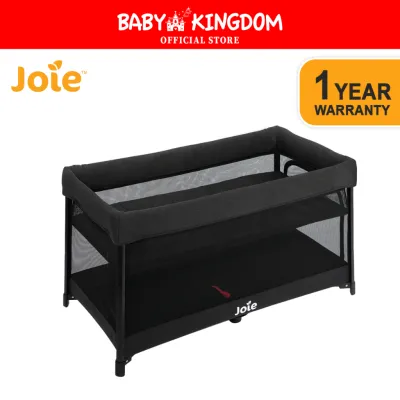
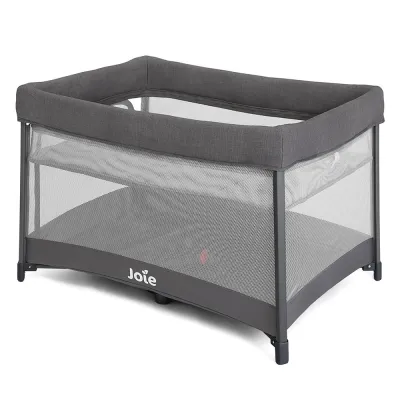
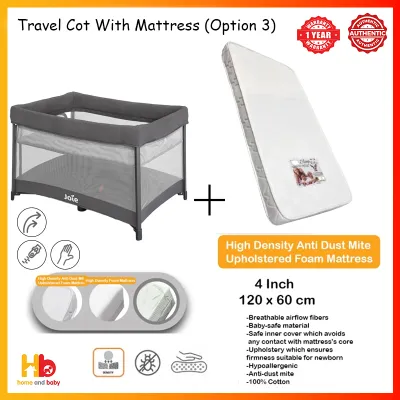
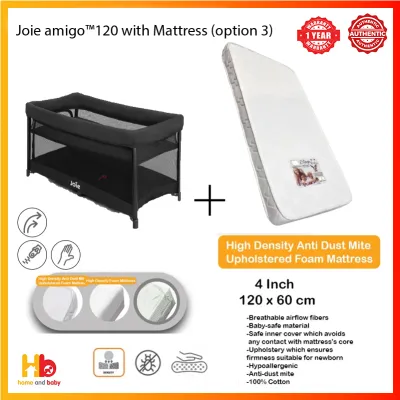
![[Joie] Amigo 120 Foldable Travel Cot Playpen with Bassinet - Baby Portable Bed for Newborn to Toddler (0–15kg)](https://img.lazcdn.com/g/p/d9c71662c083daae5a26458680c79d05.jpg_400x400q80.jpg_.webp)

Prices are valid at publication and may change. Please refer to the product page for the latest price.
Another widely recognized framework is the American standard, ASTM F1169, which outlines safety specifications for full-size baby cribs, or ASTM F406 for non-full-size and play yards. Additionally, the Australian and New Zealand standard, AS/NZS 2172, is frequently referenced in the region. These international standards are highly comprehensive, covering everything from the chemical safety of the paints and finishes used on the wood to the physical strength of the mattress support base under repeated impacts.
Because there is no centralized local testing registry for every individual crib model imported into Singapore, the certification marks printed on the product packaging, the user manual, and the physical labels permanently attached to the crib frame serve as the primary proof of compliance. Retailers and distributors operating in Singapore are expected to supply products that align with these international benchmarks to comply with general consumer safety regulations.
How to Verify Certifications for the Joie Amigo Crib
To confirm whether a specific Joie Amigo crib meets these essential safety standards, you should perform a systematic check of the physical product and its official documentation. The first and most reliable place to look is on the crib itself. Manufacturers who comply with international standards are required to permanently attach safety labels and warning tags to the frame, typically on the inside of the end panels or on the mattress support base. These labels should clearly state the specific standard the product meets, such as EN 716, along with the manufacturer’s details and production batch numbers.

In addition to the physical labels, the assembly and user manual provided in the box is a vital source of verification. A compliant manual will explicitly list the safety standards the crib has been tested against, alongside detailed instructions on safe weight limits, age recommendations, and proper assembly steps. If you are purchasing the crib online or want to verify these details before unboxing, you can visit the official Joie website or check the product listings of authorized retailers in Singapore to download the digital specification sheets and user manuals.
If the physical labels are missing, or if the online documentation does not clearly state the compliance status for the specific batch sold in Singapore, you should contact the local authorized distributor or Joie’s customer support directly. You can request a copy of the official declaration of conformity or the test reports issued by independent, accredited testing laboratories. Reliable manufacturers and distributors should be able to provide this documentation to verify that the product has undergone the necessary testing for structural integrity and chemical safety.
Essential Physical Safety Checks Before Use
While official certifications provide peace of mind, they do not replace the need for a thorough physical inspection once the crib is delivered and assembled in your home. Shipping, handling, or assembly errors can compromise the safety of even the most highly certified crib. Before placing your baby in the crib, you should perform several hands-on checks to ensure the structure is completely secure and free of hazards.
First, measure the distance between the side slats of the crib. To prevent a baby’s head from becoming trapped, the gap between the slats must not exceed 60 millimeters (approximately 2.36 inches). You can easily check this using a standard measuring tape or by attempting to pass a standard soda can through the slats; if the can fits through easily, the gaps are too wide, and the crib may pose an entrapment risk.
Second, verify the fit of the mattress within the crib frame using the widely accepted “two-finger rule.” Place the mattress inside the crib and attempt to slide your fingers between the edge of the mattress and the inner frame of the crib. If you can fit more than two fingers into the gap, the mattress is too small for the frame. This gap poses a serious risk of suffocation or entrapment if a baby rolls over and becomes wedged in the space. Always use a mattress that fits snugly against all four sides of the crib.
Third, inspect the entire frame for physical defects, loose hardware, or sharp edges. Run your hands along the wooden or plastic surfaces to check for splinters, rough patches, or peeling paint. Ensure that all screws, bolts, and brackets are tightened securely and that there are no protruding parts, such as corner posts or decorative cutouts, which could catch on your baby’s clothing and create a strangulation hazard.
Safe Setup and Daily Usage Guidelines
Ensuring your baby’s safety goes beyond verifying the crib’s physical structure; it also depends heavily on how the crib is set up and used on a daily basis. When assembling the crib, you must follow the manufacturer’s instruction manual precisely. Never attempt to modify the design, skip assembly steps, or use non-standard replacement hardware from a hardware store. If any parts are missing or damaged, stop assembly immediately and contact the manufacturer or authorized distributor for official replacement parts.
The placement of the crib within the nursery is another critical safety consideration. Position the crib well away from windows, where dangling blind cords, curtain strings, or window screens can present severe strangulation or fall hazards. Additionally, ensure the crib is kept at a safe distance from electrical outlets, baby monitor cords, heaters, and heavy furniture that an older baby could use to pull themselves up or pull down onto the crib.
Finally, maintain a strictly bare sleep space to minimize the risk of sudden infant death syndrome (SIDS) and accidental suffocation. The crib should contain only a firm, flat mattress covered by a tightly fitted sheet. Do not place pillows, heavy blankets, quilts, sheepskins, stuffed toys, or bumper pads inside the crib. While these items are often marketed as nursery accessories, pediatric health authorities globally and in Singapore strongly advise keeping them out of the sleep environment to ensure your baby can breathe freely at all times.
Frequently Asked Questions (FAQ)
Does Singapore require a specific local safety mark for baby cribs?
No, Singapore does not require a unique, local safety mark specifically for baby cribs. Instead, the Consumer Product Safety Office (CPSO) and local consumer protection regulations rely on recognized international safety standards, such as the European EN 716 or American ASTM standards. Cribs sold by reputable retailers in Singapore are expected to comply with these global benchmarks to ensure they meet basic safety and structural requirements.
What should I do if my Joie Amigo crib is missing its warning labels?
If your crib is missing its permanent safety labels, warning tags, or assembly instructions, you should contact the retailer or the official distributor immediately to request the correct documentation. Do not assemble or use the crib if you cannot verify the safety warnings, weight limits, or proper assembly steps. Having access to the official manufacturer guidelines is essential for ensuring the crib is set up and used correctly.
Are second-hand or hand-me-down cribs safe to use?
Using a second-hand crib carries inherent risks, as older models may not meet current safety standards, may have suffered structural wear, or might be missing critical hardware. If you choose to use a pre-owned crib, you must verify that it has not been recalled, contains all original parts and instructions, has slat spacing under 60 millimeters, and shows no signs of damage or instability. If you cannot verify its history or compliance with modern standards, it is safer to opt for a new, certified crib.

Community discussion
Share your experience or ask a question. Comments are reviewed before publication.