
Deciding on the right diaper brand for your baby often feels like a balancing act between reliable performance and household budgeting. When comparing Faybel, an emerging choice in the market, to established household giants like Pampers and Huggies, there is no single “best” diaper. Whether Faybel is a viable alternative for your family depends entirely on your baby’s specific skin sensitivity, unique body shape, and your monthly diapering budget.
While Pampers and Huggies offer extensive, clinically tested product lineups with highly predictable performance backed by decades of research, Faybel presents a cost-effective alternative if its core specifications align with your baby’s daily needs. Because every baby’s physical build and skin tolerance are unique, the most reliable approach is to purchase a small trial pack of Faybel before committing to bulk purchases. This allows you to verify the fit, absorbency, and skin compatibility firsthand without financial risk.
Core Performance Dimensions to Compare
To make an objective comparison between diaper brands, parents must look past marketing slogans and focus on observable, physical performance indicators. Evaluating a diaper requires examining three primary pillars: absorbency, breathability, and fit. A diaper that excels in one area but fails in another can lead to leaks, skin irritation, or restricted movement for your baby.
Products mentioned in this guide
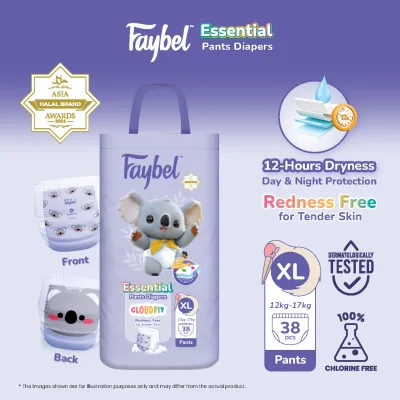
![[3 Packs]Faybel Essential Baby Diaper Pants 3 Packs All Sizes M L XL XXL XXXL for Sensitive Skin Redness-Free Dermatologically Tested](https://img.lazcdn.com/g/p/8e9f94007f2aa179d83464597ae5dce3.jpg_400x400q80.jpg_.webp)
Prices are valid at publication and may change. Please refer to the product page for the latest price.
Furthermore, a fair comparison requires matching Faybel against the specific tier of Pampers or Huggies that shares similar features and price points. Comparing a basic, budget-friendly line from one brand to a premium, organic-material line from another will not yield helpful results. You must evaluate diapers within their respective categories—such as standard daytime use, premium sensitive skin lines, or high-capacity overnight options—to determine which brand truly delivers the best value for your circumstances.
Absorbency and Leak Protection
A diaper’s primary job is to lock away moisture quickly and keep your baby’s skin dry. When evaluating absorbency, look closely at the product packaging for descriptions of the absorbent core technology. Modern disposable diapers typically rely on Superabsorbent Polymer (SAP) micro-particles blended with cellulose fluff pulp. High-performance designs often feature specialized channel patterns that distribute liquid evenly across the core rather than letting it pool in one spot. These channels prevent the diaper from sagging or clumping as it fills, which is critical for maintaining a secure seal around your baby’s legs.
To assess how Faybel stacks up against Pampers and Huggies in real-world conditions, use the trial phase to monitor the diaper’s behavior during heavy use, such as overnight sleep. Check the accuracy of the wetness indicator; it should change color consistently as moisture levels rise. After several hours of wear, inspect the diaper for sagging, shifting of the absorbent material, or any gel leakage—which occurs when SAP particles escape the core matrix. A diaper that maintains its structural integrity and keeps moisture away from the skin under heavy loads is a strong candidate for overnight use.
Breathability and Skin Sensitivity
In Singapore’s warm and humid tropical climate, diaper breathability is directly linked to skin health. Trapped moisture and heat can quickly lead to diaper dermatitis or painful heat rashes. When examining diaper options, look for explicit hypoallergenic claims, fragrance-free formulations, and breathable backsheet materials on the packaging. A breathable outer cover contains microscopic pores that allow hot air and water vapor to escape while keeping liquid safely contained inside.
It is important to remember that clinical certifications and general brand reputations do not guarantee a rash-free experience for every individual child. A baby’s skin can react to specific adhesives, materials, or elastic bands used by one brand while remaining perfectly clear with another. A short-term trial of a few days is the only definitive way to confirm skin compatibility. If you notice persistent redness, dry patches, or localized irritation along the waistband or leg cuffs, it is best to pause use and consult a pediatrician to rule out contact allergies.
Fit, Comfort, and Mobility
As babies reach developmental milestones like rolling, crawling, and walking, their diaper must adapt to their changing shape and increased mobility. A diaper’s fit is determined by its physical design, including the stretchiness of the waistband, the flexibility of the leg cuffs, and the overall cut of the chassis. Some brands favor a slim, contoured cut that minimizes bulk under clothing, while others utilize a wider, more generous cut to provide maximum coverage.
You can easily spot a poor fit by observing your baby during and after wear. Red, indented marks on your baby’s thighs or waist indicate that the elastic is too tight or that the diaper’s cut is too narrow for their build. Conversely, frequent leg leaks or waist blowouts often signal that the diaper is too loose, the leg cuffs are not flaring outward correctly, or the size is too large. If you consistently experience these issues despite proper application, it is a clear sign that you need to adjust the size or switch to a brand with a different physical shape.
Evaluating Faybel: What to Check on the Packaging
When considering Faybel as an alternative to your current diaper brand, the product packaging serves as your first line of evaluation. Start by reading the ingredient and material lists carefully. Pay close attention to the composition of the topsheet—the layer that rests directly against your baby’s skin—and the backsheet. Look for terms like “polypropylene,” “polyethylene,” or plant-derived fibers, and check if the diaper is chlorine-free or processed without optical brighteners. Identifying these components helps you assess the likelihood of skin reactions, especially if your baby has a history of eczema or sensitive skin.

Next, examine the manufacturer’s recommended weight ranges on the packaging. It is crucial to compare these guidelines against your baby’s actual physical build rather than relying solely on age recommendations. Niche or emerging brands like Faybel may use sizing charts that differ significantly from mainstream market leaders like Pampers and Huggies. For instance, a “Medium” diaper in one brand might have a tighter waist elastic or a shorter rise than a “Medium” in another. If your baby is near the upper limit of a weight bracket or has chubby thighs, you will often need to size up to ensure adequate coverage and prevent leaks.
Finally, when researching Faybel online, approach user reviews with a critical eye. Rather than focusing on isolated, highly positive or extremely negative anecdotes, look for recurring themes in customer feedback. Pay attention to comments regarding overnight performance, ease of securing the tape tabs, and whether other parents have noted frequent rash incidents or premature tearing of the side panels. A pattern of consistent feedback across multiple independent review platforms offers a much more accurate picture of the diaper’s day-to-day reliability than a handful of sponsored testimonials.
Understanding the Benchmarks: Pampers and Huggies Lineups
To make an informed decision, you must understand the established benchmarks set by the market leaders. Pampers is globally recognized for its focus on a slim, lightweight fit and proprietary absorbent channel designs. Their diapers are engineered to keep bulk to a minimum while maintaining high absorbency, making them a popular choice for parents of highly active infants. Huggies, on the other hand, is widely known for its snug-fit designs, which often feature pocketed waistbands at the back to catch liquid blowouts, along with robust, double-grip strips that keep the diaper securely fastened during vigorous movement.
Crucially, both legacy brands offer tiered product lines designed to target different consumer needs and budgets. For example, Pampers features lines ranging from standard daily protection to premium, ultra-soft options and specialized overnight variants. Huggies similarly divides its offerings into standard comfort lines, premium organic cotton blends, and active-baby pants. When comparing Faybel to these brands, you must identify which specific tier you are weighing it against. Comparing Faybel’s standard offering to a premium, clinically tested sensitive-skin line from Pampers or Huggies will not provide a fair assessment of performance or value.
Assessing Value: Cost-Per-Diaper and Bulk Buying
Evaluating the financial impact of your diaper choice requires looking beyond the price tag of a single pack. To establish a true baseline for comparison, you should calculate the cost-per-diaper using a simple formula: divide the total price of the pack by the number of individual diapers inside. This calculation allows you to compare different package sizes, such as jumbo boxes versus travel packs, on an equal footing. In Singapore, where diaper prices can fluctuate based on promotions and retail channels, tracking the cost-per-diaper ensures you are genuinely saving money.
While bulk buying is an effective way to lower your cost-per-diaper, it carries significant financial risk when you are trying a new brand like Faybel. Purchasing a large multi-pack box before verifying compatibility can result in wasted money if your baby experiences an allergic reaction, develops a diaper rash, or simply outgrows the size before you finish the box. Always purchase a single, small pack first to conduct your initial testing.
Additionally, when purchasing Faybel or any other brand from online marketplaces or brand stores in Singapore, remember to factor in shipping costs or minimum spend thresholds. A low pack price can quickly be offset by high delivery fees. Look for opportunities to consolidate your purchases or leverage platform vouchers to maximize your savings without overcommitting to a single brand too early.
Decision Framework: Which Diaper Brand Should You Choose?
Choosing the right diaper brand involves aligning your baby’s physical needs with your household’s practical requirements. To help you decide between Faybel, Pampers, and Huggies, consider the following decision framework based on your specific situation:
- Choose Pampers or Huggies if your baby has highly sensitive skin that requires clinically tested premium lines, or if you require guaranteed, predictable overnight absorbency for heavy wetters during long stretches of sleep. These legacy brands offer highly specialized designs backed by extensive consumer testing that minimize the risk of nighttime leaks.
- Choose Faybel if the diaper successfully passes your initial home trial for fit and absorbency, and it offers a significantly lower cost-per-diaper that helps reduce the financial burden of frequent daytime diaper changes.
- Verify first if the specific Faybel variant you are considering matches the current weight, mobility level, and skin profile of your growing baby. Always check the manufacturer's sizing charts and material specifications on the packaging before making a purchase.
Frequently Asked Questions (FAQ)
How do I safely transition my baby to a new diaper brand?
To safely transition your baby to a new diaper brand like Faybel, introduce the new diapers gradually. Start by using the new brand exclusively during the daytime when you can monitor your baby closely and perform frequent diaper changes. Keep using your trusted, high-absorbency brand for overnight use during this initial phase. This approach minimizes the risk of prolonged exposure to a new material if your baby’s skin reacts poorly. Throughout the transition, carefully monitor your baby’s skin for any signs of redness, chafing, or irritation around the waistband and leg cuffs, and observe whether there are changes in leak frequency.
Can I mix different diaper brands for day and night use?
Yes, mixing different diaper brands for day and night use is a highly practical and cost-effective strategy used by many parents. You can use a more affordable, highly breathable diaper like Faybel for frequent daytime changes, where the diaper is replaced every few hours anyway. Then, you can switch to a premium, high-capacity diaper from Pampers or Huggies for overnight use to ensure your baby stays dry and comfortable throughout the night. If you adopt this strategy, ensure that both diaper brands are correctly sized to fit your baby’s current weight range, as sizing discrepancies between brands can lead to unexpected leaks.

Community discussion
Share your experience or ask a question. Comments are reviewed before publication.