
When comparing popular baby changing station brands in Singapore, the “best” choice depends entirely on your nursery space, budget, and specific safety requirements. Because brand performance and features vary significantly across different model lines, relying on a brand name alone is not enough. This guide provides a structured framework to evaluate build quality, safety features, storage capacity, and price tiers, helping you narrow down your options from official brand stores and authorized retailers to find the right baby station for your family.
Key Dimensions for Comparing Baby Changing Stations
To make an informed decision, you must establish clear comparison criteria before looking at specific models. The market offers a wide variety of designs, from minimalist wooden frames to elaborate multi-drawer dressers and wall-mounted units. Evaluating these options systematically prevents you from being swayed solely by aesthetics or brand reputation.
The primary comparison axes for any baby station include structural integrity, safety compliance, storage utility, and spatial footprint. Structural integrity refers to how well the unit resists wobbling or tipping under weight. Safety compliance involves checking for certified physical barriers and secure strap systems. Storage utility dictates how easily you can access diapers, wipes, and clothing during a change, while the spatial footprint determines how well the unit fits into your home without obstructing pathways.
Products mentioned in this guide
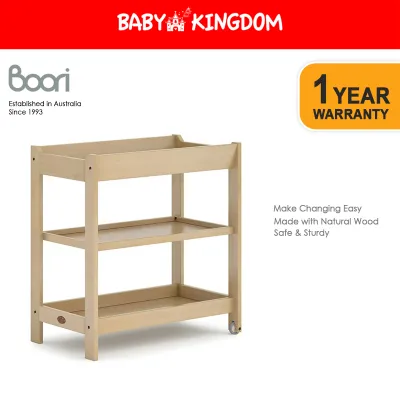
Prices are valid at publication and may change. Please refer to the product page for the latest price.
Comparing brands requires looking at their specific model lines rather than just the brand name. A single brand might produce an excellent solid wood dresser but also a lightweight, less stable folding model. Therefore, you should evaluate each product on its individual specifications, materials, and safety labels.
When shopping in Singapore, it is highly recommended to purchase from official brand stores and authorized local retailers. This ensures you receive authentic products, complete assembly hardware, and valid local warranties. Buying from unauthorized parallel importers or unverified online marketplaces can leave you without recourse if parts are missing or if a safety recall is issued.
Evaluating Build Quality and Safety Features
Ensuring the physical safety of your infant is the most critical aspect of choosing a changing station. Before purchasing any model, you should verify its safety credentials and physical stability. Never assume a product is safe simply because it is sold by a well-known brand.

First, check for recognized safety certifications on the product label or the manufacturer’s official website. Look for standards such as ASTM F2388 in the United States or EN 12221 in Europe, which govern the safety requirements for domestic changing units. These certifications indicate that the design has undergone testing for structural strength, barrier heights, and chemical safety.
Next, perform physical checks for stability if you are viewing the product in a physical showroom. A high-quality changing station must have a wide, stable base that prevents tipping. If you are purchasing a taller dresser-style unit, check whether the manufacturer includes anti-tip hardware to secure the furniture to the wall. The protective railings or barriers around the changing surface should be sturdy and meet the minimum height requirements specified by safety standards, typically at least five centimeters on all sides.
Material quality is another crucial factor. Solid wood units, such as those made from beech, birch, or pine, generally offer superior durability and weight compared to engineered wood or plastic alternatives. However, they also require proper care to prevent warping in humid climates. When reviewing manufacturer specifications, look for claims regarding non-toxic finishes, lead-free paints, and low-VOC (volatile organic compound) materials to ensure the air quality in your nursery remains safe.
Finally, always check the weight limit and age or developmental stage restrictions specified by the manufacturer. Most standard changing tables are rated for infants up to 11 or 15 kilograms, but this varies widely. Once your baby reaches the maximum weight limit or begins to sit up or roll over independently, you must stop using the elevated changing station to prevent accidental falls.
Assessing Storage Capacity and Nursery Footprint
A changing station must be highly functional, keeping all essential items within arm’s reach so you never have to leave your baby unattended. Balancing storage capacity with the physical footprint of your nursery is key to a smooth daily routine.
When comparing storage designs, consider the trade-offs between open shelving and closed drawers. Open shelves provide immediate, one-handed access to diapers, wipes, and creams, which is incredibly convenient during a messy change. However, open shelves expose items to dust and can look cluttered. Closed drawers offer a neater appearance and protect clothing and linens from dust, but they require extra physical clearance to pull open and can be more difficult to operate while keeping one hand on your baby.
Before committing to a specific model, carefully measure your available nursery space. Do not just measure the footprint of the unit itself; you must also account for the clearance required to open drawers fully and the standing room you need to maneuver comfortably. If your nursery is compact, a large dresser-style changing table might make the room feel cramped and restrict movement.
For smaller homes, compact, foldable, or wall-mounted baby stations are excellent alternatives to full-size dresser-style units. Foldable models can be tucked away when not in use, while wall-mounted stations free up valuable floor space entirely. However, these space-saving designs often have very limited storage capacity and lower weight limits, requiring you to store supplies elsewhere.
Additionally, check if the changing pad is included with the station or if the brand requires purchasing a specific proprietary size. Some brands design their changing tops with non-standard dimensions, forcing you to buy their own expensive pads. Verifying these dimensions beforehand allows you to budget for a compatible, high-quality changing pad that fits snugly within the barriers without sliding.
Price Tiers and Value Assessment in Singapore
Baby changing stations in Singapore span a wide range of price points, largely determined by materials, construction quality, and multi-functional designs. Understanding what features justify higher costs will help you assess the true value of your investment.
Budget models typically consist of basic open-shelf tables made from lightweight engineered wood, plastic, or metal frames. These units are highly functional and affordable, but they may lack long-term durability and aesthetic appeal. Mid-range options often feature sturdier engineered wood or solid wood accents, offering a balance of stability and storage. Premium models are usually constructed from solid hardwood and designed as multi-functional furniture, such as a changing table that converts into a regular chest of drawers once your child outgrows the diaper stage.
When calculating your budget, remember to factor in potential hidden costs. Many retailers list the price of the wooden frame alone. You may need to pay extra for delivery fees, professional assembly services, and a separate changing pad. In Singapore, where professional assembly can add significantly to the total cost, checking whether the retailer offers complimentary installation is a smart financial move.
To evaluate long-term value, compare the cost of a convertible furniture piece in S$ against a single-use changing table. A dedicated changing table that cannot be repurposed may only be useful for 12 to 18 months, making its cost-per-use relatively high. In contrast, a convertible dresser that transitions into standard bedroom furniture can be used for many years, easily justifying a higher upfront price.
Always verify current prices, delivery policies, and stock availability directly on the official brand websites or through authorized local retailers in Singapore. Prices can fluctuate based on promotions, shipping costs, and material availability, so direct verification is essential before making a final decision.
Decision Framework: Choosing the Right Brand for Your Needs
To help you narrow down your shortlist, use this conditional decision framework based on your household space, budget, and long-term plans.
Choose Brand Type A (Compact or Wall-Mounted Brands) if:
- You live in a compact apartment or have limited nursery floor space.
- You prioritize keeping floor areas clear and do not mind storing diapering supplies in a separate closet or cart.
- You need a secondary changing station for a living room or multi-story home.
Choose Brand Type B (Solid Wood, Convertible Dresser Brands) if:
- You want a long-term furniture investment that can transition into a standard chest of drawers as your child grows.
- You require maximum storage capacity for clothes, bedding, and bulk diaper supplies.
- You have ample nursery space to accommodate a heavy, wide-footprint piece of furniture.
Choose Brand Type C (Engineered Wood, Open-Shelf Brands) if:
- You are working with a strict budget and want a dedicated changing space without a large upfront cost.
- You prefer immediate, open access to all diapering essentials during changes.
- You plan to use the table only for the first year and do not mind replacing or donating it afterward.
Verify first if you are considering a second-hand purchase or an unbranded model:
- Inspect the unit thoroughly for any missing assembly hardware, structural cracks, or wobbly joints.
- Ensure the original manufacturer's safety labels and weight limits are clearly legible.
- Check that the dimensions accommodate standard, readily available changing pads.
- Confirm that the unit has not been subject to any safety recalls by searching the manufacturer's official support channels.
Frequently Asked Questions (FAQ)
Do I really need a dedicated baby changing station?
While a dedicated baby changing station is highly convenient, it is not strictly mandatory. Many parents successfully use alternative setups, such as placing a secure changing pad on top of a sturdy, waist-high chest of drawers, or using a portable changing mat on the floor. However, a dedicated station offers significant ergonomic benefits, saving caregivers from repetitive bending and reducing back strain during the thousands of diaper changes required in the first year. If you choose to use non-dedicated furniture, you must ensure the surface is completely stable, flat, and equipped with raised edges or a secure pad to prevent the baby from rolling off.
How do I clean and maintain a wooden changing station?
To maintain the integrity and appearance of a wooden changing station, always check the manufacturer’s specific care instructions first. For routine cleaning, use a soft, damp cloth with a mild, baby-safe soap to wipe down the surfaces, and dry them immediately with a clean towel to prevent moisture from penetrating the wood. Avoid using harsh chemical cleaners, bleach, or abrasive scrubs, as these can degrade the protective finish and potentially expose your baby to harmful residues. Additionally, perform regular maintenance checks every few months to ensure all screws, bolts, and safety straps remain tightly secured and that the unit shows no signs of wobbling.

Community discussion
Share your experience or ask a question. Comments are reviewed before publication.