
Selecting the right baby food maker is a pivotal decision when transitioning your baby to solid foods. The Philips Avent range offers specialized appliances designed to simplify this milestone by combining steaming and blending into a single, streamlined workflow. Deciding which model best fits your household depends on your baby’s current developmental stage, your preferred meal preparation style, and the amount of kitchen space you have available. Before beginning the weaning process, consult your pediatrician or a qualified healthcare professional to ensure your baby is developmentally ready for solid foods.
For parents who are just starting the weaning journey and prefer to make fresh, single-ingredient purees daily, a standard 2-in-1 steam and blend model provides an efficient, space-saving solution. On the other hand, if you plan to prepare larger batches of food in advance, freeze them, and require dedicated defrosting and reheating functions, the advanced 4-in-1 model offers the versatility needed to support your child as they transition to chunkier textures and more complex meals. By assessing your daily routine and kitchen habits, you can select an appliance that integrates seamlessly into your lifestyle.
Matching Philips Avent Models to Your Baby's Feeding Stage
Introducing solids is a gradual process that evolves rapidly over your baby’s first year. In the early stages of weaning, typically around six months of age, your baby requires incredibly smooth, liquid-like purees. At this stage, the primary goal is to introduce single ingredients, such as pureed apples, pears, or sweet potatoes, to test for allergies and get your baby accustomed to swallowing non-liquid foods. Both the 2-in-1 and 4-in-1 models excel at creating these ultra-fine textures, as their steaming process softens the fibers of fruits and vegetables before the blending blade purees them.
Products mentioned in this guide
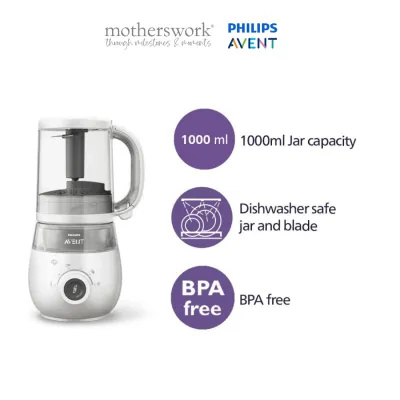
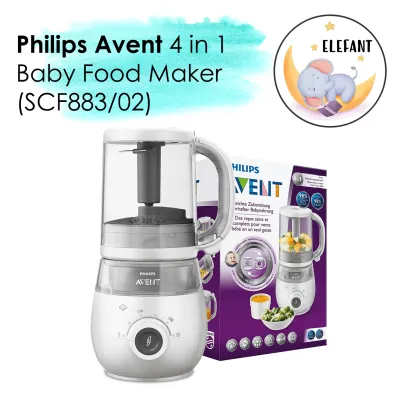
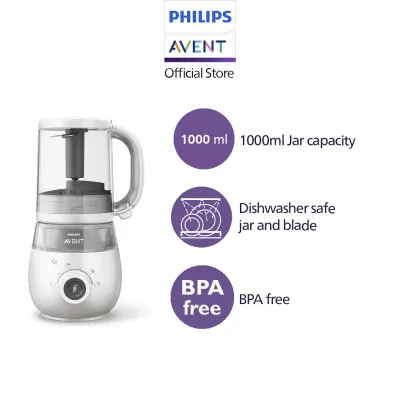
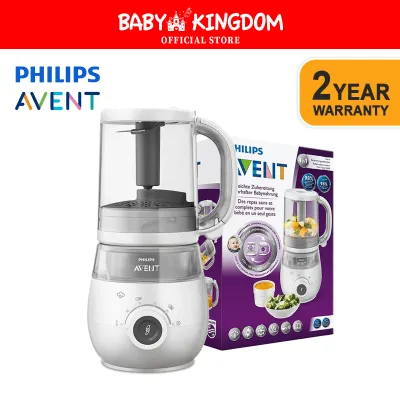
Prices are valid at publication and may change. Please refer to the product page for the latest price.
As your baby grows and reaches seven to nine months, their oral motor skills develop, and they can begin handling thicker textures with soft lumps. This transitional phase requires precise control over the blending duration. Instead of holding the blend button down continuously to create a smooth paste, you will need to pulse the blender to achieve a textured, mashed consistency. The manual pulse control on these appliances allows you to monitor the texture closely, ensuring the food matches your baby’s chewing capabilities.
By the time your baby reaches ten to twelve months, they are ready for chunkier textures, minced meats, and small soft pieces of family meals. At this stage, the steaming function of the food maker becomes highly valuable for preparing soft finger foods, such as steamed carrot sticks, broccoli florets, or fish fillets, without necessarily blending them afterward. If you choose a model with a larger capacity, you can steam multiple ingredients simultaneously, allowing you to serve a variety of finger foods alongside family meals. Always supervise your baby during feeding times to prevent choking hazards.
Your daily preparation style also dictates which model is most appropriate. If you prefer to cook fresh meals for your baby every day, a compact model that prepares one or two portions at a time is highly efficient and minimizes food waste. However, if you are a busy parent balancing work and caregiving, batch-cooking is often a more sustainable strategy. Preparing a week’s worth of purees, freezing them in small portions, and using a machine that can safely defrost and reheat those portions directly in the jar saves significant time and reduces the number of dishes you need to wash.
Comparing Core Functions and Specifications
Understanding the operational differences between the 2-in-1 and 4-in-1 models is essential for matching the appliance to your daily kitchen workflow. The standard 2-in-1 model focuses purely on the core tasks of steaming and blending. To use it, you steam the ingredients in the jar, and once the steaming cycle is complete, you lift the jar, flip it upside down, and lock it back onto the base to blend. This clever design eliminates the need to transfer hot food between different containers, preserving the nutrient-rich cooking liquids that collect at the bottom of the jar.

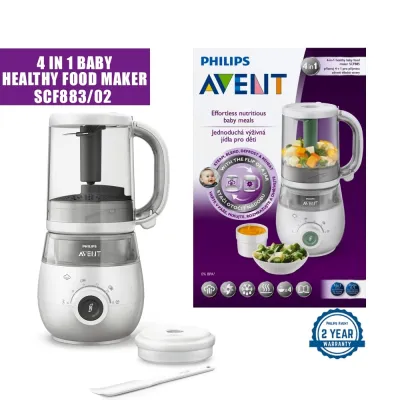
The advanced 4-in-1 model builds upon this flip-to-blend design by incorporating two additional functions: defrosting and reheating. This model features a more sophisticated digital interface with timer controls, allowing you to set precise steaming times for different ingredients. The defrosting function gently warms frozen baby food portions without hot spots, while the reheat function warms previously cooked meals back to a safe serving temperature. These added functions are particularly beneficial if you rely heavily on a freezer-stash of homemade baby meals.
To help you compare the physical and operational differences, the table below outlines the key specifications you should verify when shopping for these appliances.
| Feature / Specification | 2-in-1 Steam & Blend Model | 4-in-1 Healthy Baby Food Maker |
|---|---|---|
| Core Functions | Steaming, Blending | Steaming, Blending, Defrosting, Reheating |
| Water Tank Capacity | Verify on product label | Verify on product label |
| Max Blending Volume | Verify on product label | Verify on product label |
| Texture Control | Manual pulse blending | Manual pulse blending with timer alerts |
| Jar Design | Single jar (flip to blend) | Single jar (flip to blend) |
Blade design is another critical factor that influences the consistency of the baby food. The blades in these food makers are engineered to work in tandem with the shape of the jar to create a circular flow, often referred to as a vortex. This design ensures that all ingredients are pulled down toward the blades, preventing unblended chunks from getting stuck at the top of the jar. While both models utilize high-performance blades, the motor power and jar shape may vary slightly between specific product generations, so it is always wise to check the manufacturer’s technical specifications for the exact model you are considering.
Evaluating Daily Convenience and Maintenance
A baby food maker is only helpful if it is easy to clean and maintain amidst the chaotic schedule of caring for an infant. Both the 2-in-1 and 4-in-1 models feature removable blades and lids to facilitate thorough cleaning. Many of these components, including the jar, lid, and blade assembly, are designed to be dishwasher safe. However, because high dishwasher temperatures and harsh detergents can sometimes degrade plastic seals or dull the blades over time, you must verify the specific care instructions in your model’s user manual before placing them in the dishwasher.
Descaling is a vital maintenance task that directly impacts the performance and lifespan of your appliance. Because the food maker heats water to generate steam, mineral deposits—commonly known as limescale—will inevitably build up inside the water tank and on the heating element. This buildup is especially common in areas with hard water. If left untreated, limescale can clog the steam pathways, reduce heating efficiency, and cause the appliance to shut off prematurely. Regularly inspecting the water tank for white or grey deposits and descaling the unit with food-safe agents, such as white vinegar or citric acid, ensures the steam remains clean and the heating element functions properly.
Kitchen space is another practical consideration, particularly for parents living in compact urban apartments where counter space is limited. The 2-in-1 model typically features a more compact, vertical footprint, making it easy to tuck away in a cabinet or leave on the counter without crowding other appliances. The 4-in-1 model, while still relatively compact, often has a slightly wider base to accommodate the digital control panel and timer display. Measuring your available counter space and checking the physical dimensions of each model before purchasing will help ensure a comfortable fit in your kitchen.
Decision Framework: Which Model Fits Your Needs?
To finalize your decision, it is helpful to evaluate your household’s specific needs against a clear, conditional framework. If your primary goal is to introduce your baby to fresh, simple purees during the initial months of weaning, and you prefer to prepare small meals on demand, the standard 2-in-1 model is likely the most practical choice. It offers the essential tools you need to steam and blend fresh ingredients quickly, has a smaller physical footprint, and is highly straightforward to operate without unnecessary complexity.
Conversely, if you prefer a highly organized approach to meal preparation, the advanced 4-in-1 model is the better investment. This model is ideal for parents who want to cook large batches of food over the weekend, freeze them in individual portions, and then defrost and reheat those meals directly in the appliance throughout the week. The built-in timer and automatic shut-off features provide peace of mind, allowing you to attend to your baby while the machine handles the cooking and alerts you when the cycle is complete.
Before making your final purchase, always verify if you require any specific smart features, app connectivity, or larger jar capacities that may be available in the latest product lines. Manufacturers frequently update their product offerings, so checking the current retail packaging and official product descriptions will ensure you receive the exact features, accessories, and safety certifications you expect for your baby’s feeding journey.
Frequently Asked Questions (FAQ)
Can I use the Philips Avent food maker to prepare meals for the whole family?
The Philips Avent baby food maker is specifically engineered for preparing infant-sized portions, and its blending jar capacity reflects this purpose. While you can easily use the steaming function to prepare small side dishes of vegetables, fish, or soft fruits for adult meals, the appliance is not designed to replace a full-sized family food processor or high-capacity kitchen blender. Attempting to process large volumes of food or blending hard, dense ingredients—such as nuts, ice, frozen fruits, or large cuts of tough meat—can strain the motor and dull the blades. To protect the appliance, always check the user manual for ingredient restrictions and respect the maximum fill lines marked on the jar.
How often should I descale the baby food maker?
To maintain optimal performance and hygiene, you should descale your baby food maker regularly. A good rule of thumb is to perform a visual inspection of the water tank every two to four weeks; if you notice white, grey, or rust-colored mineral deposits forming on the heating element, it is time to descale. The descaling process typically involves mixing a solution of white vinegar or citric acid with water, pouring it into the water tank, and running a steaming cycle without any food in the jar. Afterward, rinse the tank thoroughly with clean water to remove any remaining descaling solution. Always consult your specific model’s user manual for the recommended descaling frequency and approved cleaning agents.

Community discussion
Share your experience or ask a question. Comments are reviewed before publication.