
Determining whether the Beblum Gamma car seat is compliant with Singapore’s car seat safety regulations requires a careful inspection of the physical product’s certification labels and documentation. In Singapore, all child restraint systems used in motor vehicles must meet specific international safety standards recognized by the Land Transport Authority (LTA). To confirm if a particular Beblum Gamma unit is legal for use on local roads, parents must locate the official approval sticker—typically an orange United Nations Economic Commission for Europe (UN ECE) label—affixed to the seat’s shell. This guide outlines the exact steps to verify compliance, understand Singapore’s legal framework, and ensure the seat is installed safely in your vehicle.
Understanding Singapore's Car Seat Safety Regulations
Singapore’s road safety laws place a high priority on the protection of young passengers, making the use of approved child restraints a strict legal requirement. Under the Road Traffic Act, administered by the Land Transport Authority (LTA), anyone under the height of 1.35 metres must be secured in an approved child restraint appropriate for their height and weight when travelling in a passenger vehicle. This law applies to all private cars, and failure to comply can result in legal penalties for the driver.
To ensure that child restraints offer adequate protection during a collision, Singapore authorities do not establish their own independent testing standards. Instead, they recognize several rigorous international safety standards. The most common standards accepted on Singapore roads include the European Union standards—specifically UN ECE R44/04 and the newer, more stringent UN ECE R129 (commonly known as i-Size). Additionally, standards from other jurisdictions, such as the Federal Motor Vehicle Safety Standard (FMVSS 213) from the United States, the Australian/New Zealand Standard (AS/NZS 1754), and the Japanese Industrial Standards (JIS), are also legally recognized.
Products mentioned in this guide
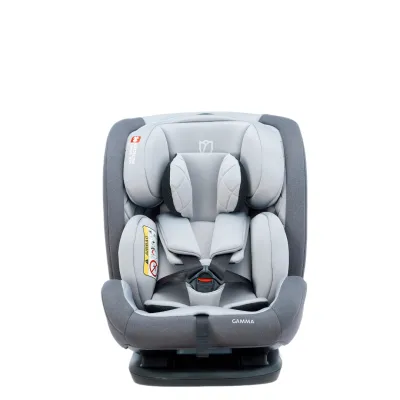
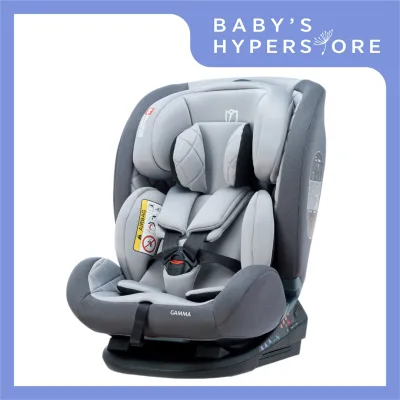
Prices are valid at publication and may change. Please refer to the product page for the latest price.
Understanding these standards is crucial because they dictate how a car seat is categorized and used. For instance, older R44/04 standards categorize seats primarily by the child’s weight, whereas the newer R129 standard uses the child’s height as the primary metric and mandates side-impact testing. When evaluating a car seat like the Beblum Gamma, you must check which of these frameworks the seat was tested under. This classification determines the exact physical limits—such as when a child must transition from rear-facing to forward-facing, or when they will eventually outgrow the seat entirely.
How to Verify the Beblum Gamma's Compliance
Verifying the compliance of a Beblum Gamma car seat involves a hands-on inspection of the physical unit. The most reliable proof of compliance is the orange approval label, which is usually pasted on the back or underside of the car seat shell. This label is a legal requirement for seats certified under European standards. If this label is missing, defaced, or appears to be a photocopy, the seat cannot be verified as compliant, and using it on Singapore roads may put you in breach of local traffic laws.
When examining the orange label, look for key pieces of information that confirm its authenticity. At the top of the label, you should see the standard version, such as “ECE R44/04” or “R129”. Below this, there will be a circle containing the letter “E” followed by a number (for example, “E1” for Germany or “E4” for the Netherlands), which indicates the country where the certification was granted. The label must also display an approval number starting with “04” for R44/04 seats, or the specific registration number for R129 seats. This unique number proves that the specific model design has undergone crash testing and met the required safety thresholds.
In addition to the physical label, you should cross-reference the product manual and manufacturer specifications with Singapore’s legal requirements. The manual should clearly state the weight or height limits of the seat and provide detailed instructions on how the seat must be configured for different developmental stages. If you are purchasing a Beblum Gamma, ensure that the user manual is provided in English and matches the details on the physical sticker. Any discrepancy between the manual’s instructions and the physical labels should be treated as a warning sign.
When acquiring a car seat, purchasing from authorized local retailers or official brand distributors in Singapore is the safest way to guarantee compliance. Authorized dealers are legally obligated to sell stock that meets local transport requirements. Conversely, buying from unauthorized third-party sellers on online marketplaces or international e-commerce platforms carries a higher risk. These units may be parallel imports designed for markets with different regulatory standards, or worse, they could be counterfeit products that lack the structural integrity to protect your child in an accident.
Key Safety Features and Installation Checks
Even a fully certified car seat cannot protect a child if it is installed incorrectly or used past its safe lifespan. When setting up the Beblum Gamma, you must carefully evaluate its built-in safety features, starting with the harness system. Check that the harness straps are not twisted, frayed, or worn, and that the buckle clicks securely into place. The harness must be adjustable to fit snugly over your child’s shoulders, with the chest clip (if applicable and approved) positioned correctly to keep the straps secure.
Vehicle compatibility is another critical factor to verify before taking your child on the road. Car seats are generally installed using either the vehicle’s three-point seat belt system or ISOFIX anchor points. You must consult both your vehicle’s owner manual and the Beblum Gamma’s compatibility list to determine the approved installation method. If using ISOFIX, ensure the connectors click firmly into the anchor points and the green indicators are fully visible. If installing via the vehicle seat belt, ensure the belt follows the exact routing paths marked on the car seat shell—typically blue guides for rear-facing and red guides for forward-facing configurations.
Because installation errors are incredibly common, parents in Singapore are highly encouraged to seek professional assistance. Many local child passenger safety technicians and specialized retailers offer car seat fitting clinics or inspection services. Having an expert review your installation can help identify subtle mistakes, such as insufficient seat belt tension or an incorrect recline angle, which could compromise the seat’s performance during a sudden stop or collision.
Finally, always check the product’s expiration date, which is usually stamped into the plastic shell of the seat. Over time, exposure to Singapore’s hot and humid climate can degrade the plastic and foam materials, making them brittle and less capable of absorbing impact forces. For this reason, using second-hand car seats is generally discouraged unless you know the seat’s complete history. A second-hand seat may have been involved in a minor collision, which can cause invisible structural micro-fractures that render the seat unsafe for future use.
What to Do If Compliance Cannot Be Confirmed
If you inspect your Beblum Gamma unit and cannot find the mandatory safety labels, or if the certification details are unclear, you must take immediate steps to resolve the uncertainty before using the seat. Your first course of action should be to contact the manufacturer or the authorized distributor in Singapore. Provide them with the seat’s serial number and batch number—usually found on a white barcode sticker on the frame—and request official documentation or a certificate of compliance that links directly to your unit.
Using an unverified or non-compliant car seat in Singapore carries significant legal and financial risks. Beyond the immediate danger to your child’s safety, operating a vehicle with an unapproved restraint system is a traffic offense. Furthermore, in the event of an accident, your motor insurance provider may void your coverage or deny claims if they discover that an unapproved or illegally configured child restraint was in use. This could leave you personally liable for medical expenses and vehicle damage.
If the seller or manufacturer cannot provide satisfactory proof of compliance, you should stop using the seat immediately. If the product was recently purchased, contact the retailer to initiate a return or exchange under local consumer protection laws, citing the lack of verifiable safety certifications. If a return is not possible, it is safer to dispose of the unverified unit and invest in a replacement car seat that clearly displays a recognized UN ECE or equivalent safety label from an authorized local source.
Frequently Asked Questions (FAQ)
Can I use a car seat bought overseas in Singapore?
You can use a car seat purchased overseas in Singapore only if it bears a safety certification mark that is officially recognized by the Land Transport Authority (LTA). These recognized standards include the European UN ECE R44/04 or R129, the American FMVSS 213, and the Australian AS/NZS 1754, among others. If you bring a seat from overseas that does not carry one of these approved labels, it is not legally compliant for use on Singapore roads, even if it was legal in its country of origin. Additionally, ensure the seat is suitable for the climate and vehicle configurations typical in Singapore.
Are there specific penalties for not using a compliant car seat?
Yes, drivers in Singapore face legal consequences if they fail to secure passengers under 1.35 metres in height in an approved child restraint. The law holds the driver responsible for the safety of all passengers. If caught using a non-compliant seat or failing to use a restraint entirely, drivers can face composition fines and demerit points. Serious or repeated offenses may result in prosecution in court, leading to larger fines or potential imprisonment. Traffic police actively enforce these regulations to ensure child passenger safety.
Does the Beblum Gamma require a specific vehicle type for installation?
To determine if the Beblum Gamma is compatible with your vehicle, you must consult the car seat’s official vehicle compatibility list and user manual. Some car seats require ISOFIX anchor points, which are standard in most modern vehicles in Singapore but may be absent in older car models. Other seats can be installed using the vehicle’s standard three-point seat belt. Always verify whether your car has the necessary anchor points or seat belt configurations required by the Beblum Gamma before attempting installation.

Community discussion
Share your experience or ask a question. Comments are reviewed before publication.