
Selecting the right doddl cutlery set depends primarily on your baby’s physical self-feeding milestones and grip development rather than chronological age alone. For early weaning infants who are still using a whole-hand palmar grasp, the short-handled Starter set is designed to help them guide food to their mouths successfully. As your child transitions to a pincer grasp and develops better wrist rotation, upgrading to the larger Toddler set—which introduces a safe, serrated knife—supports their growing independence at the family dinner table.
In Singapore, where weaning often involves a vibrant mix of traditional purees and baby-led weaning (BLW), having the correct tools can significantly reduce mealtime frustration. By focusing on your child’s observable motor skills, you can choose a utensil set that matches their physical capabilities, ensuring a smoother and more positive transition to solid foods.
Matching Cutlery to Your Baby's Self-Feeding Milestones
Understanding the physiological development of your baby’s hands is key to choosing the right feeding tools. During the initial stages of weaning, typically around six months of age, infants rely on a palmar grasp. This means they clutch objects using their entire palm and fingers as a single unit, with limited control over individual fingers. Because their wrist rotation and shoulder stability are still developing, bringing a traditional long-handled spoon to their mouth requires complex arm movements that often lead to spills and frustration.
Products mentioned in this guide
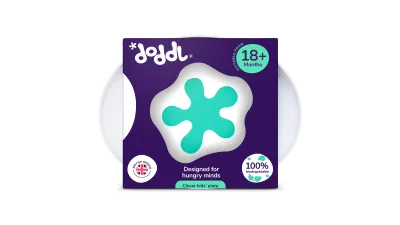
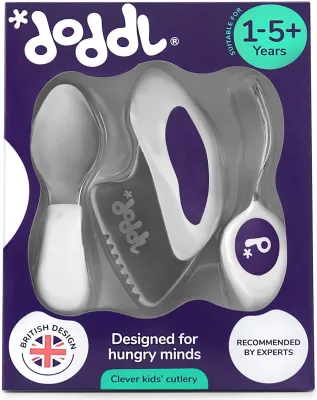
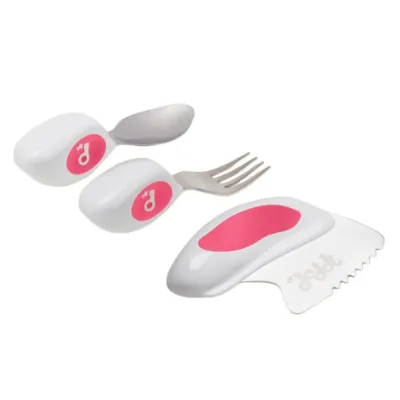
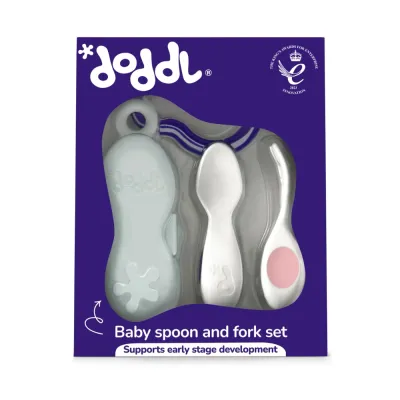
Prices are valid at publication and may change. Please refer to the product page for the latest price.
At this early stage, long utensils can act as levers, making it difficult for a baby to coordinate the precise angle needed to deposit food into their mouth. Utensils with short, ergonomically contoured handles are highly beneficial here because they bypass the need for advanced wrist flipping. They allow the baby to use their natural hand-to-mouth reflex, making the self-feeding process much more intuitive and successful.
As your baby grows and gains exposure to different food textures, their fine motor skills will naturally transition toward the pincer grasp. This milestone involves using the thumb and index finger to pinch and manipulate smaller objects. Alongside this grip refinement, you will notice improved wrist flexibility and forearm stability. Your child will begin to rotate their wrists deliberately, allowing them to scoop food horizontally and guide it steadily to their mouth without tipping the utensil prematurely.
Because every child develops at their own unique pace, observing these physical milestones is a far more reliable indicator of readiness than relying strictly on chronological age. Some babies may exhibit advanced coordination early on, while others take longer to refine their grip. Before introducing any new utensil, always check the manufacturer’s recommended age and developmental stage guidelines printed on the product packaging to ensure the tool is safe and appropriate for your child’s current abilities.
doddl Cutlery Sets Compared by Weaning Stage
To help you decide which option best suits your family’s current needs, it is helpful to compare the primary lines of doddl cutlery. Each set is tailored to a specific phase of physical development, offering unique ergonomic advantages while also presenting distinct limitations as your child grows.

| Feature / Dimension | Starter Cutlery Set | Toddler Cutlery Set | Travel Cutlery Set |
|---|---|---|---|
| Primary Milestone | Early weaning, palmar grasp, basic hand-to-mouth coordination | Advanced self-feeding, pincer grasp, refined wrist rotation | On-the-go feeding, consistent skill practice outside the home |
| Key Components | Spoon and fork with short, contoured handles | Spoon, fork, and safe serrated knife | Compact spoon and fork with a protective travel case |
| Material Options | Food-grade plastic and soft-touch silicone | Stainless steel heads with plastic handles | Stainless steel or plastic heads with protective case |
| Primary Limitation | Short handles become inefficient as child's arms and portion sizes grow | Not suitable for early weaning babies lacking wrist control | Case must be thoroughly dried to prevent mold and bacterial growth |
Starter Cutlery for Early Weaning
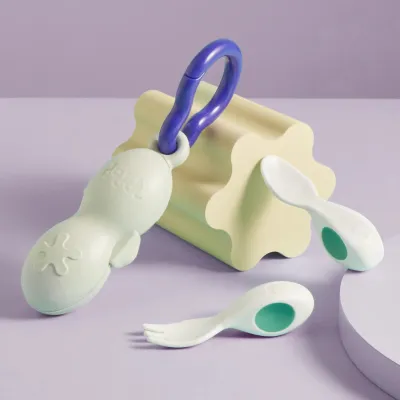
The Starter cutlery set is engineered specifically for babies who are taking their very first steps into the world of solid foods. The signature short handle design is the defining feature of this set. By keeping the handle compact, the utensil sits comfortably within a baby’s small palm, allowing them to guide the spoon or fork directly to their mouth without needing to execute complex wrist rotations or advanced arm coordination.
To support the whole-hand palmar grasp, these utensils feature ergonomic, non-slip contours. These soft-touch grip zones provide tactile feedback to small hands, helping infants maintain a secure hold even when their fingers are slippery with purees or oils. This thoughtful design minimizes the mechanical barrier of learning to use a tool, allowing the baby to focus entirely on exploring new tastes and textures.
However, parents should view the Starter set as a transitional tool with a specific operational window. As your baby’s arms grow longer, their portion sizes increase, and their fine motor skills advance, the short handles will eventually become less efficient. The limited reach and small scoop capacity of the Starter spoon will no longer satisfy an older toddler’s eating habits, necessitating an upgrade to a larger utensil set.
Toddler Cutlery for Advanced Self-Feeding
The Toddler cutlery set is designed to bridge the gap between early baby utensils and adult tableware. Featuring slightly longer handles and larger proportions, this set accommodates the physical growth of older babies and toddlers. The elongated handles are shaped to encourage the transition from a palmar grasp to a mature three-finger pencil grip, which helps prepare your child’s hand muscles for writing and drawing in the future.
A standout component of this set is the uniquely designed toddler knife. It features a safe, serrated edge that allows toddlers to cut through soft foods using a simple downward pressing motion rather than a complex sawing action. This design empowers young children to actively participate in preparing their own food at the table, significantly boosting their confidence and desire for independence during family meals.
Despite these benefits, the Toddler set is not suitable for early weaning babies. The heavier weight, longer handles, and functional cutting edges require a level of spatial awareness and wrist control that younger infants do not yet possess. Introducing this set too early can result in accidental self-poking or extreme frustration, so it is best reserved for children who have clearly mastered basic hand-to-mouth coordination.
Travel Cutlery for On-the-Go Meals
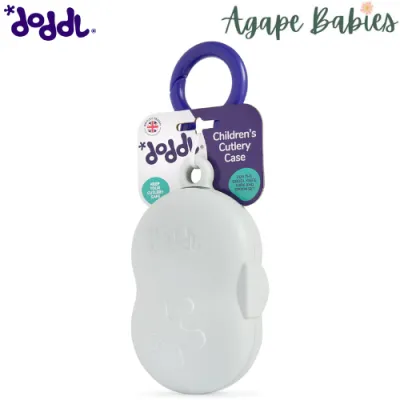
For active families in Singapore who frequently dine out at local cafes, hawker centres, or visit relatives, maintaining consistency in self-feeding practice can be a challenge. The Travel cutlery set addresses this by offering a highly portable version of the brand’s ergonomic utensils. Packaged in a compact, protective carrying case, this set allows you to maintain high standards of hygiene while feeding your child outside the home.
Using a dedicated travel set ensures that your child can continue to use the familiar, comfortable grips they are accustomed to at home, rather than struggling with oversized or slippery adult utensils provided by restaurants. It also offers a practical way to contain dirty cutlery after a meal, preventing food residue from transferring to the inside of your diaper bag or backpack while you are transit.
However, the convenient travel case presents its own maintenance challenges. Because Singapore’s tropical climate is highly humid, enclosing damp or dirty utensils inside a sealed plastic case creates an ideal environment for mold and bacterial growth. Parents must make it a priority to wash and thoroughly dry both the cutlery and the inside of the travel case as soon as possible after use, adhering strictly to the manufacturer’s care instructions.
Safety, Materials, and Care Instructions to Verify
When choosing any feeding product for your baby, verifying the safety of the materials is a critical first step. Parents should carefully inspect product labels and packaging to confirm that the utensils are made from food-grade materials. Look for explicit indicators that the plastics are free from Bisphenol A (BPA) and Bisphenol S (BPS), and that any metal components are constructed from high-quality, food-grade stainless steel. Avoid relying on unverified certification claims on third-party online marketplaces; instead, look for reputable, clearly labeled packaging.
Cleaning and sterilization requirements can vary significantly depending on the specific materials used in your cutlery set. While some parts may be highly heat-resistant, others—such as soft-touch silicone handles or the adhesive bonds joining metal and plastic components—may degrade under extreme temperatures. Always consult the manufacturer’s specific care instructions before using steam sterilizers, boiling water, or UV sterilization systems, as improper exposure to high heat can warp the materials or compromise their structural integrity.
Regular safety inspections are essential to protect your child from potential hazards. Teething infants often bite down hard on their utensils, which can cause wear and tear over time. Establish a routine to check plastic and silicone components for deep scratches, bite marks, tears, or loose pieces. If you detect any signs of damage or structural weakness, discard the utensil immediately to eliminate any potential choking hazard.
Practical Tips for Introducing Cutlery to Your Baby
Introducing cutlery to your baby is a gradual process that requires patience and positive reinforcement. One of the most effective ways to encourage self-feeding is through modeling behavior. Children are natural imitators and learn rapidly by watching their parents. By eating your meals alongside your baby and demonstrating how you use your own spoon and fork, you provide a clear, real-time visual guide that they will instinctively try to copy.
In the early stages of learning, “pre-loading” the utensils can help bridge the gap between frustration and success. Instead of expecting your baby to master both scooping and aiming at the same time, try placing a small amount of food onto the spoon or piercing a soft piece of food with the fork yourself. Hand the pre-loaded utensil to your baby, or place it on their tray for them to pick up. This allows them to focus entirely on the hand-to-mouth movement, building confidence with every successful bite.
It is equally important to manage your own expectations regarding cleanliness. Messy eating is not a sign of failure; rather, it is a vital part of sensory learning and cognitive development. Feeling food textures, dropping utensils, and smeared faces help babies understand spatial relationships and sensory boundaries. To make the cleanup manageable, utilize wide, easy-to-clean silicone bibs with built-in food catchers and place a washable splat mat beneath the highchair to protect your floors.
Finally, active adult supervision is an absolute requirement during every meal. No matter how safe or ergonomically designed a utensil is, an adult must remain within arm’s reach and actively watch the baby at all times. This is especially critical when a knife is introduced to the table, or if your child attempts to stand up or move around while holding a fork or spoon, as sudden movements can lead to accidental injury.
Frequently Asked Questions (FAQ)
When should I introduce a knife to my baby's cutlery set?
Introducing a safe, serrated toddler knife depends on your child’s individual wrist control, physical coordination, and interest in cutting, rather than a specific chronological age. Most children show readiness when they can easily manipulate a fork and spoon and express a desire to mimic adult cutting motions. When you decide to introduce the knife, ensure it is used under direct, active adult supervision and start by practicing on very soft foods, such as cooked carrots, bananas, or ripe avocados, before moving on to denser textures.
Are doddl utensils dishwasher safe?
To prolong the lifespan of your utensils, always check the specific product packaging or the manufacturer’s official website for exact care instructions, as heat tolerances can vary between silicone handles and stainless steel components. Generally, if the manufacturer indicates the set is dishwasher safe, it is best practice to place the utensils on the top rack of the dishwasher. This positions them further away from the heating element, protecting the plastic and silicone portions from warping. Additionally, avoid using highly abrasive detergents or extremely high-temperature sanitizing cycles, which can degrade the materials over time.
Community discussion
Share your experience or ask a question. Comments are reviewed before publication.