
When your child starts showing signs of wanting to stand and take their first steps, choosing the right developmental toys becomes a priority. If you are considering a VTech walker, the primary question on your mind is likely whether this toy is safe for your baby. VTech push walkers are generally safe, but their safety depends entirely on proper usage, environmental preparation, and active parental supervision. Unlike traditional sit-in baby walkers, which are widely discouraged by pediatricians due to severe safety risks, VTech designs “push-along” or activity walkers. These require your child to support their own weight, balance independently, and actively control their movements.
Clarifying the Design: Why VTech Push Walkers Differ from Sit-In Models
To evaluate safety, it is essential to distinguish between the two main types of baby walkers available on the market. Traditional sit-in walkers feature a suspended fabric seat inside a wheeled frame, allowing a baby whose feet cannot yet support their full weight to scoot around rapidly. This design has been heavily criticized by global health authorities and is banned in countries like Canada. Sit-in walkers allow babies to reach dangerous speeds and heights, increasing the risk of falling down stairs, tipping over on uneven surfaces, or reaching hazardous items like hot liquids on kitchen counters.
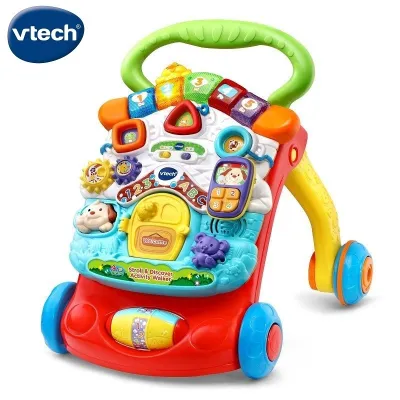
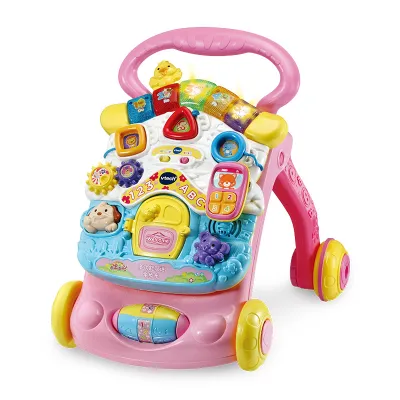
VTech walk-behind toys, often referred to as push walkers or activity walkers, operate on an entirely different mechanical principle. Instead of suspending the child, these toys feature a stable frame with a handle that the baby grips while standing on their own two feet. Because the child must actively balance, engage their core muscles, and bear their own weight, these toys act more like a support trolley than a mobility vehicle.
Products mentioned in this guide



Prices are valid at publication and may change. Please refer to the product page for the latest price.
This design shifts the safety focus away from suspension failures and toward frame stability, wheel speed control, and the physical environment in which the toy is used. While they represent a significantly safer category of developmental toys, they still require careful handling to prevent falls and collisions. Active supervision remains a necessity, as a baby learning to balance can still lose control on certain floor types.
Built-In Safety Features to Verify Before Use
Before introducing a VTech walker to your child’s play area, take the time to inspect the product and familiarize yourself with its built-in safety features. These features are designed to minimize common risks, but they must be adjusted and verified manually according to your home’s environment.

Adjustable Wheel Resistance One of the most critical safety mechanisms on a VTech walker is the speed control system, typically located on the rear wheels. Many models feature a tension dial or switch with two different resistance settings. Setting “1” provides higher friction, which prevents the wheels from spinning too freely and is ideal for babies who are just learning to pull themselves up and stand. Setting “2” releases the tension for more confident walkers who can manage a faster pace. Always test this mechanism by pushing the walker yourself on your home’s flooring before letting your baby use it.
Base Stability and Weight Distribution A safe push walker must have a low center of gravity and a wide wheel track to prevent tipping. VTech walkers are engineered with a broad, rectangular or triangular base that distributes weight evenly across all four wheels. This design helps support the baby when they pull themselves up using the handle. However, you should inspect the base regularly to ensure that no debris, pet hair, or small toys have become lodged in the wheel axles, which could compromise stability and cause uneven rolling.
Physical Design and Materials The physical construction of the walker should be smooth and robust. Check that all edges are rounded to prevent cuts or bruises if your baby bumps into the frame. Additionally, VTech walkers feature electronic play panels powered by batteries. Inspect the battery compartment on the back of the panel to ensure it is tightly sealed with a safety screw, preventing curious toddlers from accessing the batteries, which pose a severe choking and chemical hazard. Always check the packaging or manufacturer documentation to verify that the plastics used are BPA-free and non-toxic.
Secure Activity Panels Many VTech models feature a removable front activity panel that can be used for floor play. When attaching this panel back onto the walker frame, listen for a distinct clicking sound that indicates it has locked securely into place. A loose panel can detach unexpectedly when a child leans on it, leading to sudden falls or pinched fingers.
Standards Verification While VTech is an established global brand, safety standards can vary depending on the manufacturing batch and the region of purchase. When buying a walker in Singapore, look for safety marks or compliance labels on the packaging, such as the local Consumer Product Safety Office’s guidelines or international standards like EN 71 (Europe) or ASTM F963 (United States). If you are purchasing from online marketplaces or third-party sellers, verify that the product is authentic and meets these safety benchmarks.
Common Risks and Hazards to Anticipate
Even with advanced safety features, push walkers are not entirely risk-free. Understanding the potential hazards allows you to set up a safer play space and react quickly to dangerous situations.
Speed-Related Falls The most common risk associated with push walkers is a sudden loss of traction or excessive speed. On smooth, hard surfaces—such as the polished tiles, marble, or vinyl flooring common in Singapore apartments—the wheels can roll forward faster than the baby can step. This mismatch can cause the baby’s feet to slip backward, leading to a forward fall onto the hard floor or the walker’s handle.
Tipping and Rollovers Although designed with a wide base, a push walker can still tip over under certain conditions. If a baby attempts to pull themselves up from the side of the walker rather than standing directly behind the handle, the frame can tilt sideways. Similarly, if the child leans backward while holding the handle, or tries to push the walker over a threshold, a thick rug, or a transition strip between rooms, the sudden resistance can cause the unit to tip backward onto the child.
Environmental and Mobility Hazards A push walker grants a pre-walking baby a sudden surge in mobility and height. Children can move much faster than parents anticipate, quickly reaching areas that were previously out of bounds. This increased reach allows them to access low tables, pull down electrical cords, reach hot mugs of tea or coffee, or navigate toward dangerous zones like open balconies, bathrooms, or kitchens where wet floors and hot appliances present severe risks.
Pinch Points and Entrapment The moving parts of a walker can occasionally trap tiny fingers or toes. The gaps around the wheels, the hinges of the handle, and the locking mechanisms of the removable activity panel are all potential pinch points. Regularly inspect these areas to ensure they are clean, undamaged, and functioning smoothly without any broken plastic edges.
Essential Precautions for Safe Daily Use
To keep your baby safe while they enjoy their VTech walker, you must establish strict safety protocols and prepare your home environment carefully.
Environment Preparation Before letting your baby use the walker, secure the entire room. Install sturdy safety gates at the entrances of high-risk areas, especially kitchens, bathrooms, and staircases. Ensure that all external doors and balcony gates are locked securely. Clear the floor of any small objects, loose rugs, toys, and electrical cords that could catch on the wheels and cause a sudden stop or tip-over.
Active Supervision There is no substitute for active adult supervision. “Active” means staying within arm’s reach of your baby, keeping your eyes on them, and being ready to intervene instantly. Do not leave your baby unattended with the walker, even for a few seconds to answer the door or check a phone notification. If you must leave the room, take your baby out of the walker area with you.
Surface Matching Adjust the walker’s wheel resistance to match the surface your baby is playing on. If your baby is playing on slick ceramic tiles or polished wood, use the highest resistance setting (Setting 1) to slow down the wheels. If they are playing on a textured EVA foam playmat or a low-pile carpet, you may adjust the setting to allow smoother movement, but always test the roll speed yourself first. Ensure your baby is either barefoot—which provides the best natural grip on hard floors—or wearing socks with non-slip rubber grips.
Developmental Readiness Never force a baby to use a walker before they are physically ready. Check the manufacturer’s guidelines on the product box or manual; most VTech walkers are recommended for children aged 9 to 36 months. Your baby should be able to sit up completely independently and show a natural desire to pull themselves up to a standing position before you introduce the walk-behind function. If their legs fold under their weight or they struggle to hold the handle, store the walker away and focus on floor play to build their core strength.
When to Retire the Walker: Clear Stopping Points
A walker is a transitional toy, and knowing when to stop using it is just as important as knowing how to use it safely.
Manufacturer Limits Always adhere to the weight and height limits specified by the manufacturer. Once your child exceeds the maximum weight limit (typically around 15 to 20 kilograms, though you must check your specific model’s manual), the structural integrity of the plastic frame and wheels may be compromised, increasing the risk of breakage or collapse.
Developmental Milestones Once your child can walk confidently without any support, run around the room, or starts trying to climb onto the walker or use it as a ride-on toy, it is time to retire it. At this stage, the walker no longer serves its developmental purpose and instead becomes a tripping hazard or an unstable climbing platform.
Product Wear and Tear Inspect the toy weekly for signs of damage. If you notice wobbly wheels, a loose or shaking handle, cracked plastic along the frame, or a battery compartment screw that is stripped or missing, stop using the walker immediately. Do not attempt temporary DIY repairs on structural parts, as these can fail under the weight of your child.
Frequently Asked Questions (FAQ)
Are VTech push walkers safe for hardwood or tile floors?
Yes, VTech push walkers can be used on hardwood or tile floors, but these smooth surfaces increase the risk of the wheels slipping or rolling too quickly. To use the walker safely on hard floors, always engage the highest wheel resistance setting (Setting 1) to slow down the movement. Test the speed manually before letting your baby use it, and ensure your baby is barefoot or wearing socks with non-slip rubber grips to maintain traction.
Can using a push walker delay my baby's walking development?
Unlike traditional sit-in walkers, which can delay motor development by bypassing the core muscles, push walkers generally support natural physical development. They encourage babies to pull up, stand, bear their own weight, and practice balance. However, a push walker should only supplement, not replace, unrestricted floor play. Daily tummy time, crawling, and cruising along furniture remain the most critical activities for building the core strength and coordination needed for independent walking.
Community discussion
Share your experience or ask a question. Comments are reviewed before publication.