
When preparing for a new baby, choosing the right feeding gear is one of the most frequent decisions you will face. If you have settled on a Spectra breast pump, you will naturally look at Spectra baby bottles to build a seamless, closed-system feeding setup. However, deciding between glass, polypropylene (PP), and polyphenylsulfone (PPSU) can quickly become confusing.
All genuine Spectra baby bottles are completely BPA-free and designed to meet strict international safety standards for infant feeding. There is no single “safest” material in an absolute chemical sense, as each option is safe when used and maintained according to the manufacturer’s instructions. Instead, the safest and most practical bottle for your family depends entirely on your daily feeding environment, how you sterilise your baby gear, and your child’s current developmental stage.
Matching the bottle material to your lifestyle is key to a smooth feeding journey. Glass offers classic chemical purity, PP provides lightweight and budget-friendly convenience, and PPSU delivers premium durability with high heat resistance. Understanding how these materials behave under daily wear and tear will help you choose the best fit for your home.
Products mentioned in this guide
Prices are valid at publication and may change. Please refer to the product page for the latest price.
Glass Spectra Bottles: Durability and Purity for Home Use
Glass Spectra bottles are highly favored by parents who prioritize chemical purity and long-term hygiene. Because glass is an inert material, it does not absorb milk fats, food colors, or stubborn odors over time. This makes glass exceptionally easy to clean, as breast milk residue washes away smoothly without leaving a greasy film or cloudy build-up on the interior walls.
Another major benefit of glass is its resistance to scratching. Unlike plastic, which can develop microscopic scratches from bottle brushes, glass maintains a smooth, non-porous surface throughout its lifespan. This lack of scratching prevents bacteria from finding places to hide and multiply, ensuring a highly hygienic feeding vessel for your baby.
However, glass bottles are significantly heavier than their plastic counterparts, which can make feeding tiring during late-night sessions. They are also fragile and can crack, chip, or shatter if dropped on hard surfaces. In Singapore homes, where ceramic tiling or marble floors are common in kitchens and living areas, a dropped glass bottle carries a high risk of breakage.
To manage these risks, glass bottles are best reserved for home use during the early months when parents or caregivers are doing all the holding and feeding. If you choose glass, consider using compatible silicone sleeves to improve your grip and cushion the bottle against minor bumps. Always inspect the rim and body of the bottle for micro-chips or hairline cracks before every single feed, and discard the bottle immediately if you detect any damage.
PP (Polypropylene) Spectra Bottles: Lightweight and Budget-Friendly
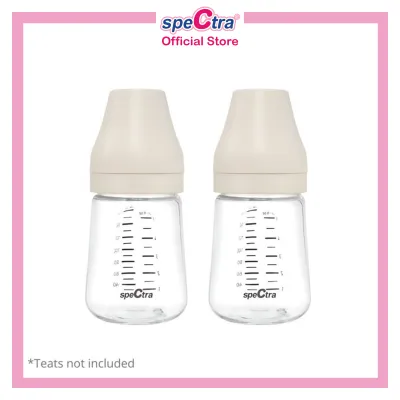
Polypropylene, commonly known as PP, is the standard plastic used in the majority of baby bottles on the market. Spectra’s PP bottles are highly valued for being exceptionally lightweight and completely shatterproof. This makes them incredibly easy to pack into a diaper bag for outings or to hand over to a baby who is just learning to hold their own bottle.

For parents sending their children to infant care or daycare centres, PP bottles are often the most practical choice. They do not pose a safety hazard if dropped on hard playmats or floors, and their lightweight design fits easily into the self-feeding developmental milestone. Furthermore, PP is highly budget-friendly, making it easy to purchase a larger supply of bottles to keep up with a busy pumping and feeding schedule.
Despite these practical advantages, PP has a shorter lifespan than glass or PPSU. The material is relatively soft, meaning it is highly prone to scratching from standard wire-stemmed bottle brushes. Over time, PP bottles tend to absorb milk fats and odors, which can lead to a cloudy appearance and a persistent stale milk smell that is difficult to wash out.
Because PP has a lower tolerance for repeated high-heat exposure compared to other materials, it will degrade and become brittle more quickly. To maintain safety, parents should plan on a more frequent replacement cycle for PP bottles. If a PP bottle becomes deeply scratched, permanently cloudy, sticky, or retains a strong odor even after thorough washing, it is time to replace it.
PPSU (Polyphenylsulfone) Spectra Bottles: Premium Heat Resistance and Longevity
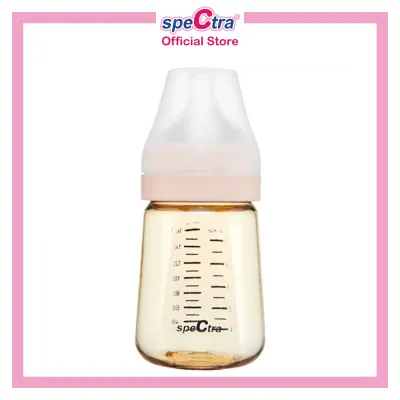
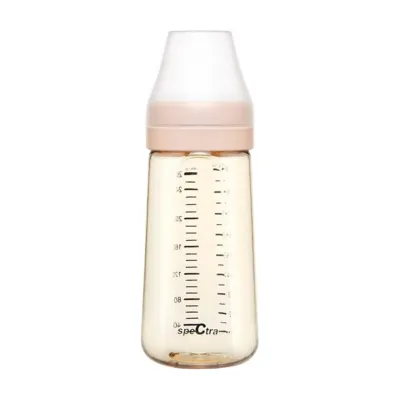
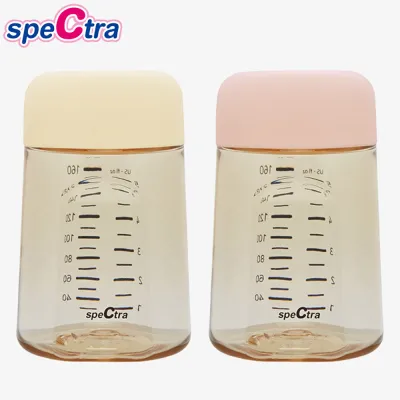
PPSU, or polyphenylsulfone, is a premium medical-grade plastic that has become increasingly popular in infant care. One of the most distinctive features of a genuine Spectra PPSU bottle is its natural amber or honey-colored tint. This warm coloration is an inherent property of the raw material itself, rather than an added dye, chemical stain, or manufacturing defect.
PPSU combines the best characteristics of both glass and standard plastic. It is incredibly lightweight and shatterproof, meaning you do not have to worry about dangerous breaks on hard kitchen floors or during outdoor trips. At the same time, it offers a level of durability, scratch resistance, and chemical stability that comes very close to glass.
The standout feature of PPSU is its exceptional heat resistance. It can withstand repeated, long-term exposure to high temperatures without losing its structural integrity or degrading. This makes it highly resilient against intensive daily sterilization routines, whether you prefer boiling water, steam sterilizers, or UV sterilization systems.
The primary trade-off with Spectra PPSU bottles is their cost, as they sit at the premium end of the price spectrum. However, because they do not scratch easily and resist heat degradation, they last significantly longer than standard PP bottles. For many parents, the higher initial investment is offset by the fact that fewer replacement bottles are needed over the course of the feeding journey.
Comparing Spectra Materials: Which Fits Your Feeding Routine?
To help you decide which bottle material aligns best with your daily routine, it is helpful to look at how they compare across key practical categories.
| Material | Weight | Durability & Lifespan | Heat Resistance | Best Use Case | Relative Cost |
|---|---|---|---|---|---|
| Glass | Heavy | High (unless dropped) | High (verify limits on label) | Home feeding, newborns | Mid-range to Premium |
| PP (Polypropylene) | Very Lightweight | Moderate (requires regular replacement) | Moderate (verify limits on label) | Daycare, travel, self-feeding | Budget-friendly |
| PPSU (Polyphenylsulfone) | Lightweight | Very High (highly scratch-resistant) | High (verify limits on label) | Frequent sterilising, long-term use | Premium |
Selecting the right bottle often comes down to matching the material to specific daily scenarios:
- For newborns and quiet home routines: Glass or PPSU are excellent choices. Glass provides maximum purity when the baby is small and stationary, while PPSU offers the same hygienic benefits without the weight.
- For daycare, travel, and active toddlers: PP or PPSU are ideal due to their shatterproof construction. They will survive being tossed out of strollers or dropped onto playground surfaces.
- For budget-conscious families: PP bottles allow you to build a large bottle rotation at a lower cost, provided you are comfortable replacing them more frequently as they show signs of wear.
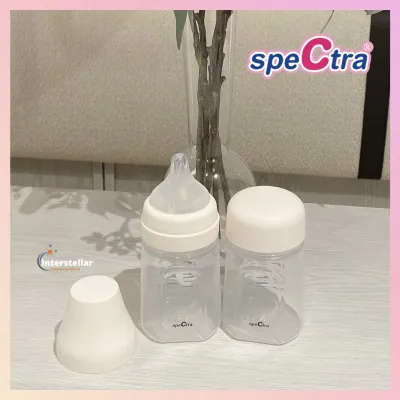
It is also worth noting that Spectra bottle collars, caps, and nipples are generally designed to be interchangeable across their wide-neck range. This means you do not have to commit exclusively to one material. You can easily use glass bottles for home feedings and switch to lightweight PP or PPSU bottles when heading out, using the exact same breast pump flanges and teat assemblies.
Material-Specific Care: Sterilizing, Cleaning, and When to Replace
Proper care and cleaning are essential to preserve the safety and longevity of your Spectra bottles. Regardless of the material you choose, always rinse bottles with cold water immediately after a feed to prevent milk proteins from sticking. Use a mild, baby-safe dishwashing liquid and a soft sponge or silicone bottle brush. Avoid abrasive wire brushes or harsh scrubbing pads, which can easily scratch plastic surfaces.
Sterilization requirements vary depending on the material’s structural limits:
- Glass and PPSU: Both materials tolerate boiling water, steam, and UV sterilization exceptionally well. They are robust enough to handle daily sterilization cycles without warping or degrading.
- PP (Polypropylene): While PP can be sterilized, prolonged exposure to high-heat steam or UV light can accelerate the aging of the plastic. This can cause the bottle to become cloudy, brittle, or misshapen. Always check the specific sterilization limits printed on your Spectra packaging.
In Singapore’s warm and humid climate, drying your bottles thoroughly after sterilization is critical. Leaving damp bottles in a closed space can encourage the growth of mold and bacteria. Use a clean, dedicated bottle drying rack in a well-ventilated area, or use the drying cycle on your sterilizer to ensure all parts are completely dry before assembly.
Knowing when to retire a baby bottle is crucial for maintaining a safe feeding routine. Inspect your bottles during every wash and replace them immediately if you observe any of the following signs:
- For Glass: Any visible chips, cracks, deep scratches, or rough edges around the rim.
- For PP and PPSU: Deep scratches on the interior, a sticky or tacky texture, persistent cloudiness that does not wash away, or a sour milk odor that remains after thorough cleaning.
Frequently Asked Questions (FAQ)
Can I mix and match Spectra bottle parts across different materials?
Yes, Spectra designs its wide-neck bottles so that the collars, travel caps, and silicone teats are interchangeable across glass, PP, and PPSU bodies of the same neck size. This allows you to mix and match parts easily, letting you pump directly into a plastic bottle for travel while using a glass bottle for overnight feeds at home.
Why did my PPSU Spectra bottle turn yellow or orange?
This coloration is completely normal. PPSU has a natural amber, honey, or light straw-colored tint that is a characteristic of the medical-grade plastic itself. It is not a sign of milk staining, chemical leaching, or degradation from sterilization, and it is entirely safe to continue using the bottle.
Are plastic Spectra bottles safe for newborns?
Yes, both PP and PPSU Spectra bottles are completely BPA-free and safe for newborns when used and maintained correctly. The choice between glass and plastic for a newborn is a matter of personal preference regarding weight, durability, and sterilization habits rather than a difference in baseline chemical safety.
Community discussion
Share your experience or ask a question. Comments are reviewed before publication.