
Evaluating whether Sebamed baby shampoo is safe for your newborn requires looking beyond brand popularity and understanding how its formulation interacts with highly delicate infant skin. While this shampoo is widely recognized for its pH-balanced formula, no single product can be guaranteed universally safe for every newborn. Safety is a relative concept that depends on your baby’s individual skin sensitivity, any underlying skin conditions, and proper application methods. In Singapore, parents often look to the Health Sciences Authority (HSA) notification status as a benchmark for safety, but it is crucial to understand what this regulatory process actually covers—and what it does not.
A newborn’s skin is vastly different from adult skin, making it highly susceptible to external irritants, dryness, and chemical absorption. Consequently, choosing a bath product involves decoding the ingredient list, understanding the role of regulatory oversight, and learning how to perform safe home checks like patch testing. By taking a systematic approach to evaluating what goes onto your baby’s scalp, you can minimize the risk of contact dermatitis and support the healthy development of their natural skin barrier.
Evaluating Sebamed Baby Shampoo for Your Newborn
At birth, a baby’s skin is still developing. It is significantly thinner than adult skin, with fewer cell layers and a less compact structure. This leads to a higher rate of transepidermal water loss, making the skin prone to rapid dehydration. Furthermore, the natural acid mantle—a thin, slightly acidic film on the skin’s surface that protects against harmful bacteria—takes several weeks to fully establish. Introducing harsh or alkaline cleansing agents during this critical phase can disrupt this fragile barrier, leading to irritation, dryness, and increased susceptibility to environmental triggers.
Products mentioned in this guide
Prices are valid at publication and may change. Please refer to the product page for the latest price.
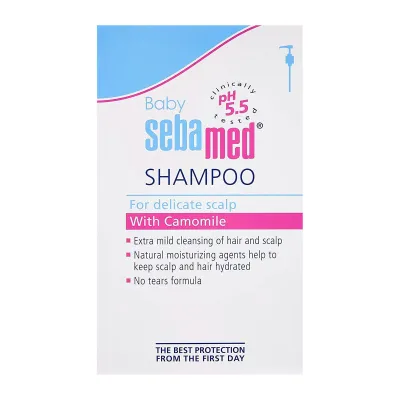
Sebamed baby shampoo is frequently marketed with a pH value of 5.5, which is designed to match the natural acidity of healthy skin. To verify this and other claims such as “tear-free” or “soap-free,” parents should carefully inspect the product packaging. A truly soap-free formulation relies on synthetic detergents rather than traditional saponified fats, which tend to have a high, alkaline pH. Additionally, check whether the specific bottle you purchase is a fragrance-free variant or if it contains added perfumes, as even mild fragrances can sometimes trigger reactions in highly sensitive newborns.
Before applying any new shampoo to your newborn’s entire scalp, conducting a localized patch test is a highly recommended precautionary measure. Dilute a tiny drop of the shampoo with warm water and apply it to a small, discreet area of the baby’s skin, such as the inner forearm or behind the ear, during their bath. Wash the area gently and rinse it off completely. Observe this specific spot over the next 24 to 48 hours for any signs of localized reactivity.
If you notice any adverse reactions during or after the patch test, or during subsequent regular use, discontinue using the product immediately. Observable signs of skin irritation include localized redness, dry or flaky patches, tiny raised red bumps, swelling, or signs that the baby is experiencing discomfort, such as scratching or unusual fussiness. If these signs appear, rinse the area thoroughly with clean, lukewarm water and avoid applying any further cosmetic products to the affected skin until it has fully recovered.
Understanding HSA Regulation for Baby Care Products in Singapore
In Singapore, cosmetic products, including baby shampoos, do not undergo a rigorous pre-market approval or clinical testing process by the Health Sciences Authority (HSA) before they can be sold. Instead, the regulatory framework operates on a notification system. Importers, manufacturers, or local distributors must submit a product notification to the HSA before placing the product on the market. This notification serves as an official declaration by the company that the product complies with the safety standards, ingredient restrictions, and labeling guidelines set out under the ASEAN Cosmetic Directive. It does not, however, constitute an endorsement or a clinical guarantee by the HSA that the product is absolutely safe or allergy-free for every individual user.

Parents who want to ensure that a specific bottle of Sebamed baby shampoo has been legally declared and registered for sale in Singapore can utilize public resources provided by the regulatory body. The HSA maintains an online public database known as the Cosmetic Product Notification register. By accessing this portal on the official HSA website, you can search for the product by its brand name, product name, or the name of the notifying company. Verifying that a product is listed in this database confirms that the importer has gone through the proper legal channels, which significantly reduces the risk of purchasing counterfeit or unregulated goods.
While HSA notification ensures that a product does not contain banned hazardous substances—such as heavy metals, mercury, or prohibited preservatives—and that restricted ingredients remain within legally permitted limits, it cannot account for individual biological variations. Every newborn’s immune system and skin barrier are unique. A product can be fully compliant with all national and regional safety regulations and still cause an allergic reaction or contact dermatitis in a sensitive infant. Regulatory compliance simply establishes a baseline of chemical safety and manufacturing standards; it does not eliminate the inherent risk of individual sensitivity to permitted ingredients.
How to Read and Decode Baby Shampoo Ingredient Labels
The primary function of any shampoo is to cleanse, which is achieved through surfactants—ingredients that attract both oil and water to wash away dirt. However, the type of surfactant used determines how gentle or harsh the product is on a newborn’s scalp. Harsh surfactants, such as Sodium Lauryl Sulfate (SLS) or Sodium Laureth Sulfate (SLES), are highly effective cleansers but are known to strip away the natural lipids that protect the skin barrier, leading to severe dryness and irritation. When reading the ingredient label of Sebamed or any other baby shampoo, look for mild, non-ionic or amphoteric surfactants. Ingredients such as Cocamidopropyl Betaine, Coco-Glucoside, Decyl Glucoside, or Lauryl Glucoside are commonly utilized in baby formulations because they cleanse gently without excessively stripping the scalp’s natural oils.
Water-based baby products require preservatives to prevent the growth of harmful bacteria, mold, and yeast over time. While essential for product safety, some preservatives can be sensitizing to delicate skin. Parents should inspect the ingredient list to identify which preservatives are used, keeping in mind that certain older preservative classes, such as formaldehyde donors or specific parabens, have largely been phased out of reputable baby care lines. Similarly, added fragrances—often listed simply as “Parfum” or “Fragrance”—are among the most common triggers for contact allergies. Even if a product is marketed as “gentle,” the presence of synthetic or natural fragrances on the ingredient list means there is a higher potential for skin irritation compared to truly fragrance-free alternatives.
It is common to see terms like “hypoallergenic,” “dermatologically tested,” or “pediatrician recommended” prominently displayed on baby shampoo bottles. These are primarily marketing terms rather than strictly regulated medical classifications. “Hypoallergenic” simply implies that the product has been formulated with ingredients that are statistically less likely to cause allergic reactions, but it does not guarantee that no reaction will occur. “Dermatologically tested” means the product was tested on human skin at some point during development, but it does not specify the testing methodology, the sample size, or whether the tests were conducted on newborns or adults. Therefore, these claims should always be treated as secondary to a thorough inspection of the actual ingredient list.
Safe Bathing Practices and When to Consult a Pediatrician
Maintaining a healthy newborn skin barrier involves not only choosing the right product but also practicing safe bathing habits. Newborns do not accumulate significant amounts of dirt and generally do not require daily hair washing with shampoo. Bathing your baby two to three times a week is typically sufficient to keep them clean without stripping their skin of natural moisture. When you do use shampoo, apply only a very small, pea-sized amount. Diluting the shampoo with warm water in your hands before gently massaging it onto the baby’s scalp can help distribute the product evenly and minimize localized concentration, reducing the risk of dryness or irritation.
After bathing, closely monitor your baby’s scalp and skin for any delayed reactions. Contact dermatitis can manifest hours or even days after exposure to an irritating ingredient. Look for persistent redness, dry or rough patches, scaling, or a fine red rash. It is also important to distinguish between general skin dryness and conditions like cradle cap (seborrheic dermatitis), which presents as oily, yellowish scales on the scalp. While mild cradle cap is common and often harmless, attempting to scrub it away vigorously with shampoo can worsen skin inflammation and damage the underlying skin barrier.
If your newborn exhibits persistent skin irritation, widespread rashes, or signs of intense itching—such as rubbing their head against bedding—you should stop using all scented or foaming bath products immediately. Switch to bathing the baby with plain, lukewarm water and consult a pediatrician or a pediatric dermatologist. Professional medical advice is essential if the skin becomes cracked, bleeds, oozes fluid, or shows any signs of infection, such as localized warmth or pus. A qualified healthcare provider can accurately diagnose the underlying issue, recommend appropriate therapeutic cleansers or emollients, and help you establish a safe, customized skincare routine.
Frequently Asked Questions (FAQ)
Can I use Sebamed baby shampoo on a newborn with eczema?
Eczema, or atopic dermatitis, is characterized by a severely compromised skin barrier that is highly susceptible to irritation. Standard baby shampoos, even those formulated to be gentle or pH-balanced like Sebamed, may still contain surfactants, preservatives, or fragrances that can trigger or worsen an eczema flare-up. If your newborn has been diagnosed with eczema or shows signs of chronically dry, itchy, and inflamed skin, you should not rely on general commercial baby shampoos. Instead, consult your pediatrician or a pediatric dermatologist before introducing any new bath products. They will typically recommend specialized, non-foaming, fragrance-free syndet bars or medical-grade bath oils specifically formulated to cleanse compromised skin without causing further irritation.
Does HSA certification mean a baby product is 100% allergy-free?
No, an HSA notification does not mean a baby product is 100% allergy-free. The Health Sciences Authority (HSA) notification process ensures that a product complies with safety regulations, does not contain prohibited hazardous substances, and is manufactured under acceptable quality standards. However, it cannot guarantee that an individual baby will not have an allergic reaction or sensitivity to one of the permitted ingredients. Allergic reactions are highly individualized immune responses that can be triggered by completely safe and common ingredients, such as specific plant extracts or mild cleansing agents. For this reason, performing a localized patch test on a small area of your baby’s skin remains a necessary and practical precaution before fully introducing any new product.

Community discussion
Share your experience or ask a question. Comments are reviewed before publication.