
As your baby transitions from crawling to those exciting first steps, finding the right developmental tools becomes a top priority. In Singapore, where modern apartments often feature smooth tiled, vinyl, or polished wood floors, selecting a stable and secure push walker is essential. A high-quality push walker provides the necessary support for your little one to explore their mobility safely, but not all models are designed with the same level of safety and structural integrity.
When evaluating the safest baby push walker brands in Singapore, parents frequently look to established names such as VTech, Fisher-Price, Hape, and PlanToys. These manufacturers are widely recognized for their rigorous safety testing and thoughtful engineering. However, selecting the right walker goes beyond brand reputation; it requires a deep understanding of physical design, wheel mechanics, and your baby’s specific developmental stage. By focusing on certified safety features and proper home setup, you can confidently support your child’s journey toward independent walking.
Why Push Walkers Are Preferred for Early Walkers
A baby push walker is an active developmental toy designed with a handle and a wheeled frame that your baby pushes from behind while walking upright. Unlike older equipment designs, these walkers require your child to actively engage their core, balance their weight, and use their own muscle power to move forward. This design aligns with natural pediatric recommendations for motor development, as it encourages a healthy, upright posture rather than artificial suspension.
Products mentioned in this guide
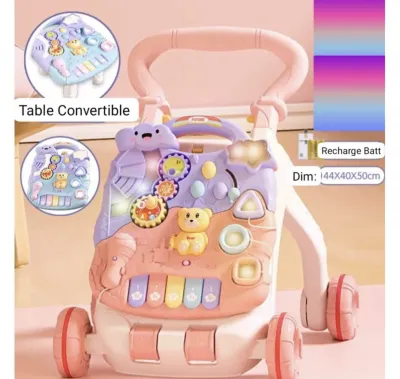
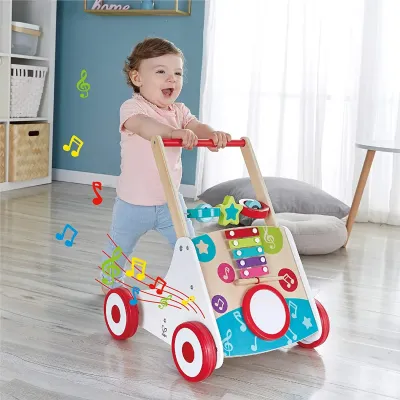
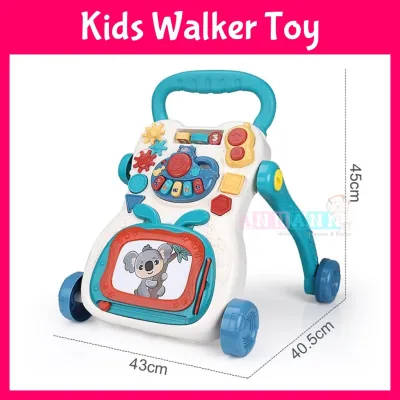
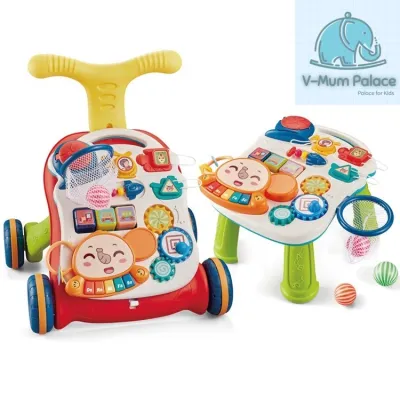
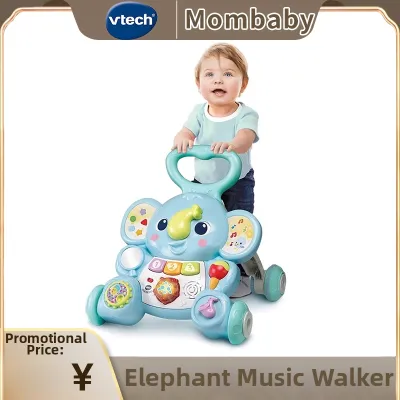
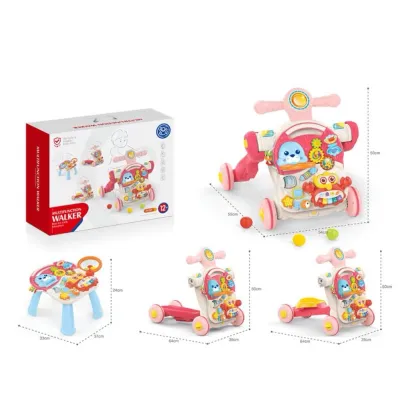
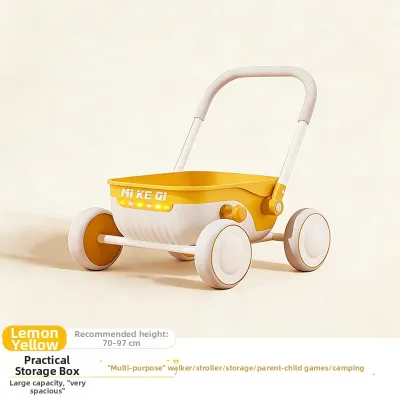
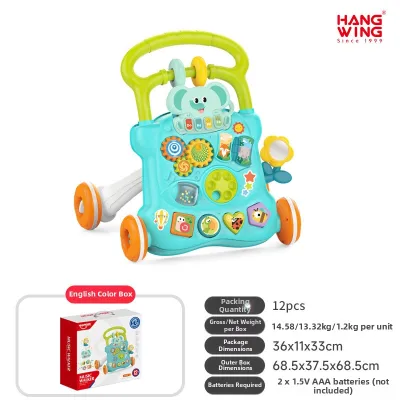
Prices are valid at publication and may change. Please refer to the product page for the latest price.
Traditional sit-in walkers, by contrast, suspend a baby in a fabric seat inside a wheeled frame, allowing them to glide across the floor using only their toes. This design has faced significant criticism from pediatricians and safety authorities worldwide because it can alter natural hip alignment and encourage abnormal walking patterns. Additionally, sit-in walkers allow babies to reach higher surfaces and move at surprisingly high speeds, significantly increasing the risk of tipping over or falling down steps.
By choosing a push walker, you allow your baby to maintain a natural heel-to-toe walking motion. This active engagement helps build essential strength in the legs, hips, and core muscles. Because the baby is not strapped into the device, they can easily choose to sit down or step away when they feel tired. This freedom of movement teaches them natural boundaries of balance and falling, which are crucial steps in learning how to navigate the physical world.
While push walkers offer excellent developmental support, they are intended to complement, not replace, natural floor play. Crawling, pulling up on furniture, and cruising are irreplaceable milestones that build the foundational coordination required for walking. Introducing a push walker should be viewed as an additional tool in your baby’s active play toolkit, always balanced with plenty of unassisted floor time.
Essential Safety Features to Look for in Top Brands
When shopping for a push walker in Singapore, the mechanical safety features of the device should be your primary consideration. One of the most critical elements to look for is adjustable wheel resistance or speed control. On smooth indoor surfaces like polished marble, ceramic tiles, or vinyl flooring, a walker without wheel resistance can easily shoot forward, causing a baby to lose balance and fall face-first. Top brands often include adjustable tension screws or rubberized friction strips on the wheels, allowing you to tighten the wheels for early walkers and loosen them as your child gains confidence and strength.

Base stability and weight distribution are equally vital for preventing backward or sideways tipping. A safe push walker must feature a wide, low-slung base that places the center of gravity close to the floor. When a baby is in the early stages of standing, they will inevitably use the walker’s handle to pull themselves up from a sitting position. If the walker is too light or has a narrow wheelbase, it can easily flip backward onto the child. Wooden push walkers, such as those made from solid rubberwood or birch, naturally offer more weight and stability, while high-quality plastic models often incorporate wide, flared wheel designs to distribute weight evenly.
The design of the handle itself plays a significant role in ergonomic safety. The handle should be positioned at a height that allows your baby to hold it with a slight bend in their elbows while standing upright. If the handle is too high, it forces the baby to reach upward, shifting their center of gravity dangerously forward; if it is too low, it encourages slouching. Look for handles with textured, non-slip grips that fit comfortably in tiny hands, ensuring a secure hold even if your baby’s palms are slightly damp.
Material quality and structural construction must never be overlooked, especially since young children frequently explore toys with their mouths. If you prefer wooden walkers, ensure they are constructed from sustainably sourced, splinter-free wood and finished with non-toxic, water-based paints. For plastic walkers, verify that the material is entirely BPA-free, phthalate-free, and heavy-metal-free. The entire frame should feature smooth, rounded edges, and any integrated activity panels must be free from small, detachable parts that could present a choking hazard.
Finally, pay close attention to the assembly joints and hardware of the walker. Screws and bolts should be deeply recessed into the frame so they cannot scratch your baby’s skin or snag their clothing. The wheels must be securely fastened to the axles with locking mechanisms that prevent them from vibrating loose during active use. Ensuring these mechanical details are present will give you peace of mind as your child explores.
How to Verify Brand Safety and Certifications in Singapore
Navigating the wide array of baby products on the market requires a critical eye, particularly when evaluating safety claims. To ensure a push walker is genuinely safe, start by verifying its compliance with recognized international safety standards. Reputable brands will clearly state their certifications on the product packaging or official website. Look for standards such as EN 71 (the European standard for toy safety) or ASTM F963 (the American standard). These certifications indicate that the product has undergone rigorous testing for physical stability, mechanical safety, flammability, and chemical toxicity.
In Singapore, the Consumer Product Safety Office (CPSO) oversees the safety of general consumer goods, including children’s toys and equipment. Before purchasing a push walker, it is highly recommended to visit the CPSO website or local consumer safety portals to check for any active product recalls or safety alerts. Even well-known international brands occasionally experience manufacturing defects that lead to recalls, so taking a few minutes to verify local compliance is a crucial step in protecting your child.
When browsing online marketplaces or ecommerce platforms, user reviews can serve as a valuable source of real-world safety feedback. However, instead of focusing solely on overall star ratings or aesthetic praise, actively filter reviews for critical safety keywords. Search for terms like “tipped,” “fell,” “slid,” “cracked,” or “wheels came off.” Pay close attention to comments describing how the walker behaves on smooth tiled floors or whether the activity parts detached easily. If multiple parents report that a specific model tips backward when a baby pulls up on the handle, it is best to avoid that model regardless of its visual appeal.
A brand’s overall transparency is another strong indicator of product safety. Reputable manufacturers will always provide a detailed, easy-to-read instruction manual that outlines correct assembly procedures, maximum weight limits, and recommended age ranges. They will also have clear customer service channels where you can ask safety-related questions or request replacement parts. If a brand lacks a clear website, provides vague safety guidelines, or fails to specify its manufacturing materials, you should look for a more transparent alternative.
Matching the Walker to Your Baby's Developmental Stage
Selecting the right push walker requires matching the equipment to your baby’s current physical milestones and developmental readiness. Push walkers generally fall into two main categories: sit-to-stand activity centers and standalone push walkers. Sit-to-stand models, which are often made of durable plastic, feature interactive toy panels on the front. These are ideal for younger babies who are still sitting independently but are not yet standing, as they can play with the panel on the floor before transitioning to using the wheeled frame. Standalone push walkers, such as wooden carts or blocks wagons, are designed specifically for babies who are actively trying to stand and take their first steps, offering a simpler, heavier frame focused purely on physical support.
Before introducing any push walker, you must carefully verify the specific age, weight, and height limits printed on the manufacturer’s label. These limits are not arbitrary; they are determined through safety testing to ensure the walker’s frame can support the physical forces exerted by a child of that size. Relying on general marketing descriptions or assuming a walker is suitable just because your baby is within the typical age range can lead to structural failures or tipping accidents.
Recognizing the physical readiness signs in your baby is essential before letting them use a push walker. Your baby is generally ready to try a push walker if they can sit up steadily without support, pull themselves up to a standing position using furniture, and cruise sideways along a sofa or coffee table. These milestones demonstrate that your baby has developed the baseline core strength, pelvic stability, and leg muscle tone necessary to guide a moving object without collapsing.
Equally important is knowing when to transition your baby out of the push walker. Once your child can walk several steps independently without holding onto anything, or if they begin to push the walker at high speeds, run with it, or climb on top of it, it is time to retire the device. At this stage, the walker can actually become a hazard, as a running child can easily trip over the wheels or lose control of the frame. Transitioning to complete, unassisted walking allows them to refine their balance and spatial awareness naturally.
Creating a Safe Home Environment for Push Walker Use
Even the safest, most highly certified push walker can become hazardous if used in an unprepared environment. To ensure your baby’s safety, you must carefully prepare the walking pathways within your home. Start by clearing all clutter, small toys, and loose items from the floor. Secure loose rugs with non-slip underlays or remove them entirely, as a walker’s wheels can easily catch on the edges of a rug, causing the frame to stall and tip forward. Additionally, ensure that all electrical cords, phone chargers, and curtain pulls are tucked safely away out of your baby’s reach.
Hazard blocking is another non-negotiable step in home preparation. If your home has multiple levels, split-level living rooms, or balcony areas, you must install secure safety gates at the top and bottom of all staircases. Keep doors to bathrooms, kitchens, and service yards closed, as these areas often have wet floors, chemical cleaners, or heavy appliances that pose severe risks. You should also check for uneven thresholds or transition strips between different rooms, as a sudden bump can stop the walker’s wheels abruptly while your baby’s momentum carries them forward.
It is vital to remember that a baby push walker is an active play toy, not a babysitter or a safe containment device. Continuous, active adult supervision is mandatory whenever your baby is using the walker. This means staying within arm’s reach so you can quickly intervene if the walker moves too fast, if your baby loses their grip, or if they head toward an unexpected obstacle. Avoid using your phone or leaving the room, even for a moment, while your baby is in motion.
Finally, establish a simple routine for inspecting and maintaining the push walker. Over time, the vibrations from active use can cause screws and bolts to loosen slightly. Once a week, take a few moments to check all structural joints and tighten any loose hardware. Inspect the wheels for accumulated hair, dust, or lint, which can clog the axles and prevent the wheels from rotating smoothly. If you are using a wooden walker, run your hand along the edges to check for any splinters or chipped paint, and ensure that all attached activity toys remain firmly secured to prevent choking hazards.
Frequently Asked Questions (FAQ)
Are push walkers safer than traditional sit-in walkers?
Yes, push walkers are widely considered much safer than traditional sit-in walkers. Push walkers allow your baby to maintain a natural, upright posture and control their own speed using their core and leg muscles. Because they are not suspended in a seat, babies can easily let go of the handle and sit down if they lose their balance, which significantly reduces the risk of high-speed tipping. Furthermore, push walkers do not allow babies to reach dangerous heights or move at the rapid, uncontrollable speeds common with sit-in models, making stair and tipping accidents far less likely.
At what age should my baby start using a push walker?
Most babies are developmentally ready to start using a push walker between 9 and 12 months of age, but readiness depends entirely on physical milestones rather than a strict chronological age. Before introducing a walker, your baby should be able to sit independently, pull themselves up to stand using furniture, and cruise along walls or coffee tables. Always verify the minimum age and weight requirements printed on the specific product’s manufacturer label, as some models are designed with heavier frames or complex activities suited for slightly older toddlers.
Can using a push walker delay my baby's independent walking?
When used correctly and in moderation, a push walker will not delay your baby’s independent walking and can actually help build the leg and core strength needed for balance. However, relying too heavily on a walker can prevent your baby from practicing the independent balancing skills required to walk without support. To promote healthy development, balance walker play with plenty of unassisted floor time, crawling, and cruising. If you have any concerns about your baby’s motor development or walking posture, consult a pediatrician or a pediatric physical therapist for professional guidance.
Community discussion
Share your experience or ask a question. Comments are reviewed before publication.