
Selecting the right baby bottle is one of the most critical decisions for early parenthood, directly impacting feeding comfort, colic prevention, and daily cleaning routines. Among the premium options on the market, the Pigeon Softouch PPSU bottle has gained significant popularity for its durability, lightweight design, and natural latch nipple. When comparing this bottle to other brands and materials, the choice ultimately depends on your baby’s feeding style, your sterilization setup, and your budget. PPSU offers a highly resilient, heat-resistant alternative to traditional glass and standard plastic, while the SofTouch nipple design focuses on mimicking natural breastfeeding. However, competing brands like Dr. Brown’s and Philips Avent offer distinct advantages in anti-colic technology and milk flow control that may better suit specific infant needs.
Understanding PPSU vs. Other Bottle Materials
PPSU (polyphenylsulfone) is a medical-grade plastic known for its distinct honey-colored tint. It combines the best properties of glass and standard plastics, offering exceptional durability and high heat resistance without the heavy weight or fragility of glass. Unlike cheaper plastics, PPSU does not easily absorb odors or stains, and it can withstand repeated sterilization cycles without degrading. This makes it an excellent long-term investment for parents who plan to use the same bottles for many months or across multiple children.
Glass remains a classic choice for parents who prioritize a completely plastic-free feeding environment. Glass bottles are naturally scratch-resistant, highly hygienic, and do not discolor over time. However, they present clear practical challenges: they are heavy to hold during long night feedings, risk breaking if dropped on hard kitchen tiles, and pose a safety hazard as your baby begins to hold the bottle independently.
Products mentioned in this guide
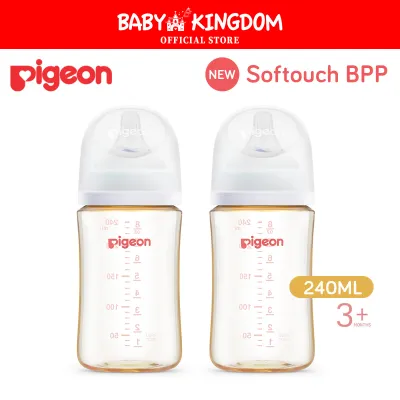
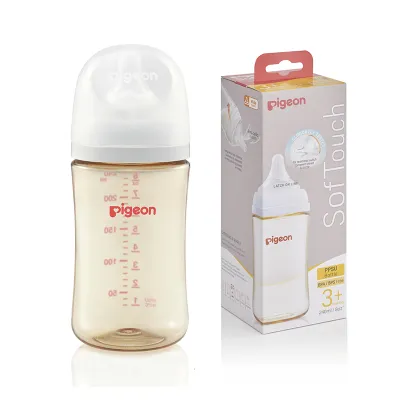
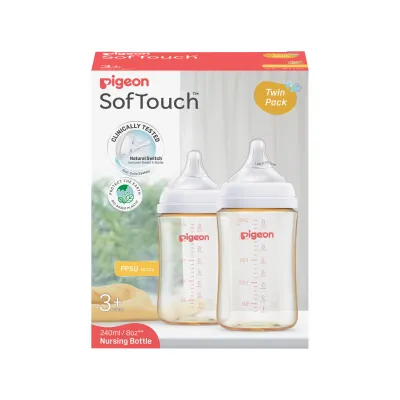
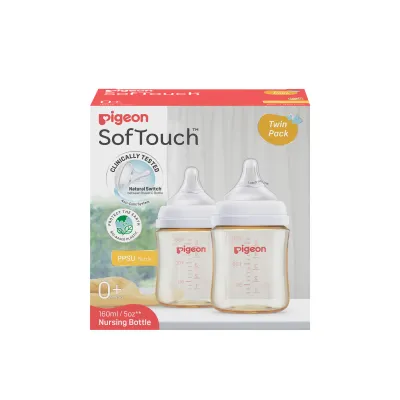
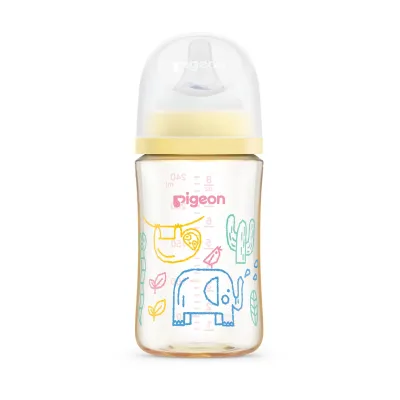
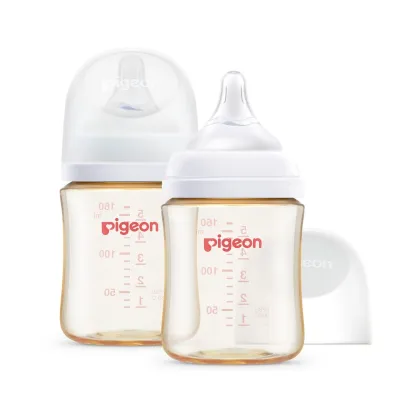
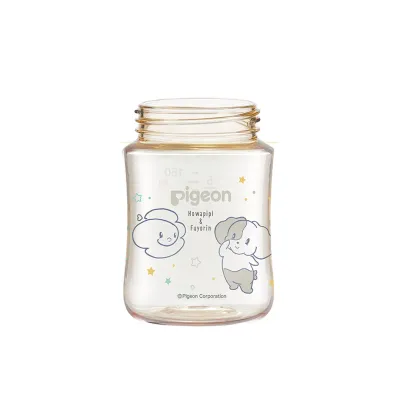
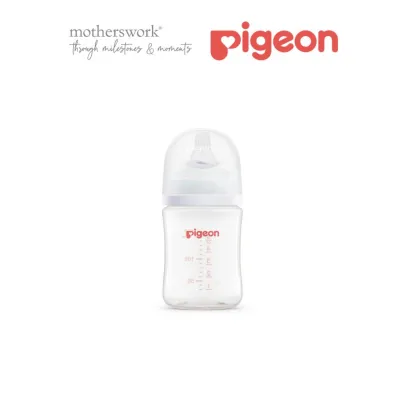
Prices are valid at publication and may change. Please refer to the product page for the latest price.
Standard plastic, primarily Polypropylene (PP), is the most common and budget-friendly material available. While PP bottles are lightweight and shatterproof, they have a much shorter lifespan. They tend to cloud over, scratch easily during cleaning, and degrade under high-temperature sterilization, requiring replacement every few months to prevent bacterial buildup in micro-scratches.
Silicone bottles have introduced a soft, squeezable texture designed to mimic the feel of skin. They are highly durable and drop-proof, but they can be unstable on flat surfaces due to their flexible bases. Additionally, silicone can sometimes retain soapy smells or milk fats, requiring more intensive scrubbing and specialized cleaning agents to keep them pristine.
Pigeon Softouch vs. Competing Brand Designs
The core appeal of the Pigeon SofTouch bottle lies in its nipple design and simple construction. The nipple features a unique “latch-on line” that guides caregivers to position the baby’s lips correctly for an optimal seal. Made from incredibly soft, flexible silicone, it supports the natural peristaltic tongue movement of breastfeeding, making it a preferred choice for families practicing mixed feeding. Its anti-colic mechanism is a simple, integrated Air Ventilation System (AVS) built directly into the nipple base, which requires no extra parts to clean.

In contrast, Dr. Brown’s bottles are famous for their specialized internal green vent system. This multi-part system channels air away from the milk to prevent vacuum formation, significantly reducing air ingestion, gas, and spit-up. While highly effective for infants suffering from severe colic, this design introduces a major trade-off: the vent insert, reservoir tube, and collar must be disassembled and cleaned individually with specialized miniature brushes, adding substantial time to daily kitchen chores.
Philips Avent offers another major alternative with its Natural Response range. These nipples are designed to release milk only when the baby actively compresses the tip, closely mimicking the mechanics of breastfeeding where milk does not flow continuously. Avent’s wide-neck design makes the bottles exceptionally easy to fill and clean, and their broad ecosystem allows parents to easily transition parts across breast pumps, storage cups, and toddler trainer cups.
Decision Framework: Which Bottle Fits Your Baby?
To determine the best bottle system for your household, consider your baby’s specific feeding behavior alongside your daily lifestyle constraints.
Choose the Pigeon Softouch PPSU bottle if you want a premium, long-lasting bottle that transitions smoothly between breast and bottle feeding. It is ideal for parents who want a lightweight, highly durable option that is easy to toss into a diaper bag and quick to wash, thanks to its minimal parts and wide-neck opening. While PPSU bottles represent a higher upfront investment in S$ compared to standard PP, their extended lifespan often makes them more cost-effective over time.
Opt for Dr. Brown’s if your infant struggles with persistent gas, severe colic, or reflux. The extra cleaning time required for the internal vent system is often a worthwhile trade-off for parents seeking maximum air reduction during feeds.
Select glass bottles if your primary concern is avoiding plastic contact entirely and you primarily feed your baby at home, where the risk of dropping bottles on hard outdoor surfaces is minimized.
Before making a bulk purchase, always verify how your baby responds to the nipple shape. Some infants have specific latch challenges, oral ties, or medical feeding requirements that necessitate specialized therapeutic bottles. If your baby consistently rejects a bottle, coughs during feeds, or shows signs of distress, consult a pediatrician or a certified lactation consultant before switching systems.
Safety, Maintenance, and Replacement Checks
Ensuring the safety of your baby’s feeding equipment requires regular inspection and disciplined maintenance routines. Even highly durable PPSU bottles should be checked weekly for signs of wear. Look closely for deep scratches, cracks, or persistent cloudiness; these physical imperfections can harbor microscopic bacteria that standard washing might miss. If you detect any structural damage, discard the bottle immediately.
Nipples require even more frequent monitoring as your baby grows. Check the silicone regularly by pulling gently on the bulb to ensure there are no tears or thinning areas. It is crucial to match the nipple flow rate to your baby’s developmental stage rather than relying solely on age guidelines. If your baby is choking, coughing, or milk is leaking from the corners of their mouth, the flow may be too fast; conversely, if they collapse the nipple or take exceptionally long to finish a feed, they may need a faster flow.
Always consult the manufacturer’s instruction manual for specific sterilization limits. While PPSU can withstand high temperatures, excessive boiling or prolonged exposure to UV sterilizers can accelerate the aging of silicone nipples and plastic collars. Caregivers must supervise all bottle-feeding sessions and never leave an infant unattended with a bottle to prevent choking hazards.
Frequently Asked Questions (FAQ)
Are Pigeon Softouch nipples cross-compatible with other bottle brands?
While some wide-neck bottles from different brands may appear to have similar thread patterns, mixing and matching nipples and collars is generally not recommended. Using a Pigeon SofTouch nipple on a non-Pigeon bottle collar can compromise the seal, leading to persistent leaks during feeding. Furthermore, the integrated Air Ventilation System (AVS) relies on a precise fit against the collar to function correctly; an improper fit can block the vent, causing the nipple to collapse and increasing the amount of air your baby swallows. Always use matched sets to ensure safe and comfortable feeding.
How do I know when it is time to replace a PPSU bottle?
Although PPSU is exceptionally durable and can last significantly longer than standard PP plastic, it is not permanent. You should replace a PPSU bottle if you observe deep scratches on the inner walls, stubborn stains that do not wash out, or a change in the material’s texture. Most manufacturers recommend replacing plastic bottles every six to twelve months of regular use, depending on the frequency of sterilization. Nipples, however, wear out much faster due to constant biting and stretching; they should generally be replaced every two to three months, or immediately if you notice any stickiness, tears, or changes in flow rate.
Community discussion
Share your experience or ask a question. Comments are reviewed before publication.