
To determine if the Mimosa Magnus V2 meets Singapore’s car seat safety regulations, you must verify the specific certification label affixed to the physical seat. In Singapore, all child restraints used in motor vehicles must comply with recognized international safety standards, such as the United Nations (UN) ECE R44/04 or the newer UN R129 (i-Size) regulations. Because product specifications and regional distributions can vary, parents must physically inspect the seat’s orange approval label or request official compliance documentation from the retailer before installation.
Understanding Singapore's Mandatory Car Seat Standards
Under the Singapore Road Traffic Act, anyone under the height of 1.35 metres must be secured with an approved child restraint appropriate for their height and weight when travelling in a passenger vehicle. This law applies strictly to private cars and private hire vehicles (PHVs), such as ride-hailing services. While public taxis are legally exempt from this requirement due to practical constraints, safety experts strongly advise using a portable or compatible car seat in all motor vehicles to protect young passengers.
The Land Transport Authority (LTA) and traffic police recognize specific international standards to ensure that child restraints sold and used in Singapore offer adequate protection. The most common standards found on compliant seats are the UN ECE R44/04 and the UN R129. The older R44/04 standard categorizes seats based on the child’s weight, while the newer R129 standard uses the child’s height as the primary metric and mandates rigorous side-impact testing.
Products mentioned in this guide
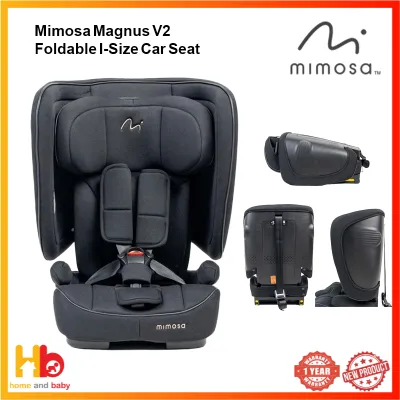
Prices are valid at publication and may change. Please refer to the product page for the latest price.
Safety best practices strongly recommend keeping children in a rear-facing position for as long as possible, typically until they are at least 15 months old or have outgrown the rear-facing limits of their specific seat. Rear-facing seats distribute the forces of a collision more evenly across the child’s back and neck, offering significantly better protection for their developing spine compared to forward-facing alternatives.
Additionally, Singapore’s hot and humid tropical climate can affect the longevity and comfort of car seats. High cabin temperatures in parked vehicles can accelerate the degradation of plastics and foam materials over time. Therefore, understanding how to verify a seat’s compliance and structural integrity is crucial for long-term safety on local roads.
How to Check the Mimosa Magnus V2 Certification Label
To confirm that your Mimosa Magnus V2 is legally compliant for use on Singapore roads, you must locate the physical approval label on the seat itself. This label is typically a bright orange sticker affixed to the plastic shell, often found on the base, the rear panel, or the side of the seat. If this label is missing, damaged, or illegible, the seat cannot be legally verified as compliant.

When inspecting the orange label, look for several critical markers. First, look for a circle containing the letter “E” followed by a number (such as E1 for Germany, E2 for France, or E4 for the Netherlands), which indicates the European country that granted the safety approval. Below or next to this circle, you should find the specific standard number—either ECE R44/04 or R129. The label will also clearly state the approved weight range (for R44/04) or height range (for R129) for which the seat is certified.
The label will also indicate the category of use, such as “Universal,” “Semi-Universal,” or “Vehicle Specific.” A “Universal” approval means the seat can be installed in almost any car using the vehicle’s seatbelts or standard ISOFIX anchor points. If the label indicates “Semi-Universal,” it may require a support leg or a top tether, meaning you must verify compatibility with your specific vehicle’s floor storage compartments or anchor points.
If you are purchasing the Mimosa Magnus V2 from an authorized retailer or an online marketplace in Singapore and cannot locate the label, or if the information is unclear, do not rely on verbal assurances. Request the official Certificate of Conformity (CoC) or test documentation from the manufacturer or distributor. Legitimate distributors should be able to provide documentation verifying that the specific batch imported into Singapore has passed the necessary safety assessments.
Inspecting Observable Safety and Installation Features
Beyond checking the paper or sticker certifications, you must evaluate how the Mimosa Magnus V2 physically installs into your specific vehicle. Car seats generally secure to a vehicle using either the ISOFIX anchor system or the vehicle’s three-point seatbelt. Before purchasing, check your car’s owner manual to locate the physical ISOFIX anchor points, which are typically found in the crevice between the vehicle seat back and the seat cushion.
Next, inspect the harness system of the seat. A secure child restraint should feature a multi-point harness—typically a five-point system—that secures the child at the shoulders, hips, and crotch. Verify that the harness straps are easy to adjust and that the headrest can be raised or lowered to position the shoulder straps correctly (at or just below the shoulders for rear-facing, and at or just above the shoulders for forward-facing).
You should also observe the physical construction of the seat’s shell. Look for visible side-impact protection features, such as deep side wings or energy-absorbing foam linings (like EPS or EPP foam) within the headrest and torso areas. While these design elements are intended to help manage crash forces, remember that their presence is a design feature to be verified in the product manual rather than an absolute guarantee of crash performance.
Given Singapore’s warm climate, also inspect the seat’s fabric and ventilation features. Look for breathable mesh materials and ventilation channels built into the plastic shell. These features help keep your child cool and comfortable, reducing the risk of overheating during long drives under the sun.
Safety Boundaries and Next Steps If Unverified
Operating a car seat without verifiable safety compliance poses significant risks to your child’s safety and may lead to legal penalties under Singapore’s traffic laws. If the orange approval label on your Mimosa Magnus V2 is missing, torn, or displays an unrecognized standard, establish a strict safety rule: do not install or use the seat.
If you discover compliance issues after purchase, contact the retailer immediately to request a replacement or a full refund. Keep all original packaging, receipts, and product manuals to facilitate this process. If the retailer is uncooperative, you can escalate the matter to the manufacturer or report the issue to local consumer protection bodies.
Another critical safety boundary is the lifespan of the car seat. Most manufacturers specify an expiration date, typically between six to ten years from the date of manufacture, due to the natural degradation of plastic components. In Singapore’s intense heat, this degradation can occur more rapidly, so always locate the manufacture date stamp on the plastic shell and avoid using seats past their recommended lifespan.
For lingering doubts about installation or compliance, do not guess. You can consult certified child passenger safety technicians (CPSTs) available through local parenting organizations or specialized baby gear retailers in Singapore. These professionals can physically inspect your vehicle and the car seat to ensure a correct, secure fit that complies fully with local regulations.
Frequently Asked Questions (FAQ)
Can I use a car seat without an ECE or i-Size label in Singapore?
No, using a car seat without an approved international certification label like UN ECE R44/04 or UN R129 is illegal on Singapore roads. The traffic police require all child restraints to meet recognized safety standards to ensure they can withstand collision forces. Using unapproved restraints can result in fines and demerit points, and more importantly, fails to guarantee your child’s physical protection during an accident.
Does the Mimosa Magnus V2 support rear-facing travel?
To determine if the Mimosa Magnus V2 supports rear-facing travel, you must check the specific weight and height limits printed on its orange approval label and detailed in its user manual. Different versions or configurations of convertible seats have distinct limits for rear-facing and forward-facing modes. Always follow the manufacturer’s exact instructions regarding when to transition your child from rear-facing to forward-facing travel.
Are second-hand car seats safe and legal to use?
Using second-hand car seats is generally discouraged unless you can fully verify their complete history. A used seat may have been involved in a collision, which can cause invisible structural damage that compromises its safety. Additionally, second-hand seats may have expired materials, missing instruction manuals, or degraded safety labels, making it difficult to confirm their compliance with Singapore’s current safety regulations.
Community discussion
Share your experience or ask a question. Comments are reviewed before publication.