
Ensuring your child is safe on Singapore’s roads requires understanding both local traffic laws and the specific safety credentials of your car seat. To verify if the Mimosa Magnus V2 complies with Singapore regulations, you must check for an approved international safety certification label, such as the United Nations Economic Commission for Europe (UN ECE) standard, which is legally recognized by the Land Transport Authority (LTA). This guide explains how to locate these certifications, inspect the seat’s physical safety features, and ensure correct installation to keep your child secure during every journey.
Understanding Singapore's Child Car Seat Laws
Under the Road Traffic Act in Singapore, anyone under the height of 1.35 metres must be secured in an approved child restraint appropriate for their height and weight when traveling in a motor vehicle. This law applies to all private cars and private hire vehicles. While public taxis are currently exempt from this rule due to practical constraints, safety experts strongly advise using a portable or compatible restraint even in taxis to protect young passengers from sudden stops.
The Land Transport Authority (LTA) and the Traffic Police do not certify car seats independently; instead, they recognize specific international safety standards. For a car seat to be legally compliant on Singapore roads, it must meet standards set by recognized international bodies. These include the European standard (UN ECE R44/04 or R129), the American standard (FMVSS 213), the British standard (BS 3254 or BS AU 202), the Australian standard (AS 1754), or the Japanese standard (JIS D0401).
Products mentioned in this guide
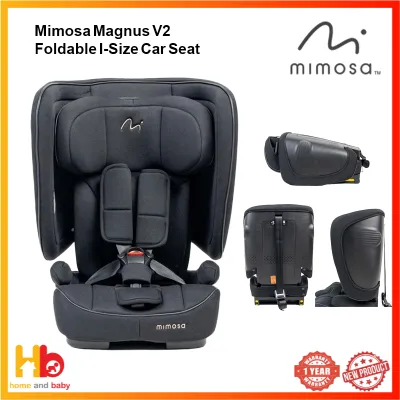
Prices are valid at publication and may change. Please refer to the product page for the latest price.
Failing to secure a child under 1.35 metres in an approved restraint is a serious traffic offense in Singapore. Drivers found in breach of this regulation face a composition fine and demerit points, while passengers can also be prosecuted. Beyond the legal penalties, the primary motivation for compliance is physical protection, as standard adult seatbelts are designed for individuals at least 1.35 metres tall and can cause severe abdominal or neck injuries to smaller children during a crash.
How to Verify the Mimosa Magnus V2 Certifications
To confirm that your Mimosa Magnus V2 complies with Singapore’s legal framework, you must locate the physical certification label affixed to the seat’s shell. This is typically an orange sticker containing critical regulatory information. Look for the “E” mark, which consists of a circle surrounding the letter “E” followed by a number (such as E1 for Germany or E4 for the Netherlands), indicating the European country that granted the safety approval.

Next, examine the label for the specific standard version code. If the seat is certified under the UN ECE R44/04 standard, the label will display “ECE R44/04” along with the approved weight group. If it is certified under the newer UN ECE R129 standard, also known as i-Size, the label will focus on height ranges rather than weight groups, and will feature an “i-Size” logo.
Cross-reference the physical label with the product’s user manual and manufacturer documentation. The manual should clearly state the approval certificate number, the testing parameters, and the manufacturer’s official declaration of conformity. If you notice any discrepancies between the manual’s instructions and the physical label on the seat, contact the authorized distributor in Singapore to verify the authenticity of the product before installation.
Finally, verify that your child’s current physical measurements align with the certified limits printed on the label. A car seat’s safety rating is only valid when used within its specified weight or height boundaries. Regularly weigh and measure your child, as transitioning them to a different configuration or a larger seat too early can compromise the restraint’s ability to distribute crash forces safely.
Key Safety Features to Inspect Before Use
Before installing the Mimosa Magnus V2 in your vehicle, perform a thorough physical inspection of the harness system and buckle mechanism. Fasten the buckle and pull firmly on the straps to ensure they lock securely into place without slipping. The harness adjuster button or strap should operate smoothly, allowing you to tighten the harness snugly against your child’s chest without any slack or binding.
Inspect the installation connectors, whether the seat utilizes ISOFIX anchors or relies on the vehicle’s three-point seat belt routing paths. If using ISOFIX, check that the latch connectors extend and retract properly, and verify that the color-coded safety indicators turn completely green when locked onto your car’s anchor points. For seat belt installations, ensure the belt guides and lock-offs are free from cracks and can hold the vehicle seat belt tightly without slipping.
Examine the side-impact protection structures and the overall integrity of the seat shell. Look closely at the energy-absorbing foam lined inside the headrest and side wings to ensure there are no hairline cracks, chips, or missing pieces. The plastic shell itself should be free from stress marks, deep scratches, or warping, which could indicate manufacturing defects or damage sustained during shipping.
Proper Installation and Usage Boundaries
Safe transportation depends entirely on following the manufacturer’s instructions regarding rear-facing and forward-facing transitions. Keeping your child rear-facing for as long as possible is widely recommended by safety experts, as this position provides superior support for the child’s head, neck, and spine during a frontal impact. Do not transition your child to a forward-facing position until they have fully reached the minimum weight or height threshold specified by the manufacturer.
Achieve a secure installation by testing the seat’s movement at the belt path or ISOFIX base before every single journey. Grab the seat near the installation anchor points and pull firmly from side to side and front to back; the seat should not move more than 2.5 centimeters in any direction. If the seat moves excessively, adjust the tension of the vehicle seat belt or re-engage the ISOFIX connectors until a tight, rigid fit is achieved.
Avoid using any aftermarket accessories, such as unapproved seat liners, harness pads, head supports, or toys that did not come in the original packaging with the Mimosa Magnus V2. These items have not undergone crash testing with this specific seat and can interfere with the harness’s ability to hold your child securely. Additionally, never place thick jackets or bulky clothing on your child under the harness, as this creates hidden slack that can cause the child to be ejected from the seat during a sudden stop.
When to Stop Using the Car Seat
You must retire the car seat immediately once your child reaches the maximum height or weight limit specified on the product’s certification label. Continuing to use a seat beyond its certified capacity puts excessive stress on the structural components and harness, increasing the risk of failure during an accident. Keep a close eye on your child’s growth milestones to plan for their next transition well in advance.
Any car seat involved in a moderate to severe vehicle collision must be replaced immediately, even if there is no visible damage on the exterior. The forces generated during a crash can cause microscopic fractures in the plastic shell and stretch the internal webbing of the harness, permanently compromising its structural integrity. Most manufacturers recommend replacing the seat after any accident to ensure continued protection.
Car seats have a limited lifespan due to the natural degradation of plastic and foam materials over time, especially under Singapore’s hot and humid climate. Check the user manual or the bottom of the seat shell for an expiration date or a manufacture date stamp. If the materials show signs of wear, such as frayed harness straps, cracked foam, or brittle plastic, stop using the seat immediately and dispose of it responsibly so it cannot be reused by someone else.
Frequently Asked Questions (FAQ)
Can I use the Mimosa Magnus V2 in the front passenger seat?
In Singapore, placing a rear-facing child restraint in the front passenger seat is highly dangerous and legally restricted if the front passenger airbag is active. If an airbag deploys during a collision, it strikes the back of the rear-facing seat with immense force, which can cause severe or fatal injuries to an infant. If you must install a forward-facing car seat in the front, you must slide the vehicle seat as far back as possible to maximize the distance between the child and the dashboard, though the rear seat remains the safest location.
What should I do if the certification label is missing or unreadable?
If the physical orange certification label on your car seat is missing, torn, or completely faded, you should treat the seat as uncertified until you can verify its compliance. Locate the serial number and batch number, which are usually printed on a separate white sticker on the shell, and contact the manufacturer or authorized retailer in Singapore to request a verification of compliance. Avoid using a car seat on public roads if you cannot definitively prove its safety standard, as traffic authorities or vehicle inspectors may deem it non-compliant.
Does a higher price guarantee better safety certification?
A higher retail price does not automatically mean a car seat has superior safety certifications, as all legally sold seats must meet the same mandatory baseline safety standards to be approved for road use. Premium pricing often reflects advanced convenience features, such as 360-degree rotation, high-end fabrics, lighter materials, or integrated cup holders, rather than a higher level of crash protection. Focus on finding a seat that fits your vehicle’s installation system perfectly and matches your child’s physical dimensions, as a correctly installed mid-range seat is far safer than an incorrectly installed premium model.
Community discussion
Share your experience or ask a question. Comments are reviewed before publication.