
Quick Answer: Safety Overview and Age Recommendations
When considering if Babyganics hand sanitizer is safe for babies and toddlers, the answer is not a simple yes or no. Safety depends heavily on the specific formulation of the product—whether it is alcohol-based or alcohol-free—and your child’s exact developmental stage. Pediatricians and health authorities globally emphasize that plain soap and water remain the absolute safest and most effective method for cleaning an infant’s hands.
While certain Babyganics formulations are designed to be gentler on young skin, parents must always read the manufacturer’s label for specific age limits, warnings, and usage instructions before application. Never assume a sanitizer is safe for a newborn simply because it features baby-themed branding. For infants under two months of age, hand sanitizers of any kind are generally discouraged due to skin permeability and ingestion risks.
Checking the Label: Alcohol-Based vs. Alcohol-Free Formulas
To determine the safety of any hand sanitizer, you must look closely at the active ingredients listed on the back of the bottle. Babyganics produces different formulations, and understanding what is inside each bottle is crucial for protecting your child’s delicate skin.
Products mentioned in this guide
Prices are valid at publication and may change. Please refer to the product page for the latest price.

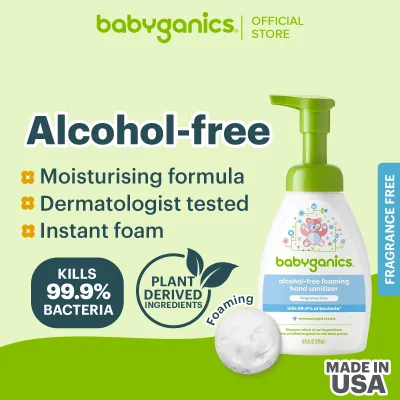
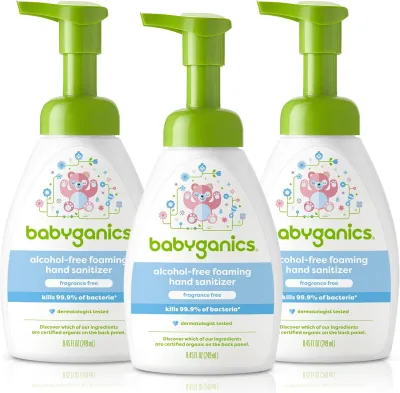
The most common Babyganics product marketed for families is their alcohol-free foaming hand sanitizer. The active ingredient in this formula is typically Benzalkonium Chloride (usually at a concentration of 0.1% or 0.13%). Benzalkonium Chloride is a quaternary ammonium compound that works by disrupting the cell membranes of bacteria and certain viruses. Because it does not contain ethanol or isopropyl alcohol, it is less likely to dry out skin or cause a stinging sensation on minor scratches. However, it is still a chemical agent that must be handled with care.
In contrast, alcohol-based hand sanitizers rely on ethyl alcohol (ethanol) or isopropyl alcohol, usually at concentrations between 60% and 70%, to kill germs. While highly effective at neutralizing a broad spectrum of pathogens, alcohol-based formulas present a significant hazard if accidentally ingested by a curious toddler. They are also highly flammable and can quickly dry out a young child’s sensitive skin barrier.
When reviewing a Babyganics bottle, establish a practical checklist:
- Identify the Active Ingredient: Confirm whether the bottle contains Benzalkonium Chloride (alcohol-free) or Ethyl Alcohol (alcohol-based).
- Examine the Inactive Ingredients: Check for the presence of botanical extracts, essential oils, or preservatives that could trigger an allergic reaction or skin sensitivity in your child.
- Read the Warnings: Look for age-specific directions, such as warnings indicating that children under six years of age should only use the product under direct adult supervision.
It is also important to look beyond marketing terms. Labels featuring words like “natural,” “plant-based,” or “gentle” do not mean a product is entirely risk-free. A plant-derived ingredient can still cause contact dermatitis, and any sanitizer can cause gastrointestinal distress if a baby licks a significant amount of wet product off their hands.
General Pediatric Guidelines for Hand Sanitizer Use
Pediatric guidelines regarding hand hygiene are structured around a child’s developmental stages and the unique characteristics of their skin.
Newborns and Infants Under 2 Months
For newborns and infants under two months of age, hand sanitizers of any kind should be avoided entirely. An infant’s skin barrier is still developing during these early weeks. The stratum corneum—the outermost layer of the skin—is significantly thinner than that of an adult, making it highly permeable. This means any chemicals applied to a newborn’s skin are absorbed into their bloodstream much more readily.
Furthermore, infants at this stage have a high surface-area-to-body-mass ratio, compounding the risk of systemic absorption. Because babies frequently put their hands in their mouths as a natural self-soothing mechanism, the risk of chemical ingestion is exceptionally high. For this age group, mild soap and warm water are the only recommended cleaning methods.
Toddlers and Older Babies
As babies grow older and enter the toddler stage, their skin barrier becomes more resilient, but hand sanitizer should still be treated as a secondary backup option rather than a daily habit. Pediatricians advise using hand sanitizers only when soap and water are genuinely unavailable.
For example, if you are out at a playground in Singapore, such as those at East Coast Park, and your toddler wants a quick snack but there is no washing facility nearby, a sanitizer can be useful.
Even for older babies and toddlers, continuous adult supervision is mandatory during application. Toddlers are highly impulsive and often rub their eyes or put their fingers in their mouths immediately after something is applied to their hands. You must control the bottle, dispense the correct amount, and actively rub it into their hands until it has evaporated completely. Never allow a toddler to carry or play with a hand sanitizer bottle, as accidental ingestion or eye exposure can occur in a matter of seconds.
Potential Risks and Side Effects to Monitor
While hand sanitizers are convenient, parents must remain vigilant about the potential risks and side effects associated with their use on young children.
Ingestion and Toxicity
Accidental ingestion is one of the most serious risks associated with hand sanitizers. If a child swallows an alcohol-based sanitizer, even a small quantity can lead to alcohol poisoning. In a small child’s body, this can cause a rapid drop in blood sugar (hypoglycemia), confusion, loss of coordination, vomiting, and in severe cases, respiratory depression.
While alcohol-free sanitizers containing Benzalkonium Chloride do not carry the risk of alcohol poisoning, ingesting them is still harmful. It can cause severe irritation to the lining of the mouth, throat, and stomach, resulting in nausea, vomiting, and abdominal pain.
Skin Irritation and Barrier Damage
A child’s skin is much more sensitive than adult skin. Frequent use of hand sanitizers can strip away the natural lipids and oils that protect the skin barrier. In Singapore’s warm and humid climate, children sweat frequently, and the combination of sweat, friction, and harsh sanitizers can quickly lead to localized irritation.
This risk is significantly higher for children who suffer from baby eczema (atopic dermatitis). Sanitizers can dry out the skin further, leading to painful cracking, redness, itching, and an increased susceptibility to secondary bacterial skin infections.
Allergic Reactions
Some Babyganics formulations contain botanical blends or essential oils designed to provide a pleasant scent or skin-conditioning benefits. However, these natural extracts are common triggers for contact dermatitis. An allergic reaction may manifest as localized redness, swelling, small bumps, or an itchy rash on the areas where the product was applied.
Stop-Use Conditions
Parents should establish clear boundaries for when to stop using hand sanitizer. Discontinue use immediately and consult a pediatrician if you observe:
- Persistent redness, dry patches, or skin peeling on your child's hands.
- Signs of localized discomfort, such as your child crying or rubbing their hands together in pain after application.
- Any hives, swelling, or spreading rash.
- Behavioral changes, extreme drowsiness, or vomiting, which could indicate accidental ingestion.
Best Practices: When to Use Sanitizer vs. Soap and Water
To keep your child safe and healthy, it is helpful to establish a clear hierarchy of hand hygiene methods.
Washing hands with plain soap and running water for at least 20 seconds is always the gold standard. Soap molecules physically bind to dirt, grease, and pathogens, lifting them from the skin so they can be rinsed away down the drain. This physical removal is crucial because hand sanitizers do not wash away dirt or grime; they only kill certain germs on contact.
Furthermore, hand sanitizers are ineffective against several highly contagious pathogens, such as Norovirus and Coxsackievirus. Coxsackievirus is the primary cause of Hand, Foot, and Mouth Disease (HFMD), a common concern in Singapore preschools and childcare centers. Because these non-enveloped viruses are highly resistant to both alcohol and Benzalkonium Chloride, relying solely on hand sanitizer will not protect your child from HFMD.
Hand sanitizer should be reserved for specific, limited scenarios where clean running water is unavailable:
- During transit on public transportation or while traveling.
- At outdoor parks, beaches, or playgrounds.
- Immediately after diaper changes on the go when a sink is out of reach.
When you must use sanitizer, follow these step-by-step application guidelines:
- Dispense: Place a small, pea-sized amount of the foaming or liquid sanitizer into your own palm or directly onto your child's hand.
- Spread: Rub the product thoroughly over all surfaces of your child's hands. Pay close attention to the backs of the hands, the spaces between the fingers, around the thumbs, and under the fingernails where dirt and germs accumulate.
- Dry: Continue rubbing the hands together until they are completely dry. This process should take about 15 to 20 seconds. Do not let your child wipe their hands on their clothes or a tissue while the sanitizer is still wet, as this removes the active ingredient before it can fully sanitize the skin.
- Verify: Ensure their hands are completely dry before allowing them to touch food, toys, or their face.
Frequently Asked Questions (FAQ)
Can I use Babyganics hand sanitizer to clean my baby's toys and pacifiers?
No, you should never use Babyganics hand sanitizer—or any other hand sanitizer—to clean toys, pacifiers, or teethers. Hand sanitizers are specifically formulated for topical use on human skin and often contain emollients, preservatives, and active chemical ingredients designed to remain on the skin surface. They are not food-safe or intended for ingestion.
When a baby puts a sanitized toy or pacifier into their mouth, they will directly ingest these chemical residues. To clean items that frequently go into your baby’s mouth, wash them thoroughly with mild dish soap and warm water, or use sterilization methods recommended by the toy manufacturer, such as boiling or steam sterilization.
What should I do if my toddler licks their hands right after applying sanitizer?
If your toddler licks their hands while the sanitizer is still wet, take immediate but calm action. First, wipe your child’s mouth with a clean, damp cloth to remove any remaining wet residue. Offer them a few sips of water or breast milk to help rinse their mouth and dilute any small amount they may have swallowed.
Monitor your child closely for the next few hours. If the product was an alcohol-free version containing Benzalkonium Chloride, a single lick typically only causes a bad taste or mild localized irritation in the mouth. However, if they show symptoms like persistent vomiting, drooling, difficulty swallowing, or extreme drowsiness, seek medical attention immediately. If you suspect they have ingested a larger amount of an alcohol-based sanitizer, contact emergency medical services or a local poison control center immediately, keeping the product bottle nearby so you can provide the exact active ingredients to the healthcare provider.
Community discussion
Share your experience or ask a question. Comments are reviewed before publication.