
Selecting the right baby spoon is a critical milestone in your child’s weaning journey, directly influencing how comfortably they transition from milk to solid foods. The ideal choice is not determined by chronological age alone, but rather by your baby’s specific developmental stage and fine motor skills. For early weaning around six months, a long-handled, shallow silicone spoon allows parents to feed purees safely and gently. As your baby transitions to self-feeding between seven and nine months, a short, chunky utensil with a built-in choke guard helps them practice their palmar grasp. Finally, toddlers aged ten months and beyond benefit from sturdier, ergonomically angled spoons that mimic adult cutlery. Matching the utensil’s design to your child’s physical abilities reduces mealtime frustration, encourages independence, and supports safe oral development.
How to Identify Your Baby's Current Weaning Stage
Before purchasing any feeding utensils, it is essential to observe your baby’s motor skills and physical readiness. Chronological age is a helpful guideline, but developmental milestones dictate which spoon design is safest and most effective. Introducing the wrong type of spoon too early can lead to food aversion, gagging, or mealtime stress, while delaying the transition to self-feeding utensils can slow down fine motor development. If your baby consistently struggles to swallow, frequently chokes, or shows persistent resistance to the spoon, stop feeding and consult a pediatrician or a qualified pediatric feeding specialist for professional guidance.
To identify if your baby is ready for Stage 1 (typically around six months), look for key physical indicators of core strength and oral coordination. Your baby should be able to sit upright with minimal support, hold their head steady without tilting, and show active interest when you eat. Crucially, they must lose the extrusion reflex—the natural infant instinct to push solid objects out of the mouth with the tongue—and open their mouth willingly when a spoon approaches.
Products mentioned in this guide
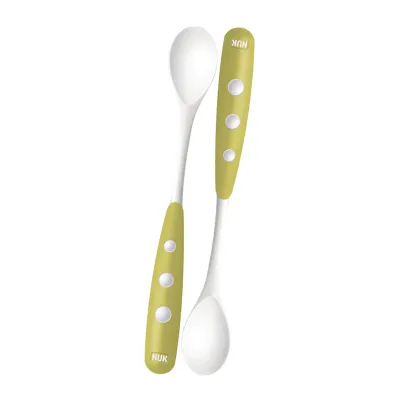
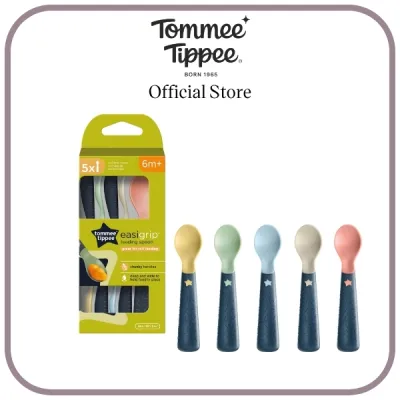
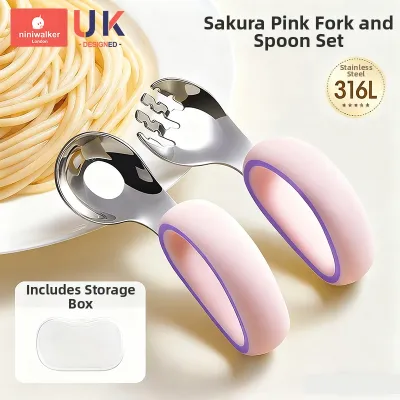
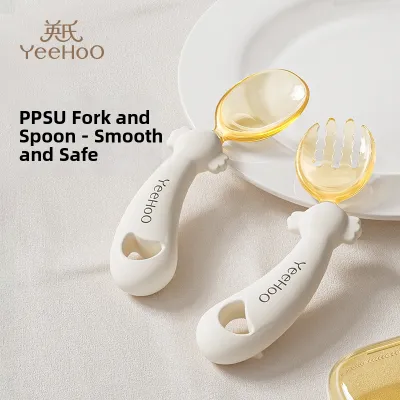
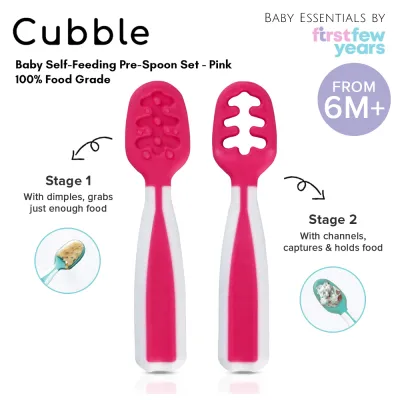
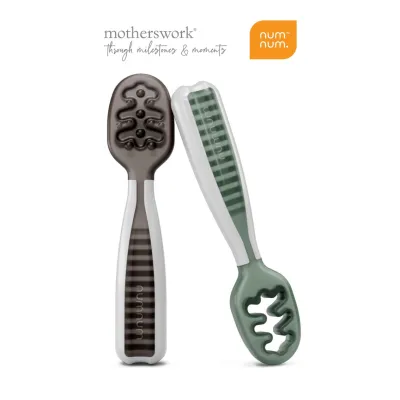

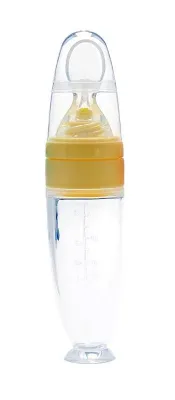
Prices are valid at publication and may change. Please refer to the product page for the latest price.
Stage 2 begins when your baby shows a strong desire for autonomy, usually between seven and nine months. You will notice them reaching out to grab your spoon, putting their hands directly into their food bowl, and bringing their fingers to their mouth. At this point, they use a palmar grasp, which means they clutch objects tightly inside their closed fist rather than using individual fingers, indicating they are ready for a spoon designed for self-feeding.
Stage 3 marks the transition to true independent eating, typically occurring around ten months and beyond. During this phase, your baby is refining their pincer grasp, allowing them to pick up small pieces of food using their thumb and index finger. They will attempt to scoop food independently and guide the spoon to their mouth with increasing accuracy, although spilling is still highly common as they perfect their wrist rotation.
Best Spoon Features for First Tastes and Purees (Around 6 Months)
During the initial phase of weaning, parent-led feeding is the standard approach, meaning you will be holding the utensil and controlling the portions. For this task, a spoon with a long, slender handle is highly practical. The extra length allows you to easily reach the bottom of deep commercial baby jars or tall homemade puree containers without getting sticky food all over your knuckles and fingers.

Furthermore, a long handle keeps your hand at a comfortable distance from your baby’s face, giving you an unobstructed view of their mouth and facial expressions. This clear line of sight is vital for reading your baby’s subtle feeding cues, such as a slight turn of the head or a slow swallow, helping you pace the meal safely and prevent overfeeding.
The design of the spoon’s bowl is equally critical during these first tastes. It must be exceptionally narrow and shallow to fit comfortably inside an infant’s tiny oral cavity. Because babies at this stage are transitioning from the deep sucking motion of bottle or breastfeeding, they cannot clear food from a deep spoon bowl. A shallow design ensures the puree slides off easily with minimal scraping against their sensitive upper lip.
Protecting your baby’s delicate oral tissues is paramount, making material selection a key consideration. Food-grade silicone is the ideal choice for early weaning spoons because of its soft, flexible nature. It bends easily and cushions the impact if your baby suddenly lunges forward or bites down hard, preventing painful bruising to their tender, toothless gums or newly erupting primary teeth.
Hygiene should also guide your purchase, so look for smooth, seamless designs. Spoons molded from a single piece of silicone are highly recommended because they lack joints, crevices, or seams where food residue and moisture can hide. Multi-part spoons made of plastic and silicone glued together can trap bacteria over time, making them difficult to sanitize thoroughly even with regular washing.
Best Spoon Features for Learning to Self-Feed (7 to 9 Months)
When your baby transitions to self-feeding, the physical design of the spoon must adapt to their developing grip. Because infants at this stage rely on a palmar grasp, they cannot comfortably hold or manipulate long, thin handles. Instead, look for self-feeding spoons with short, chunky, and rounded handles that fit naturally inside a small, tightly closed fist, allowing for better control and direction.
Safety is a major priority during this experimental phase, as babies lack the coordination to judge distance accurately. A common risk is that they will push the spoon too far into their mouth, triggering a strong gag reflex or causing minor throat injuries. To prevent this, select spoons equipped with built-in choke guards—wide, collar-like shields situated between the handle and the bowl that physically block over-insertion.
The materials used for self-feeding spoons must be exceptionally durable and resilient. During meals, your baby will treat the spoon as a teething toy, chewing on it to soothe sore gums, and will frequently drop or throw it onto the floor. The utensil must be robust enough to withstand this rough handling without cracking, chipping, or shedding small particles that could pose a choking hazard.
To help your baby maintain a secure hold despite messy, food-covered fingers, opt for handles with textured surfaces. Ridges, embossed patterns, or rubberized non-slip grips provide essential tactile feedback and prevent the spoon from slipping out of their grasp. This added stability reduces frustration, helping your baby build the hand-eye coordination required to guide food successfully from the bowl to their mouth.
Best Spoon Features for Independent Eating (10 Months and Beyond)
As your child approaches toddlerhood, their fine motor control becomes more precise, enabling them to transition from a fist-like grip to a finger-led grasp. Spoons designed for this stage should feature slightly longer, contoured handles that mimic adult utensils but remain scaled to toddler proportions. This ergonomic shape helps them transition toward standard eating habits while accommodating their growing hand size.
Many specialized toddler spoons feature an ergonomically angled neck. This design is highly beneficial because it compensates for a toddler’s limited wrist rotation. By angling the spoon bowl toward their face, the utensil ensures that food stays level and does not spill off the side as they lift it, making it much easier to scoop food from flat plates and shallow bowls.
With your child eating a wider variety of textures—including grains, small pasta, and soft cooked vegetables—the spoon material needs to be sturdier. While silicone remains useful, you can gradually introduce high-quality, BPA-free plastics or lightweight stainless steel spoons with rounded, blunt edges. These materials provide the structural rigidity required to cut through soft foods and scoop up heavier, denser textures without bending.
This developmental window is also the ideal time to introduce a matching baby fork to their mealtime routine. A suitable baby fork should feature short, blunt, and rounded tines that can easily pierce soft foods like steamed sweet potato or banana slices without posing a puncture risk to their mouth. Introducing a fork helps expand their motor skills and teaches them to adapt their grip to different food types.
Even as your child displays impressive confidence and feeds themselves independently, active caregiver supervision remains absolutely essential. Toddlers can still choke on inappropriately sized food portions, or they may attempt to walk or play while holding a utensil, which can lead to serious injuries. Always remain within arm’s reach, maintain a calm dining environment, and ensure your child remains seated throughout the meal.
Essential Safety and Material Checks Before You Buy
Before purchasing any baby feeding utensils, conducting a thorough safety and material check is vital for protecting your child’s health. Always examine the product packaging and manufacturer labels to verify that the materials are entirely free from harmful chemical compounds. Ensure the spoon is explicitly certified as BPA-free, PVC-free, and phthalate-free, as these industrial chemicals can leach into food and impact developmental health.
To ensure long-term hygiene and convenience, check whether the utensils are dishwasher-safe. If you plan to sterilize the spoons regularly, read the manufacturer’s care instructions to confirm if the materials can safely withstand boiling water, steam sterilizers, or ultraviolet (UV) sterilization systems. Some materials, particularly those with embedded color-changing dyes or mixed-material handles, can degrade or warp under high heat or intense UV light.
Before using any new spoon for the first time, and prior to every subsequent feeding session, perform a quick physical inspection. Run your fingers along the edges of the spoon bowl and handle to check for any sharp plastic flashing, rough manufacturing seams, or cracks. If the spoon consists of multiple joined parts, gently pull on the components to ensure they are securely bonded and will not detach during use.
Silicone and soft plastic spoons are subject to wear and tear, especially when used by teething infants. Inspect these utensils regularly under direct light for signs of degradation, such as deep bite marks, tears, peeling edges, or a sticky surface texture. If you detect any structural damage or compromise to the material, discard the utensil immediately and replace it to prevent your baby from swallowing loose pieces.
Frequently Asked Questions (FAQ)
Are heat-sensitive (color-changing) baby spoons necessary?
Heat-sensitive baby spoons are not strictly necessary, but they can serve as a helpful visual guide for caregivers. These utensils utilize thermochromic materials that change color when exposed to food that exceeds a safe feeding temperature. However, they are not a substitute for manual safety checks. You must always test the temperature of any puree or solid food on the inside of your wrist or lip before offering it to your baby to prevent accidental oral burns.
When should I introduce a baby fork alongside the spoon?
You can typically introduce a baby fork when your child has mastered the basic mechanics of using a spoon and shows an active interest in piercing solid foods, which usually occurs between 9 and 12 months. Choose a fork designed specifically for infants, featuring short, chunky handles and blunt, rounded tines. This design allows them to practice the stabbing motion safely without risking injury to their sensitive gums, lips, or eyes.
How do I clean and sterilize silicone baby spoons?
To clean silicone baby spoons, wash them thoroughly in warm, soapy water using a mild, unscented dishwashing liquid, or place them on the top rack of your dishwasher if the manufacturer’s label permits. For sterilization, always consult the specific product documentation first. While most food-grade silicone can withstand boiling or steam sterilization, excessive heat can degrade certain plastics or adhesives if the spoon features a multi-material handle.
Community discussion
Share your experience or ask a question. Comments are reviewed before publication.