
Monitoring your baby’s growth is one of the most reassuring parts of early parenthood. While regular check-ups at the maternal health clinic or pediatrician provide official milestones, having a reliable baby weighing scale at home offers peace of mind between appointments. This is especially true during the first few weeks of life when tracking feeding success and steady weight gain is top of mind for many parents.
However, choosing the right scale involves more than simply picking the first digital option you see on an online marketplace. Infant measurements require a level of precision and safety features that standard household scales cannot provide. To make an informed decision, you need to evaluate technical specifications, physical safety designs, and functional features that accommodate a wriggling infant.
By focusing on verified accuracy, movement-compensation technology, and practical design elements, you can select a home scale that provides consistent, reliable data. This guide outlines the essential features to look for, how to verify manufacturer claims, and how to integrate home tracking safely into your baby care routine.
Products mentioned in this guide
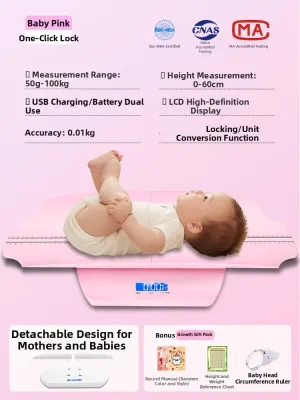
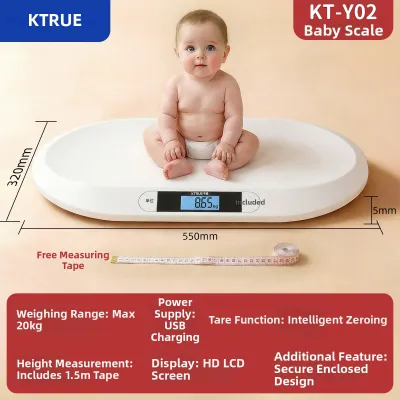

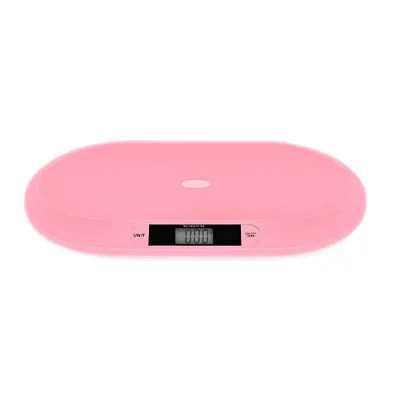
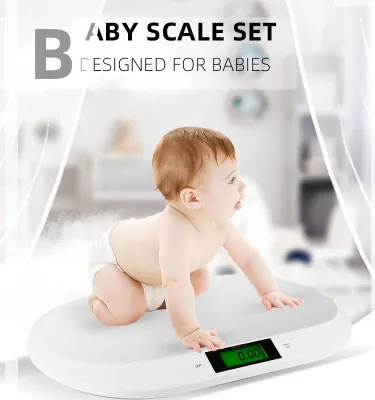

Prices are valid at publication and may change. Please refer to the product page for the latest price.
Understanding Accuracy and Precision for Infant Tracking
When tracking an infant’s growth, understanding the distinction between accuracy and precision is fundamental. Accuracy refers to how close the scale’s reading is to the baby’s actual weight, while precision (or resolution) refers to the smallest increment of weight the scale can display. For adults, a scale that measures in 100-gram increments is perfectly adequate, but for a newborn, a few grams can represent a significant portion of their daily intake or growth.
To track a newborn’s progress effectively, look for a scale that offers measurement increments of 5 grams or 10 grams. Scales with larger increments, such as 50 grams or 100 grams, are too coarse to capture the subtle changes associated with early feeding patterns. When reviewing product listings, always look for the “graduation” or “increment” specification rather than just the overall capacity.
Manufacturer specifications should also state the margin of error, which is the expected variance in the scale’s readings. A high-quality baby scale typically has a margin of error that matches its smallest increment size. Before purchasing, download the product’s official user manual from the manufacturer’s website to verify these technical details, as marketing summaries on retail sites can sometimes conflate overall capacity with actual measurement precision.
Calibration is another critical factor in maintaining accuracy over time. Some digital scales feature automatic calibration, which resets the sensors to zero every time the scale is turned on. Others may require manual calibration using a certified calibration weight. If you choose a model that requires manual calibration, ensure the instructions are straightforward and that any necessary calibration weights are either included or easily obtainable.
Once you have set up your scale at home, you can verify its consistency and accuracy using a simple reference test. Find an object with a known, stable weight, such as an unopened one-kilogram bag of flour or a calibrated hand weight. Place the object on the scale several times in succession, ensuring it is positioned in the center of the tray each time. The scale should display the exact same reading for every trial; any fluctuation indicates a lack of consistency, which could compromise your tracking data.
Essential Functions for Weighing a Moving Baby
Weighing a newborn or an active infant is rarely a static process. Babies naturally kick, wriggle, and shift their weight, which can cause the numbers on a standard digital screen to fluctuate wildly. To counter this, specialized baby weighing scales incorporate specific software functions designed to deliver a stable reading despite constant movement.

The first essential feature to look for is the Tare function. This function allows you to place a soft blanket, a towel, or even a clean diaper on the scale tray, and then reset the display to zero before placing your baby down. This is crucial for both comfort and hygiene, as it prevents you from having to lay your bare baby directly onto a cold plastic surface. By subtracting the weight of the bedding automatically, the Tare function ensures you obtain an accurate measurement of your baby alone without performing manual mental math.
The second vital feature is the Hold function, which is specifically engineered to handle a moving baby. When activated, the scale’s internal software takes multiple rapid readings over a short period, filters out the spikes caused by sudden movements, and calculates an average weight. The scale then “locks” this calculated weight on the digital display, allowing you to read it clearly even if your baby continues to move. Some scales offer an automatic hold function that locks the weight after a few seconds of stability, while others require you to press a physical button when the baby is relatively still.
Ergonomic tray design is equally important for both safety and ease of use. The weighing tray should feature a gently curved, contoured shape that cradles the baby securely, preventing them from rolling toward the edges. Look for trays made from smooth, non-porous materials that are easy to wipe down with mild, baby-safe sanitizing wipes. Some models feature a removable tray, which allows you to detach the infant cradle entirely once your child grows, transforming the device into a flat step-on scale suitable for toddlers.
Finally, consider the scale’s unit conversion capabilities. Depending on your pediatrician’s preferences and your own comfort level, you may need to switch between kilograms (kg), grams (g), pounds (lb), and ounces (oz). In Singapore, healthcare professionals and maternal clinics almost exclusively use the metric system for medical records. Choosing a scale that allows you to lock the display to kilograms and grams prevents confusion and ensures your home records align perfectly with your child’s official health booklet.
Physical Design, Safety, and Comfort Checks
The physical construction of a baby scale directly impacts both the safety of your infant and the longevity of the device. Because you will be placing a vulnerable, often unclothed baby onto the scale, every physical detail must be evaluated with safety as the primary priority.
Begin by examining the materials used in the scale’s construction. The weighing tray should be made from high-quality, impact-resistant plastic with completely smooth, rounded edges. There should be no sharp seams, rough plastic molding leftovers, or exposed battery compartments on the upper surface. Check the manufacturer’s product documentation for claims regarding non-toxic, BPA-free materials, and verify these details to ensure the surface is safe for direct skin contact.
Stability is another non-negotiable safety factor. A baby scale must have a low profile, meaning it sits close to the surface on which it is placed, giving it a low center of gravity. This design minimizes the risk of the scale tipping over if the baby shifts weight to one side. Flip the scale over to inspect the base; it should be equipped with wide, robust, non-slip rubber feet. These feet must grip flat surfaces securely to prevent the scale from sliding or shifting during use.
Always place the scale on a firm, flat, and level surface, such as a sturdy dining table, a low chest of drawers, or even a clean, hard floor. Never place a baby scale on a soft surface like a bed, carpet, or sofa, as this not only compromises the accuracy of the weight sensors but also creates a significant fall hazard. Keep one hand hovering safely just above your baby at all times during the weighing process to prevent any accidental falls.
Additionally, check the scale’s maximum weight capacity to understand its long-term utility. Most dedicated baby scales support weights up to 20 kilograms, which typically covers the toddler years. Understanding this limit helps you plan for the transition to a standard adult scale. Once your child can stand completely steadily on their own without assistance, and their weight exceeds the scale’s precise tracking range, it is time to transition them to a standard household scale.
Smart Connectivity vs. Traditional Digital Displays
As smart home technology continues to expand, parents must decide between a traditional digital baby scale and a smart scale equipped with wireless connectivity. Both options have distinct advantages, and the right choice depends on your tracking needs, budget, and comfort with digital applications.
Traditional digital scales feature a straightforward, built-in LCD or LED screen that displays the weight immediately. To track your baby’s growth over time with a traditional scale, you must manually record the numbers in a physical notebook, a spreadsheet, or a manual baby-tracking app. This approach is highly reliable, requires no software updates, and does not depend on a stable wireless connection. It is often the most cost-effective choice for parents who simply want to perform occasional spot checks.
In contrast, smart baby scales utilize Bluetooth or Wi-Fi to automatically sync weight data to a companion smartphone application. Every time you weigh your baby, the reading is sent to the app, which automatically plots the data points on a growth chart. This automated tracking can be incredibly convenient for parents who want a visual representation of their baby’s growth trends without the hassle of manual data entry. It also makes it easy to share clear, organized charts with your pediatrician during routine consultations.
However, smart connectivity introduces important data privacy considerations. Because these companion apps collect and store sensitive infant health data, parents must exercise caution. Before downloading a companion app, review the developer’s privacy policy and terms of service. Verify where the data is stored, whether the company shares or sells user data to third-party advertisers, and if you have the option to delete your account and data permanently. If an app requires excessive permissions—such as access to your contacts, location, or personal photos—it may be safer to opt for a traditional digital scale.
Ultimately, a simple, clear digital display with large, backlit numbers is more than sufficient for the vast majority of families. If you do choose a smart scale, ensure that the device can still function as a standalone scale without requiring the app to be open. This ensures that even if you experience connectivity issues, app crashes, or software compatibility problems after a phone update, you can still obtain an accurate weight reading when you need it.
Building Your Shortlist and Verifying Specifications
When you are ready to purchase a baby weighing scale, creating a structured shortlist will help you cut through marketing hype and focus on verified performance. Do not rely solely on the bullet points listed on online marketplace pages, as these can sometimes contain generalized or unverified claims.
Start by cross-referencing product marketing labels with the detailed user manual. You can usually find the PDF version of the manual on the manufacturer’s official website. Verify the exact increment size (aiming for 5g or 10g), the power source (such as standard AAA batteries or a rechargeable lithium-ion battery), and the physical dimensions of the tray to ensure it will fit comfortably in your designated home space.
Next, evaluate the warranty coverage and customer support options available in Singapore. Electronic health monitors contain sensitive load cells that can be damaged during shipping or experience calibration drift over time. Purchasing from a brand with an established local distributor or a clear local warranty process ensures that if you receive a defective unit or experience a technical failure, you can easily obtain a replacement or repair without paying high international shipping fees. Look for warranties that cover manufacturing defects for at least twelve months.
Finally, establish clear safety and operational boundaries for using your scale. Stop using the device immediately if you notice any physical damage, such as cracks in the plastic tray, loose battery compartment covers, or if the scale begins displaying highly inconsistent readings that vary by more than 50 grams within a few minutes. Remember that a home baby scale is a supportive tracking tool, not a diagnostic medical device. If you have any concerns about your baby’s feeding, growth rate, or overall health, always prioritize the advice and assessments of a qualified pediatrician or maternal health professional.
Frequently Asked Questions (FAQ)
How often should I weigh my baby at home?
You should always consult your pediatrician or maternal health visitor to establish a personalized weighing schedule tailored to your baby’s specific health needs. For a healthy, full-term infant who is feeding well and meeting developmental milestones, daily weighing is generally unnecessary and is often discouraged by medical professionals. Infant weight naturally fluctuates throughout the day based on feeding times, bowel movements, and hydration levels. Weighing too frequently can lead to unnecessary parental anxiety and stress; in most cases, a weekly or bi-weekly check is more than enough to monitor long-term growth trends.
Can I use a regular adult scale to weigh my baby?
Using a standard adult scale to weigh an infant is not recommended due to significant limitations in accuracy and safety. Adult scales are designed to measure much larger weights and typically have measurement increments of 100 grams or more, which are far too large to detect the subtle weight changes of a newborn. The common method of weighing yourself, then weighing yourself while holding the baby and subtracting the difference, introduces a very high margin of error. Additionally, adult scales lack the protective, contoured tray design of a dedicated baby scale, creating a serious physical safety risk if an active baby shifts or slips while you are trying to balance them.
Community discussion
Share your experience or ask a question. Comments are reviewed before publication.