
Tracking your baby’s growth is one of the most reassuring parts of early parenthood. While regular visits to Singapore polyclinics or private pediatric clinics provide official growth milestones, having a reliable baby scale at home offers peace of mind between appointments. To choose the right baby scale, focus on three essential features: reliable accuracy, a tare function to subtract the weight of blankets, and an ergonomic, contoured tray that keeps your little one secure. Home scales are designed for general growth tracking and should never replace professional medical evaluations.
Quick Guide to Baby Scale Specs
When shopping for a home baby scale, the sheer number of technical specifications can feel overwhelming. However, you only need to focus on a few core features to make an informed purchase. Prioritize a scale with reliable accuracy (usually measured in graduation increments), a functional tare feature, and an ergonomic tray. A tare function allows you to zero out the weight of a diaper or swaddle, while a contoured tray ensures your baby remains safely positioned. Keep in mind that home monitoring is meant to track general growth trends over time for your peace of mind, not to make medical diagnoses or replace clinical check-ups.
Measurement Specs: Accuracy, Capacity, and Units
Understanding the numerical specifications on a product box or online listing helps you evaluate whether a scale will meet your daily tracking needs and last throughout your child’s early years.
Products mentioned in this guide
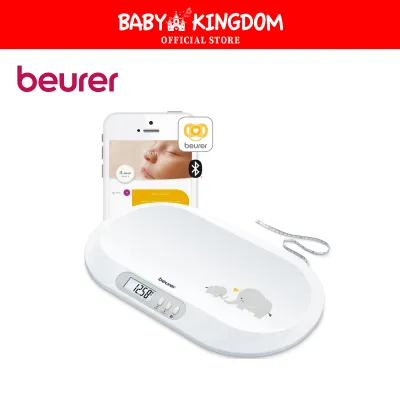
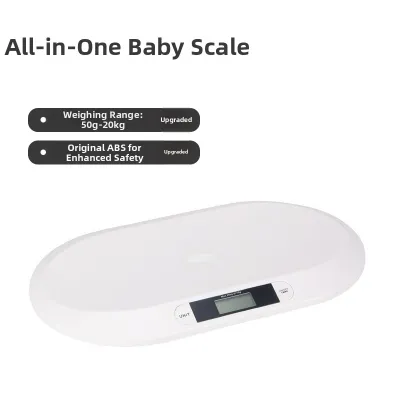
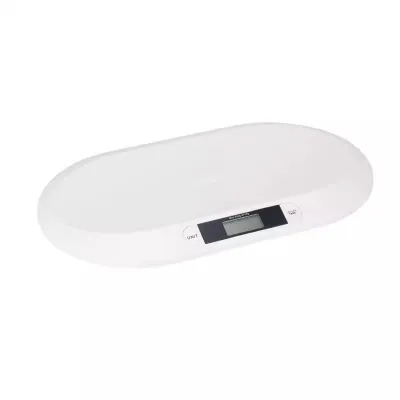
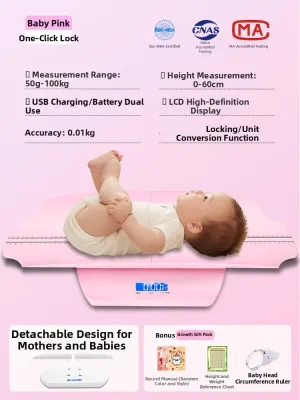
Prices are valid at publication and may change. Please refer to the product page for the latest price.

Accuracy and Graduation
The term “graduation” refers to the smallest increment of weight change that a digital scale can detect and display. For home use, look for a scale with a graduation of 5 grams to 10 grams. This level of precision is more than sufficient to monitor standard newborn growth and feeding progress. While medical-grade scales used in hospitals offer 1-gram precision, these specialized devices usually come at a significant price premium and are unnecessary for typical home monitoring. When tracking growth at home, consistency in weighing conditions is far more important than ultra-precise clinical increments.
Maximum Weight Capacity and Limits
Most dedicated baby scales feature a maximum weight capacity of around 20 kilograms. This limit generally dictates the usable lifespan of the device. Once your baby exceeds this weight threshold, becomes highly active, or can sit and stand independently, it is time to transition to a standard toddler or bathroom scale. Before buying, also check the scale’s minimum weight threshold. This specification ensures the device can accurately register the weight of very small or premature newborns, who require precise tracking in their first few weeks of life.
Design Features for Comfort and Safety
A scale’s physical design directly impacts how safe and comfortable your baby feels during weigh-ins, as well as how easy the device is for you to operate.
Tray Design and Ergonomics
An ergonomic tray is essential for keeping a squirming infant safe. Look for curved, contoured trays with raised sides that naturally help keep your baby secure and centered on the platform. Some models feature removable trays, which offer two distinct advantages: they are much easier to clean and sanitize, and removing the tray often reveals a flat standing platform underneath. This design allows you to continue using the scale as a toddler standing scale as your child grows, maximizing your investment. Always inspect the tray for smooth, rounded edges and non-slip surfaces or feet to prevent the scale from sliding on your tabletop. Before use, always consult the manufacturer’s instructions for weight limits and safety guidelines.
Tare Function and Hold Feature
Two digital features are absolutely non-negotiable for real-world home weighing:
- Tare Function: This allows you to place a blanket, towel, or clean diaper on the scale, press a button to reset the display to zero, and then weigh your baby. This ensures your baby stays warm on a soft surface without the extra material skewing the measurement.
- Hold Feature: Babies rarely lie completely still. A hold feature automatically or manually locks the weight reading on the digital display the moment the scale detects a stable second, ignoring the constant movement and wiggling.
Without these two functions, obtaining an accurate, stress-free reading is incredibly difficult.
Smart Connectivity: Do You Need an App-Connected Scale?
Modern baby scales often come equipped with Bluetooth or Wi-Fi connectivity, allowing them to sync data directly to a smartphone application. These apps automatically log each weigh-in, plot the data points on digital growth charts, and track trends over time. While this smart connectivity offers a high level of convenience for parents who love digital tracking, it does come with trade-offs. Smart scales require a stable wireless connection, regular app updates, and a consideration of data privacy policies regarding your child’s medical information. If you prefer a simpler approach, a basic digital scale is perfectly adequate. You can easily log weights manually in a physical baby book, a simple spreadsheet, or a free tracking app, or simply rely on the official records kept by your pediatrician during routine developmental assessments.
Which Specs Actually Matter for Your Needs?
To make the best purchasing decision without overspending, it helps to know which features to prioritize and which ones you can safely ignore.
Prioritize these essential features:
- Hold function: Crucial for locking in readings when your baby wiggles.
- Tare function: Essential for zeroing out blankets or diapers.
- Contoured tray: Keeps your baby safe, centered, and comfortable.
- Clear digital display: A large, backlit LCD screen makes it easy to read numbers quickly in dim lighting.
Deprioritize or ignore these extra features:
- Ultra-high medical precision (1g): Unnecessary for home tracking and adds significant cost.
- Built-in height or length measurers: These are often awkward to use on a squirming baby and yield highly inaccurate results compared to a flat measuring mat.
- Excessive multi-user profiles: Unless you are tracking multiple infants simultaneously, complex profile systems add unnecessary navigation steps to the scale's interface.
Frequently Asked Questions (FAQ)
Can I use a regular bathroom scale for my baby?
Standard bathroom scales are not suitable for infants because they lack the necessary precision, typically measuring only in 100-gram increments. This makes it impossible to track the small, critical weight changes of a newborn. Furthermore, bathroom scales do not provide a safe, contoured surface for a lying infant. The common alternative method—weighing yourself first, then weighing yourself while holding your baby and subtracting the difference—is highly inaccurate due to a large margin of error and should not be used for tracking infant growth.
How often should I weigh my baby at home?
Daily weighing is rarely necessary and can cause unnecessary parental anxiety, as an infant’s weight naturally fluctuates throughout the day based on feeding and wet diapers. For healthy, term infants, weighing once a week or even once every two weeks is generally sufficient to monitor steady growth trends. Always consult your pediatrician or a qualified healthcare professional to establish a personalized monitoring schedule tailored to your baby’s specific health and developmental needs.
Community discussion
Share your experience or ask a question. Comments are reviewed before publication.