
Determining the absolute “drier” diaper between Drypers SuperDry Tape M and Huggies Tape M requires observing your baby’s unique physiology, as independent, climate-specific lab results for current batches are unavailable. In Singapore’s persistently high humidity, which frequently exceeds 80 percent, a diaper’s ability to manage moisture is not just a matter of total capacity, but also of how quickly it draws wetness away from the skin and how effectively it allows heat to escape. This guide provides a practical framework to compare their structural designs, breathability features, and physical fit, helping you make an informed choice for managing moisture and leaks in a tropical climate.
Every baby has a distinct body shape, urination pattern, and skin sensitivity level, meaning a diaper that keeps one infant perfectly dry might cause leaks or irritation on another. By understanding the design differences between these two prominent brands, you can better interpret your baby’s physical reactions and optimize their diapering routine. Rather than relying on universal performance claims, the key to maintaining skin integrity lies in matching the diaper’s specific structural attributes to your baby’s daily movement and growth stages.
Core Absorbent Structures and Moisture Management
To understand how Drypers SuperDry Tape M and Huggies Tape M handle wetness, it is essential to look at their core construction. Both brands design their diapers with a multi-layered system consisting of a top-sheet, an acquisition distribution layer (ADL), and a core containing superabsorbent polymers (SAP) mixed with wood pulp. The top-sheet is the immediate contact layer, designed to let liquid pass through quickly while remaining dry to the touch. The ADL then distributes the liquid evenly along the length of the diaper, preventing it from pooling in a single spot, while the SAP locks the moisture into a gel format to prevent rewetting when the baby sits or rolls.
Products mentioned in this guide
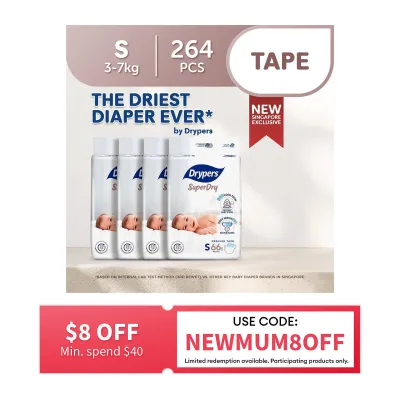
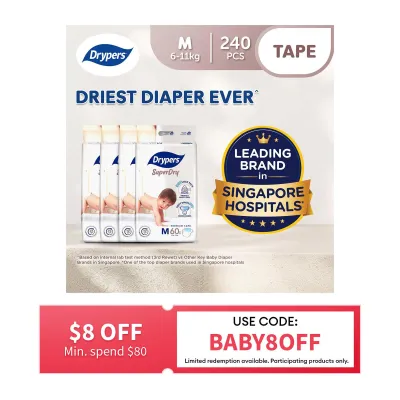
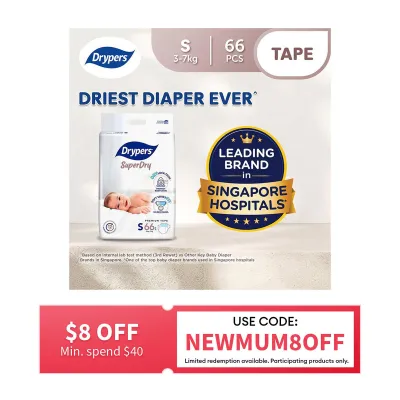
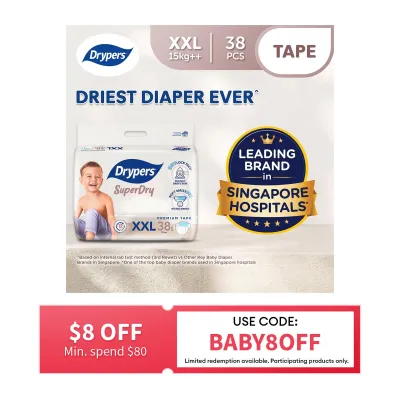
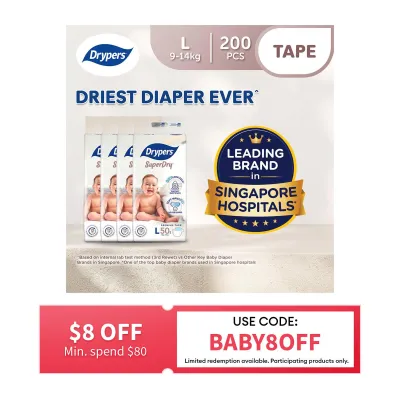
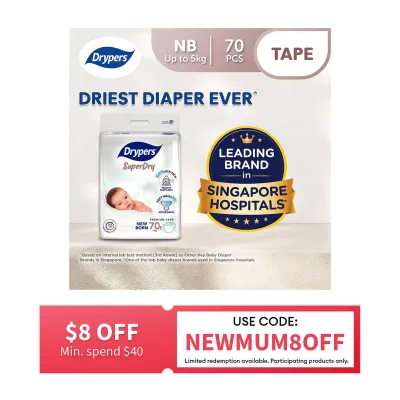
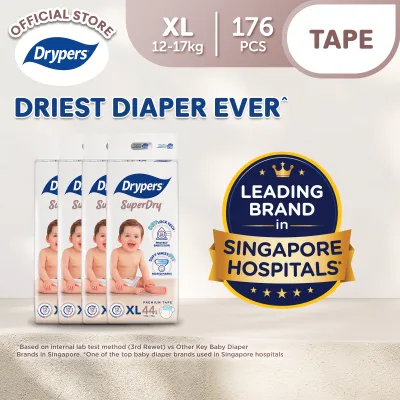
Prices are valid at publication and may change. Please refer to the product page for the latest price.
On the packaging, manufacturers often highlight proprietary terms for these layers, such as specialized channels or rapid-draw top-sheets. These features are designed to accelerate the speed at which urine is drawn away from the surface. However, in a humid environment like Singapore, the rate of evaporation from the diaper’s outer layers is significantly slowed. This means that even the most advanced absorbent core can become saturated and feel damp on the outside if the diaper is not changed regularly. The speed of absorption is highly dependent on the volume of a single urination and the frequency of wetting.
Because material names and marketing terms do not guarantee absolute dryness, parents must perform physical checks during use. A simple way to evaluate moisture management at home is to gently press a dry, clean paper towel against the inside of a moderately wet diaper during a change. If the paper towel remains dry, the core is successfully locking away moisture under pressure. If the paper towel dampens, it indicates that the core has reached its effective dryness limit for your baby’s current output, signaling that a more frequent changing schedule or a different core structure may be required.
Breathability and Skin Comfort in Humid Weather
In tropical climates, heat and humidity can easily build up inside a diaper, creating a microclimate that increases the risk of diaper rash and skin friction. To combat this, both Drypers and Huggies incorporate breathable backsheets into their tape diaper designs. These backsheets are typically made of non-woven materials laminated with a micro-porous film. These microscopic pores are large enough to allow water vapor and heat to escape, but small enough to prevent liquid water molecules from leaking through. You can often identify these features on packaging by looking for terms indicating air circulation or vapor-permeable outer covers.

Beyond the backsheet, the flexibility and thickness of the waistband and leg cuffs play a critical role in overall breathability. A thicker waistband may offer structural stability, but it can also trap sweat around the baby’s lower back and abdomen, leading to heat rash. Conversely, a thinner, highly elastic waistband allows for better airflow but must be checked to ensure it does not fold over or bunch up, which can concentrate moisture against the skin. The leg cuffs must also balance elasticity with softness; tight, non-breathable elastics can trap moisture in the groin creases, leading to chafing and redness.
Parents should actively monitor their baby’s skin for observable signs of heat trapping. If you notice excessive sweating under the waistband, localized redness along the leg elastics, or small pink bumps indicative of heat rash, the current diaper may not be providing sufficient ventilation for your baby’s activity level. In such cases, adjusting the room temperature, allowing for brief periods of diaper-free time during changes, or switching to a diaper with a lighter, more porous outer material can help restore skin comfort.
Fit, Sizing, and Leak Prevention
Even the most absorbent diaper will leak if the physical fit is incorrect. Drypers SuperDry Tape M and Huggies Tape M feature distinct cuts and shapes that suit different infant builds. Some diapers are designed with a narrower crotch area and longer rise, which can be beneficial for taller, leaner babies. Others feature a wider chassis and more generous hip coverage, which typically suits rounder, more robust babies. The elasticity of the fastening tapes and the landing zone also vary, affecting how securely the diaper can be anchored without restricting movement.
To ensure a proper fit and prevent leaks, parents can use several reliable physical checks during fastening:
- The Two-Finger Rule: Once the tape diaper is fastened, you should be able to easily slide two fingers between the diaper waistband and your baby's stomach. If it feels tighter, the diaper may restrict breathing and digestion; if looser, liquid can easily escape from the back.
- The Leg Cuff Flare: Always run your finger around the inner and outer leg ruffles after fastening. The ruffles must be fully flared outward. If they are tucked inward, they will act as a funnel, leading to immediate side leaks.
- Symmetrical Tape Placement: Use the numbered guides on the front landing zone to ensure the tapes are fastened symmetrically. Uneven fastening skews the diaper's alignment, creating gaps at the thighs.
It is a common misconception that leaks are solely caused by a diaper’s absorbency limits. In many cases, persistent leaks in a size M diaper indicate that the baby is transitioning between sizes. If your baby is approaching the upper weight limit recommended by the manufacturer, or if you notice the diaper sagging quickly even when not fully wet, it may be time to transition to size L. Conversely, if the diaper is too large, gaps around the legs will inevitably cause leaks, regardless of the brand’s absorbency technology.
Value Assessment and Purchasing Guidelines
When managing a household budget in Singapore, calculating the true cost of diapering requires looking beyond the retail price of a single pack. Because pack counts vary between brands and sizes, the most accurate metric is the cost per individual piece. You can easily calculate this using a simple formula:
Cost per piece = Pack Price (S$) / Number of Pieces in Pack
By tracking this cost, you can make objective comparisons when shopping across different retailers, pharmacies, or online marketplaces. While bulk-purchasing large quantities of diapers can offer significant savings, it is highly advisable to avoid buying multiple cartons of a single brand or size before confirming that the diaper fits your baby well and does not cause skin irritation. Babies grow rapidly, and a sudden growth spurt or skin sensitivity can leave you with unusable stock.
When purchasing diapers, always verify the integrity of the product. Check that the packaging seal is completely intact to prevent humidity and dust from entering the pack during storage. It is also wise to inspect the manufacturing or batch codes printed on the packaging to ensure you are receiving fresh stock. Buying from official brand stores, established local supermarkets, or reputable pharmacies helps ensure that the products have been transported and stored in temperature-controlled environments, preserving the adhesive quality of the tapes and the integrity of the absorbent core.
Decision Framework: Which Diaper Suits Your Baby?
Selecting the right diaper involves matching the specific design characteristics of each brand to your baby’s physical needs and daily routine. Because there is no universal winner, parents can use the following conditional framework to guide their choice:
- Consider Drypers SuperDry Tape M if your baby has a body shape that aligns well with its specific cut, and you observe consistent skin dryness and minimal sagging during their typical wear cycle. This option is often suitable for parents who prefer a structured fit that holds its shape well during active daytime play.
- Consider Huggies Tape M if your baby requires a highly flexible waistband and leg cuff design to accommodate active crawling or rolling. This profile is often preferred if your baby's body shape requires a more contoured, snug fit around the thighs and waist to prevent gaps.
If you experience persistent leaks with either brand, first verify that the sizing is correct and that the tapes are fastened symmetrically with the leg cuffs fully flared. Often, adjusting the fastening technique or moving up a size resolves the issue without needing to switch brands entirely. However, if your baby develops persistent diaper rash, severe redness, or frequent blowouts despite correct sizing and frequent changes, stop using the diaper and consult a pediatrician or qualified healthcare professional to rule out skin infections or allergies.
Frequently Asked Questions (FAQ)
How often should I change a size M tape diaper in a humid climate?
In Singapore’s humid climate, changing intervals should be determined by your baby’s fluid intake, output, and skin sensitivity rather than relying solely on the diaper’s maximum capacity. As a general guideline, it is highly recommended to check the diaper every 2 to 3 hours during the day. You should change the diaper immediately following any bowel movement to prevent stool enzymes and ammonia from irritating the skin, which can rapidly lead to diaper dermatitis in warm, moist conditions.
Can I use diaper barrier cream with both Drypers and Huggies tape diapers?
Yes, standard zinc oxide or petroleum-based barrier creams are fully compatible with both Drypers and Huggies tape diapers. To ensure the cream does not interfere with the diaper’s performance, apply a thin, even layer to your baby’s clean, dry skin and allow it to absorb slightly before fastening the diaper. Applying an excessively thick layer of cream can transfer to the diaper’s top-sheet, creating a hydrophobic barrier that slows down the absorption speed of urine.
Community discussion
Share your experience or ask a question. Comments are reviewed before publication.