
Quick Answer: Matching Your Stokke Mattress to Your Crib Setup
When shopping for a baby mattress, many parents expect to choose between different comfort levels, such as soft, medium, or firm. However, infant sleep safety requires a different approach. All genuine Stokke baby mattresses are engineered to meet strict global safety standards that mandate a highly firm, unyielding surface. Therefore, your primary decision is not selecting a custom firmness level, but rather matching the mattress design to the exact shape, size, and manufacturing year of your specific Stokke crib.
To make the right choice, use this quick conditional framework:
- If you own an oval Stokke Sleepi crib: You must purchase the corresponding oval Stokke Sleepi mattress. Standard rectangular mattresses will not fit and will leave dangerous gaps.
- If you own a standard rectangular Stokke crib (such as historical or regional models like the Stokke Home): You must purchase the dedicated rectangular mattress designed specifically for that frame.
Before finalizing your purchase, always verify your crib’s exact model name and manufacturing year. Stokke updated its Sleepi range in late 2022 (often referred to as V3), and the dimensions of these newer models differ slightly from older versions (V2). Using a mattress from one generation in a crib from another can create unsafe spaces between the mattress edge and the crib frame.
Products mentioned in this guide
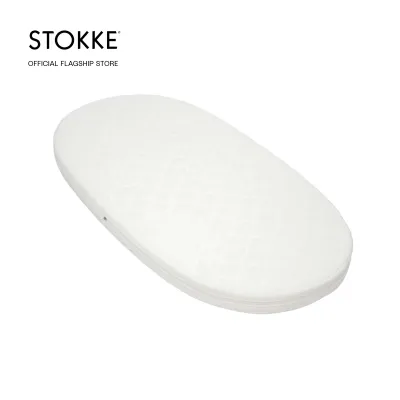
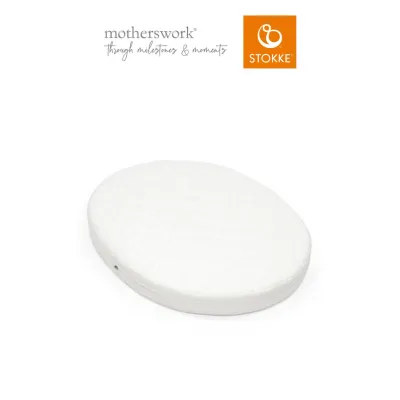
Prices are valid at publication and may change. Please refer to the product page for the latest price.
Why Firmness and Support Are Non-Negotiable for Baby Safety
Understanding why infant mattresses feel remarkably hard compared to adult beds is essential for every parent. A baby’s skeletal system is rapidly developing, consisting largely of soft, flexible cartilage that requires consistent, flat resistance to grow correctly. A soft mattress that conforms to the body does not provide the structural support needed for healthy spinal alignment during sleep.

Beyond bone development, firmness is a critical safety measure to reduce the risk of Sudden Infant Death Syndrome (SIDS) and accidental suffocation. When an infant sleeps on a surface that is too soft, the material can indent under the baby’s weight. If the baby rolls onto their stomach, a soft surface can conform to their face, blocking their nose and mouth and creating a pocket of exhaled carbon dioxide. A firm surface ensures that even if a baby rolls over, their airway remains unobstructed.
Parents often worry that a firm mattress will be uncomfortable for their newborn. However, infants do not experience mattress firmness the way adults do. Because babies are lightweight, they do not sink into a mattress, meaning a firm surface provides a comfortable, stable base. Additionally, a firm mattress provides the necessary resistance when babies begin pushing up, rolling over, and crawling, helping them develop motor skills safely.
When evaluating any mattress, rely on official pediatric guidelines, such as those from the American Academy of Pediatrics or local health authorities, which consistently recommend a flat, firm sleep surface free of soft bedding, toppers, or positioners. Never add aftermarket mattress pads or soft overlays to make a baby mattress feel softer, as doing so directly compromises sleep safety.
Comparing Stokke Mattress Designs by Crib Type
Stokke designs its mattresses to integrate seamlessly with its proprietary wooden frames. Because the brand prioritizes specific structural fits, the internal core materials and dimensions are tailored to the unique geometry of each bed.
The table below outlines the primary design categories and key specifications you must verify when comparing options:
| Crib Type | Mattress Shape | Core Material Types to Verify | Primary Safety Focus | Fit Requirement |
|---|---|---|---|---|
| Stokke Sleepi Mini | Compact Oval | Breathable 3D fiber or high-resilience foam | Zero gaps along curved edges | Exact match for Mini frame |
| Stokke Sleepi Bed | Standard Oval | Breathable 3D fiber or high-resilience foam | Spinal support for growing toddlers | Exact match for Bed frame |
| Stokke Rectangular | Classic Rectangle | High-resilience foam or polyester fiber | Edge-to-edge support | No corner or side gaps |
Mattresses for Oval and Convertible Cribs
Stokke’s signature oval cribs, including the Sleepi Mini and the Sleepi Bed, require highly specialized mattresses. The curved edges of these beds mean that standard, mass-market rectangular mattresses cannot be used under any circumstances. The mattress must match the curved contours of the wooden frame perfectly to prevent dangerous gaps where a baby’s head or limbs could become trapped.
The Sleepi system is designed to grow with your child, converting from a compact bassinet (the Mini) into a full-sized crib (the Sleepi Bed) using extension kits. When you transition your crib using an extension pack, you must also upgrade the mattress. You cannot safely piece together multiple small mattress sections to fill the extended frame; instead, you must transition to the single, continuous mattress designed for the larger bed size.
For the latest oval models, Stokke utilizes advanced core designs, such as breathable 3D mesh and high-resilience polyester fibers, which allow for maximum airflow while maintaining a flat, supportive surface. Always check the official product documentation to verify the exact core material, thickness, and cover features of the specific model available in your region, as specifications can vary.
Mattresses for Standard Rectangular Cribs
While Stokke is famous for its oval furniture, the brand has also produced classic rectangular designs, such as the Stokke Home bed. These models require standard rectangular mattresses engineered to provide uniform support across a larger, flat surface area.
Rectangular mattresses must feature robust edge support to ensure the mattress does not sag or compress when the baby moves near the wooden rails. This is particularly important as toddlers grow and begin standing or walking along the perimeter of the bed.
When choosing a rectangular mattress, verify the official dimensions against your crib frame’s interior measurements. Even among rectangular cribs, minor variations in length and width can exist between different brands and models. Ensure the mattress thickness complies with the safety warnings printed on the crib frame, which indicate the maximum allowable height to prevent a climbing child from falling over the rails.
Essential Specs to Verify for Fit, Breathability, and Care
Before purchasing a Stokke mattress, compile a checklist of physical specifications to verify. This ensures the product is safe, hygienic, and compatible with your home setup.
- Exact Dimensions and Generation Compatibility: Carefully check whether your crib is a V2 (manufactured before late 2022) or a V3 (manufactured from late 2022 onward). The V3 Sleepi Bed mattress is slightly different in size compared to the V2 version. Mixing these generations can leave gaps wider than safety limits allow.
- Cover Breathability: Look for multi-layered covers featuring 3D mesh fabrics. In warm, humid climates like Singapore, high breathability is essential to prevent heat retention, keep your baby cool, and reduce sweat accumulation.
- Cover Tautness: Inspect how tightly the cover fits over the mattress core. The cover must fit snugly without any loose fabric, bunching, or wrinkling, as loose material can pose a suffocation risk.
- Washability and Care: Infant mattresses will inevitably encounter spills, diaper leaks, and spit-up. Verify that the mattress cover is fully removable and machine washable. Check the manufacturer's care label for the recommended washing temperature to ensure effective sanitization.
- Core Composition: Check whether the core is made of high-resilience polyurethane foam or a fully washable 3D polyester fiber. Some modern cores can actually be rinsed in the shower, which is a major advantage for deep cleaning.
Avoid choosing a mattress based solely on marketing terms like “organic” or “hypoallergenic” without reading the actual material composition list. Always prioritize physical safety specifications, such as firmness and precise fit, over promotional claims.
How to Test Mattress Firmness and Fit at Home
Once your new Stokke mattress arrives, do not place your baby on it immediately. Perform these simple, physical safety checks in your home to confirm that the mattress is safe for sleep.
The Two-Finger Test
Place the mattress inside the assembled crib frame. Try to slide your index and middle fingers between the outer edge of the mattress and the wooden rails of the crib. If you can easily fit more than two fingers into the gap at any point around the perimeter, the mattress is too small for the frame. This gap poses a severe entrapment hazard, and you must stop using the setup immediately.
The Hand Press Test
To verify that the mattress provides adequate firmness, place your hand flat in the center of the mattress. Press down firmly with your body weight, then lift your hand quickly. The mattress should immediately snap back to its original, completely flat surface. If your hand leaves a temporary indentation, or if the material feels soft and slow to recover, the mattress does not offer the safe level of firmness required for an infant.
Visual and Physical Inspection
Examine the entire mattress under good lighting. Check all seams to ensure there are no loose threads or split stitching. Ensure the zipper is fully closed and that the zipper tab is tucked away into its protective fabric pocket so your baby cannot reach or play with it. Run your hand across the surface to check for any uneven lumps, sagging areas, or loose fabric.
If the mattress fails any of these checks, or if you notice any physical defects, do not use it. Contact the retailer or the manufacturer’s customer service department immediately to arrange for a replacement or verification.
Frequently Asked Questions (FAQ)
Can I use a non-Stokke mattress in a Stokke crib?
Using a third-party mattress in a Stokke crib is highly discouraged, especially for oval models like the Sleepi. Because of the unique curved geometry of the Sleepi frame, aftermarket mattresses rarely fit perfectly, often leaving dangerous gaps that can trap an infant. Additionally, using a non-Stokke mattress may void your crib’s manufacturer warranty and compromise compliance with official safety certifications. Always prioritize your baby’s safety by using the matching, manufacturer-approved mattress.
When should I flip or rotate my Stokke baby mattress?
Always consult the specific care label attached to your mattress model. Many modern baby mattresses are designed with a single-sided construction, meaning they have a specific top sleep surface (often featuring breathable 3D mesh) and a different bottom layer. These mattresses should never be flipped upside down. However, you should rotate the mattress 180 degrees (switching the head and foot ends) every two to three months to ensure even wear and maintain consistent support over time.
How do I clean and dry a Stokke mattress cover?
To clean your mattress cover safely, unzip it and remove it from the core. Wash it according to the specific temperature and cycle instructions on the care label, using a mild, baby-safe detergent. Never use harsh bleach or fabric softeners. After washing, ensure the cover is completely dry before putting it back on the mattress core. In humid environments, damp fabric can quickly encourage mold and mildew growth. Once dry, pull the cover taut over the core, ensuring there are no wrinkles or loose areas before placing your baby in the crib.
Community discussion
Share your experience or ask a question. Comments are reviewed before publication.