
Managing infant reflux requires careful positioning, especially during and immediately after feeding. In Singapore, where parents navigate a wide array of baby products, finding a nursing pillow that provides the right elevation and firm support is a common priority. While no single brand or product can cure reflux, selecting a pillow with a firm core, an appropriate incline, and breathable materials can significantly ease the feeding process for both caregiver and baby.
Understanding Baby Reflux and Nursing Pillow Needs
Infant reflux occurs when stomach contents flow back up into the esophagus, a common occurrence because the lower esophageal sphincter is still developing. Keeping your baby in a semi-upright position at an angle of approximately 30 to 45 degrees during feeding, and maintaining this elevation for 20 to 30 minutes afterward, uses gravity to help keep milk down. This positioning can reduce the frequency of spit-ups and minimize the discomfort associated with mild reflux.
It is important to distinguish between normal infant spitting up and symptoms that require professional medical evaluation. A “happy spitter” generally grows well, wet diapers are frequent, and the spitting up does not cause obvious pain. However, if your baby exhibits signs of distress, poor weight gain, respiratory issues, or persistent coughing during feeds, you should consult a pediatrician immediately to rule out Gastroesophageal Reflux Disease (GERD) or other underlying conditions.
Products mentioned in this guide
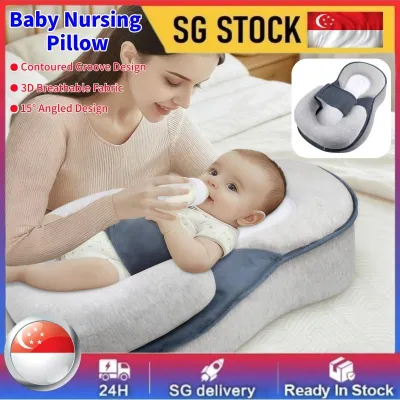
Prices are valid at publication and may change. Please refer to the product page for the latest price.
When selecting a nursing pillow, remember that these products are designed primarily as ergonomic aids to support the caregiver’s arms and reduce strain on the back and shoulders. They are not medical devices, nor are they designed to serve as unsupervised lounging or sleeping surfaces. Using them correctly means keeping your baby actively supervised throughout the entire feeding and holding process.
Key Comparison Dimensions for Reflux-Friendly Pillows
To find a nursing pillow that effectively supports a baby with reflux, you must evaluate several critical design dimensions rather than relying solely on brand popularity. The first dimension is incline and elevation. The pillow’s shape should naturally elevate the baby’s head and chest above their stomach without causing their neck to bend uncomfortably forward.

Firmness is equally vital. Soft, plush pillows might feel comfortable to the touch, but they allow a baby’s heavy head and torso to sink into the material. This sinking flattens the feeding angle and, more critically, can cause the baby’s chin to drop toward their chest, which poses a serious airway obstruction hazard. A firm foam core or high-density polyester fiberfill ensures the baby remains on a stable, elevated plane.
Ergonomic shape determines how well the pillow fits the caregiver’s body and maintains its position. C-shaped pillows wrap around the waist but can slide forward, creating a gap where the baby might slip. U-shaped or wrap-around pillows with adjustable straps secure the cushion tightly to your body, eliminating gaps and providing a stable platform that keeps the baby close and elevated.
Given Singapore’s warm and humid climate, cover materials are a crucial consideration. Reflux inevitably leads to frequent spit-ups, requiring a pillow with a removable, machine-washable cover. Natural, breathable fabrics like organic cotton or bamboo rayon help regulate the baby’s temperature during long feeding sessions, reducing sweating and minimizing the risk of skin irritation or heat rash.
Comparing Nursing Pillow Designs Available in Singapore
Traditional C-shaped or crescent pillows are widely available in local baby boutiques and department stores. These pillows excel at lateral support and are highly convenient for standard cradle-hold feeding. However, because they are typically uniform in height, they do not inherently provide a head-elevating incline. Caregivers using these pillows often need to manually prop up the baby’s head with an arm or an additional folded cloth, which can lead to muscle strain during long feeding sessions.
U-shaped or wrap-around pillows often feature adjustable straps or buckles that secure the pillow around the caregiver’s waist. This secure fit prevents the pillow from shifting, allowing you to use both hands to position your baby at a consistent semi-upright angle. Some premium models in this category feature dual-firmness cores or adjustable foam inserts, allowing parents to customize the elevation as the baby grows.
Wedge-style or inclined feeding cushions are specifically engineered with a gradual slope to keep the baby at a precise angle during bottle feeding. While highly effective for maintaining a consistent incline, they are less adaptable for breastfeeding. When considering a wedge cushion, you must carefully verify the manufacturer’s age and weight limits, as these products are often designed for specific developmental stages.
Because product specifications and safety standards vary widely across brands sold on local e-commerce platforms, you should always verify the physical product labels, check for certified non-toxic materials, and consult a pediatrician before introducing a specialized feeding cushion for severe reflux.
Safety Boundaries and Supervision Rules
The most critical safety rule for any nursing pillow or inclined cushion is that it must never be used for unsupervised sleep, lounging, or tummy time. The soft, inclined surface of a nursing pillow poses a severe risk of positional asphyxiation if the baby’s head rolls forward or sideways, blocking their airway.
Caregivers must maintain active, visual supervision at all times while the baby is on the pillow. If your baby falls asleep during or after a feeding session, you must transfer them immediately to a flat, firm sleep surface, such as a cot or crib, free of any loose blankets, pillows, or bumper pads.
Nursing pillows have strict developmental limits. Once a baby begins to roll over, push up on their hands and knees, or outgrow the manufacturer’s weight limit, the pillow should no longer be used for positioning. At this stage, the baby’s increased mobility makes the pillow unstable, increasing the risk of falls or entrapment.
Decision Framework: Choosing the Right Pillow for Your Baby
To help navigate the options available in Singapore, consider this structured decision framework:
- Choose a firm, wrap-around pillow if you primarily breastfeed and require hands-free stability to maintain a comfortable, semi-upright feeding position for your baby.
- Choose an inclined wedge cushion if you bottle-feed, your baby has mild to moderate reflux, and you need a consistent, pre-set angle that reduces physical strain on your arms.
- Consult a pediatrician immediately if your baby exhibits severe reflux symptoms, such as projectile vomiting, arching their back in pain, coughing during feeds, or failing to gain weight.
- Avoid consumer nursing pillows entirely if your healthcare provider prescribes a specific medical-grade positioning device or clinical intervention, as standard consumer products cannot safely replicate medical equipment.
Frequently Asked Questions (FAQ)
Can a regular nursing pillow cure baby reflux?
No, a nursing pillow cannot cure infant reflux. Reflux is a physiological condition caused by an underdeveloped lower esophageal sphincter, which naturally matures as the baby grows. A nursing pillow is simply a positioning aid that helps caregivers maintain a semi-upright angle during and after feeds, which can temporarily reduce the frequency and volume of spit-ups.
Is it safe to let my baby sleep on a nursing pillow after feeding?
No, it is highly unsafe to let a baby sleep on a nursing pillow or any inclined surface. The risk of positional asphyxiation is extremely high if the baby’s head falls forward, chin-to-chest, or if they roll into the soft fabric. Always transfer a sleeping baby to a flat, firm mattress in a crib or cot immediately after they fall asleep.
Community discussion
Share your experience or ask a question. Comments are reviewed before publication.