
Choosing the right baby head protector depends heavily on your child’s current motor skills, mobility level, and the specific fall risks they encounter daily. Neither design is universally superior; instead, each serves a distinct protective role tailored to different stages of infant physical development. Backpack-style protectors are highly effective for early sitters who are prone to falling straight backward, as they cushion the back of the head and upper spine without wrapping around the face. Conversely, hat-style protectors are better suited for active crawlers, cruisers, and early walkers who require 360-degree coverage to guard against unpredictable, multi-directional tumbles and collisions with furniture.
When selecting a protector, parents must evaluate their home environment, climate, and how well their child tolerates wearing gear. For families living in warm, humid climates like Singapore, where hard ceramic tiles or vinyl floors are common, balancing impact protection with thermal comfort is a major consideration. By understanding the structural differences and matching them to your baby’s developmental milestones, you can make an informed choice that supports safe, active exploration.
How Backpack and Hat-Style Protectors Differ
To make an informed decision, it is essential to understand how these two protective designs differ in physical construction, weight distribution, and coverage areas. A backpack-style protector is a plush, padded cushion shaped like an animal or a ring with a hollow center. It is worn on the baby’s back using adjustable elastic shoulder straps, much like a standard backpack. This design focuses exclusively on protecting the occipital region (the back of the skull) and the upper spine, leaving the top, sides, and front of the baby’s head completely uncovered.
Products mentioned in this guide
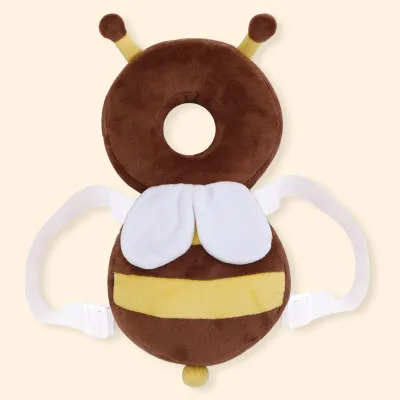

Prices are valid at publication and may change. Please refer to the product page for the latest price.
In contrast, a hat-style protector—often referred to as a baby safety helmet or protective cap—is a soft, lightweight headpiece that wraps entirely around the baby’s head. It is secured under the chin with a soft strap or hook-and-loop fastener. This style provides comprehensive coverage, shielding the frontal (forehead), temporal (sides), parietal (top), and occipital (back) areas of the skull. Rather than resting on the shoulders, the weight of a hat-style protector is borne entirely by the baby’s head and neck muscles.
These fundamental structural differences dictate where and how each product absorbs impact. The backpack style acts as a localized cushion that dampens the force of a direct backward fall onto a flat surface. The hat style functions more like a continuous protective bumper, absorbing minor impacts from various angles when a baby bumps into table legs, walls, or sharp furniture corners during active play.
Head-to-Head Comparison: Protection, Comfort, and Usability
Evaluating both styles across key functional dimensions helps parents determine which design aligns best with their daily routine and physical space.

Protection Coverage and Impact Absorption
The most significant difference between the two designs lies in their protective coverage. The backpack-style protector offers targeted, high-density cushioning for backward falls. Because it is physically thicker—often filled with thick polypropylene (PP) cotton or dense memory foam—it provides excellent shock absorption for the specific zone it covers. However, it leaves the forehead and temples completely exposed, offering zero protection if a baby trips forward or slides sideways off a play mat.
The hat-style protector provides comprehensive 360-degree coverage, making it highly effective for multi-directional impacts. These helmets are typically constructed from specialized impact-absorbing materials, such as high-density IXPE (irradiation cross-linked polyethylene) foam encased in a soft cotton shell. While thinner than the plush padding of a backpack protector, the material is engineered to distribute impact forces across a wider surface area. When purchasing, always check the product packaging or manufacturer specifications to verify the density and type of shock-absorbing foam used, rather than relying solely on visual thickness.
| Feature | Backpack-Style | Hat-Style |
|---|---|---|
| Coverage Area | Back of head and upper spine | 360-degree (top, front, sides, and back) |
| Primary Impact Zone | Occipital region | Frontal, temporal, parietal, and occipital |
| Best Fall Trajectory | Straight backward falls | Unpredictable, multi-directional tumbles |
| Typical Weight | Approximately 100g to 200g | Approximately 50g to 100g |
Comfort, Breathability, and Weight
In warm, tropical climates, thermal comfort is a critical factor in baby gear selection. The backpack-style protector excels in breathability because it does not cover the baby’s head. The scalp, where a significant amount of infant body heat is dissipated, remains completely open to air circulation. This design significantly reduces the risk of overheating, heavy sweating, and the subsequent development of heat rash (miliaria) during active play.
Conversely, hat-style protectors cover a large portion of the scalp, which naturally traps body heat. To mitigate this, high-quality safety helmets incorporate ventilated top panels, open-loop designs, or specialized 3D air-mesh fabrics that facilitate airflow. If you choose a hat-style protector, prioritize models with moisture-wicking inner linings and multiple ventilation slots. Additionally, consider the weight of the product; while hat-style protectors are generally engineered to be ultra-lightweight (often under 80 grams) to prevent neck fatigue, any added weight on an infant’s head requires their neck muscles to work harder to maintain balance.
Ease of Use and Baby's Acceptance
Getting a baby to tolerate safety gear is a common parental challenge. Backpack-style protectors are generally well-tolerated because they do not restrict the head or face. Many babies quickly forget they are wearing the cushion, as it feels similar to a gentle hug around the shoulders. However, if the elastic shoulder straps are too loose, the protector can slide to one side, rendering it ineffective during a fall. If the straps are adjusted too tightly, they can pinch the underarms or restrict arm movement, leading to fussiness.
Hat-style protectors face much higher rates of rejection. Babies are naturally inclined to pull off objects placed on their heads, especially if they feel hot, heavy, or restrictive. Ensuring a secure fit requires a soft, adjustable chin strap that holds the helmet in place without causing skin irritation or choking hazards. Parents must carefully adjust the hook-and-loop fasteners to achieve a snug yet comfortable fit, checking regularly to ensure the strap does not compress the throat or cause redness under the chin.
Mobility and Interference with Daily Activities
Each design impacts a baby’s natural movement patterns differently. A backpack-style protector adds physical bulk behind the baby’s torso. This extra depth makes it uncomfortable or difficult for the baby to lie flat on their back, and it can actively interfere with their ability to roll over from back to tummy. If a baby tries to rest or sit back against a sofa while wearing it, the cushion can push their head forward into an unnatural chin-to-chest position, which must be avoided to ensure an open airway.
Hat-style protectors do not interfere with lying down or rolling, but they do alter the baby’s spatial awareness. The added outer dimensions of the helmet can cause a baby to misjudge clearances when crawling under low tables or squeezing through tight spaces, leading to minor bumps. Furthermore, because the weight is positioned on the head, it can slightly shift the baby’s center of gravity, which may temporarily affect their balance when they are first learning to stand independently or take their first steps.
Matching the Protector to Your Baby's Development Stage
As infants grow, their movement patterns, balance, and fall risks evolve. Matching the protective design to your baby’s specific motor milestones ensures they receive targeted protection where they need it most.
Learning to Sit (Approximately 4 to 7 Months)
During this early stage, babies are developing their core strength but often lack the trunk control and protective reflexes needed to save themselves when they lose balance. When sitting independently, they are highly susceptible to falling straight backward—often referred to as a “banana peel” slip—where the back of the head is at direct risk of hitting the floor.
For this developmental phase, a backpack-style protector is highly suitable. It provides a thick, dedicated cushion directly behind the occipital bone, protecting against hard impacts on flat play areas. Because the baby is not yet crawling or moving rapidly, the lack of side and front protection is less of a concern, and the open-head design keeps them cool during stationary play.
Crawling and Cruising (Approximately 7 to 10 Months)
Once a baby begins to crawl and pull themselves up to stand using furniture (cruising), their movement becomes highly dynamic and unpredictable. They are no longer stationary; they explore low-lying areas, crawl under tables, and attempt to stand near sharp edges. At this stage, fall trajectories are multi-directional, and the risk of bumping the forehead or temples against table legs, TV consoles, or wall corners increases dramatically.
At this point, a backpack-style protector is no longer sufficient, as it leaves the front and sides of the head completely exposed. A hat-style protector is much more appropriate for this phase, providing comprehensive 360-degree coverage that cushions the head against lateral slips and forward tumbles.
Early Walking (Approximately 10 to 15 Months)
As toddlers take their first independent steps, their gait is wide and unstable. They frequently trip over their own feet, lose balance on uneven surfaces, or fall sideways. While they are starting to develop protective reflexes—such as putting their hands out to break a fall—their reactions are often too slow to prevent head bumps.
A lightweight, highly ventilated hat-style protector is ideal for early walkers, provided it is properly fitted and does not block their line of sight. It offers all-around protection during indoor exploration. However, as the child’s balance improves and they become more stable on their feet, the protector should be phased out to allow their natural balance and protective reflexes to mature without relying on artificial cushioning.
Safety Checks and Features to Verify Before Buying
Before purchasing any baby head protector, parents must conduct thorough safety and material checks to ensure the product is safe for daily use.
- Verify Material Safety: Carefully inspect product labels and manufacturer documentation to ensure all materials, including outer fabrics, inner foam, and dyes, are non-toxic, hypoallergenic, and free from harmful chemicals such as BPA, phthalates, and lead. Look for recognized material safety standards or certifications indicated on the packaging.
- Check for Breathability Features: Ensure the product incorporates high-quality breathable elements. For hat styles, look for multiple ventilation cutouts and 3D air-mesh linings. For backpack styles, verify that the shoulder straps are wrapped in soft, breathable cotton to prevent skin chafing.
- Inspect Fasteners and Small Parts: Examine all buckles, straps, and decorative elements. Ensure there are no small, detachable parts that could pose a choking hazard. Hook-and-loop fasteners should be soft to the touch and positioned so they do not scrape against the baby's delicate skin.
- Ensure Correct Fit and Alignment: The protector must fit snugly without restricting the baby's natural movements. For hat styles, verify that the rim sits above the eyebrows and does not obstruct the baby's vision, cover their eyes, or press against their ears. For backpack styles, adjust the straps so the padded ring aligns perfectly with the back of the head when the baby is sitting upright.
- Monitor for Physical Distress: Always supervise your baby closely during use. Check their skin regularly for red marks, irritation, or signs of localized sweating. If your baby shows signs of neck fatigue, struggles to hold their head up, or exhibits physical distress, remove the protector immediately.
It is critical to understand that baby head protectors are designed solely as supplementary cushioning tools for minor, low-impact household bumps. They are not medical devices, nor are they safety helmets designed for outdoor wheeled toys, such as balance bikes or trikes. They do not prevent concussions or internal brain injuries, which are caused by the rapid movement of the brain within the skull during a sudden impact. No protective gear can ever replace active, close-proximity adult supervision and a thoroughly baby-proofed living space.
Decision Framework: Which One Should You Choose?
To finalize your choice, use this structured, condition-based framework to determine which head protector fits your baby’s current needs.
Choose a Backpack-Style Protector if:
- Your baby is primarily in the sitting stage (4 to 7 months) and tends to fall straight backward.
- Your home has dedicated, flat play mats where backward falls are the primary risk.
- You live in a hot, humid environment and your baby sweats easily or is prone to heat rash.
- Your baby strongly resists wearing hats, headbands, or anything on their head.
Choose a Hat-Style Protector if:
- Your baby is actively crawling, cruising, or learning to walk (7 months and older).
- Your living space features hard flooring (such as tile, marble, or polished wood) and furniture with sharp edges or low clearances.
- Your baby falls in multiple directions, including sideways and forward.
- Your baby tolerates wearing hats comfortably and does not constantly try to pull them off.
Verify First or Consult a Professional if:
- Your baby has a history of developmental delays, weak neck muscles, or difficulty holding their head upright.
- Your baby has sensory processing sensitivities that make wearing restrictive gear or straps highly distressing.
- Always consult your pediatrician before introducing any weighted or head-worn protective gear if you have concerns about your child's motor development, muscle tone, or skull growth.
Frequently Asked Questions (FAQ)
Do pediatricians recommend baby head protectors?
Pediatricians generally emphasize that baby head protectors are not mandatory safety items and should not replace active adult supervision or proper home baby-proofing. While these products can cushion minor, superficial bumps on hard surfaces, they do not prevent serious internal head injuries or concussions. Many pediatricians advise allowing babies to experience minor, low-impact slips on soft play mats, as these experiences help them develop essential spatial awareness, protective reflexes, and balance. If your baby has specific motor delays or physical conditions, consult a pediatrician before using any headgear.
Can a baby sleep while wearing a head protector?
No, a baby must never be allowed to sleep while wearing any type of head protector. Safe infant sleep guidelines dictate that a baby should always sleep on a flat, firm, bare surface free of any loose bedding, toys, or wearable padding. Wearing a head protector during sleep poses severe safety risks, including suffocation, airway obstruction if the protector shifts over the face, and extreme overheating. If your baby falls asleep while wearing a protector during play, remove the gear immediately and transfer them to a safe sleep environment.
How do I clean and maintain these protectors?
Always refer to the manufacturer’s care label on the product first to avoid damaging the internal padding. Generally, backpack-style protectors filled with polyester fiber can be placed in a mesh laundry bag and washed on a gentle, cold-water cycle. Hat-style protectors, which often contain specialized IXPE foam, typically require gentle hand washing with a mild, baby-safe detergent to preserve their structural integrity. After washing, thoroughly air-dry the protector in a well-ventilated area. Ensuring the product is completely dry is crucial to prevent the growth of mold or mildew within the internal padding, especially in humid climates.
Community discussion
Share your experience or ask a question. Comments are reviewed before publication.