
When your baby reaches the one-year mark, their curiosity and desire to explore the home grow rapidly. Choosing a baby walker for a 1-year-old requires prioritizing safety features that actively prevent falls, tipping, and uncontrolled acceleration. The most critical safety features to look for include adjustable wheel resistance, a wide and stable base, slip-resistant wheels, and certified compliance with international safety standards like ASTM F977 or EN 1273. While traditional sit-in walkers remain a common sight, modern pediatric guidance strongly favors push walkers and stationary activity centers due to their superior safety profile and developmental benefits. This guide outlines the essential safety specifications you must verify to protect your toddler during this exciting transition.
Sit-In vs. Push Walkers: Understanding the Safety Risks
Before selecting any walking aid, you must understand the structural differences between traditional sit-in models and modern push walkers. A sit-in walker features a suspended fabric seat inside a wheeled frame, allowing a baby who cannot yet stand on their own to move rapidly across the floor. In contrast, a push walker is a walk-behind toy with a handlebar and wheels, requiring the child to stand independently behind the device and push it forward. This fundamental difference in design directly impacts both your child’s physical safety and their motor skill development.
Traditional sit-in walkers pose severe safety risks that have led pediatricians and safety authorities worldwide to advise against their use. The primary danger is the extreme speed and mobility these devices grant to a baby who lacks the cognitive ability to navigate hazards. In a sit-in walker, a child can travel at speeds exceeding one meter per second, making it nearly impossible for a caregiver to react in time. This rapid movement frequently leads to devastating stair falls, tip-overs on uneven thresholds, and collisions with furniture or walls.
Products mentioned in this guide

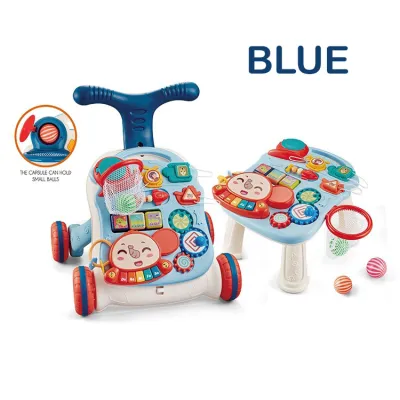

Prices are valid at publication and may change. Please refer to the product page for the latest price.
Furthermore, the elevated position of a child in a sit-in walker allows them to reach hazardous objects that would normally be out of grasp. This heightened reach increases the risk of household poisoning, burns from hot liquids on kitchen countertops, and injuries from pulling heavy items down from tables. Because the child is suspended in a seat, these models also fail to encourage the natural muscle activation required for balance and weight-bearing.
Push walkers and stationary activity centers serve as much safer alternatives for a one-year-old’s developmental journey. A push walker supports natural physiological progression because the child must actively engage their core, hips, and leg muscles to stand and push. If they lose balance, they simply sit down on the floor, which is a natural and necessary part of learning to walk. For times when you need your child to remain in a secure, stationary position, a stationary activity center with no wheels offers a safe environment without the mobility hazards of a wheeled walker.
Essential Safety Features for Push Walkers (Recommended)
If you decide to purchase a push walker for your 1-year-old, focusing on specific design elements will ensure the toy supports their mobility safely. Because your child is still developing balance, the walker must act as a stable support rather than a runaway hazard. Carefully evaluating the wheels, frame stability, and physical materials will help you select a model that minimizes the risk of falls and injuries.

Adjustable Wheel Speed and Anti-Slip Grips
One of the most important safety features on a push walker is an adjustable wheel speed mechanism. Many high-quality push walkers feature tension dials or adjustable screws on the wheels that allow you to increase or decrease rolling resistance. For a 1-year-old who is just beginning to pull themselves up, setting the wheels to maximum resistance prevents the walker from rolling away too quickly. Without this resistance, the walker can easily shoot forward under the child’s weight, causing them to fall face-first onto the floor. As your child’s balance and leg strength improve, you can gradually loosen the tension to match their natural walking speed.
The material and texture of the wheels also play a vital role in maintaining traction across different household surfaces. Look for wheels equipped with thick, rubberized traction strips or textured rubber treads rather than smooth, hard plastic. Rubberized wheels grip smooth flooring surfaces, such as polished wood, ceramic tiles, or vinyl, preventing the walker from sliding sideways. Additionally, high-quality rubber wheels provide a smoother, quieter glide and protect your home’s flooring from unsightly scuffs and scratches.
Sturdy Base and Anti-Tip Design
A safe push walker must possess a wide, heavy base and a very low center of gravity to prevent tipping. When a 1-year-old uses a push walker, they do not just push it forward; they also use the handlebar to pull themselves up from a sitting position. If the base of the walker is too narrow or lightweight, the entire toy can easily tip backward onto the child. Look for models where the wheelbase extends significantly wider than the handlebar frame, creating a stable, trapezoidal or rectangular footprint.
To verify the stability of a push walker before buying, you should perform a physical stability check if shopping in person, or carefully read verified customer feedback regarding weight distribution. Apply downward pressure on the handlebar to see if the front wheels lift off the ground easily. A well-designed walker will distribute the weight forward, ensuring that even when a toddler leans heavily on the handlebar, all four wheels remain firmly planted on the ground. Wooden push walkers often provide a natural weight advantage over lightweight plastic models, though many plastic models feature weighted compartments that can be filled with water or sand to increase stability.
Smooth Edges and Choking Hazard Prevention
Because 1-year-olds are highly active and still explore their environment using their mouths, the physical construction of the walker must be free of physical hazards. Examine the entire frame of the walker to ensure all corners and edges are rounded and smooth to the touch. If you choose a wooden push walker, verify that the wood is completely splinter-free, sealed with non-toxic, lead-free finishes, and has no rough grain that could cut delicate skin. For plastic models, inspect the seams to ensure there are no sharp plastic flashing edges left over from the manufacturing process.
Additionally, many push walkers double as busy boards or activity centers, featuring built-in gears, beads, buttons, and detachable toys. You must inspect these features closely to ensure there are no small parts that could detach and present a choking hazard. Ensure that all spinning elements, sliding beads, and mirrors are securely fastened to the main frame and cannot be pried loose by determined little fingers. Avoid models with long cords, strings, or loops attached to the toys, as these can present strangulation hazards for a young child.
Mandatory Safety Checks for Traditional Sit-In Walkers
While pediatric associations and safety experts strongly discourage the use of traditional sit-in walkers due to their high injury rates, some parents may still consider using them. If you choose to use a sit-in walker, you must exercise extreme caution and verify that the model meets strict safety criteria. Never assume a sit-in walker is safe simply because it is sold in retail stores; instead, perform rigorous checks on its physical structure and mechanical safety features.
Wide Base and Stair-Fall Prevention Mechanisms
The base frame of a traditional sit-in walker must be significantly wider than the upper tray and seat assembly. This wide, flared base serves two critical safety functions: it prevents the walker from tipping over when the baby bumps into walls or furniture, and it physically blocks the walker from fitting through narrow doorways or into hazardous areas. A narrow base allows the child to squeeze into tight spaces, increasing their exposure to dangers like kitchen appliances or electrical outlets.
Furthermore, any sit-in walker must be equipped with mechanical stair-fall prevention mechanisms, often referred to as friction strips or gripping pads. These rubberized pads are located on the underside of the walker’s base frame and are designed to grab the floor and halt the walker’s movement if a wheel slips over an edge, such as a step or threshold. However, you must remember that these friction strips are not foolproof and can fail on certain flooring materials or at high speeds. They are never a substitute for physical safety barriers; you must install secure, hardware-mounted safety gates at the top and bottom of all staircases in your home.
Locking Mechanisms and Proper Height Adjustability
A safe sit-in walker must feature reliable mechanical locks that allow you to immobilize the wheels, effectively converting the device into a stationary activity seat. This feature is essential when you need to keep your child in one place while they play with the attached toys. Ensure the locking mechanisms are robust, easy for an adult to engage, and completely inaccessible to the child sitting inside the walker.
Proper height adjustability is another critical factor for your child’s physical development and safety. The walker must feature multiple height adjustment settings so you can customize the fit to your baby’s growing body. When your child is seated in the walker, their feet must rest flat on the floor with their knees slightly bent. If the walker is too high, the child will be forced to walk on their tiptoes, which can lead to tight calf muscles and abnormal walking patterns. Conversely, if the walker is too low, the child’s knees will bend excessively, placing unnatural strain on their developing joints and increasing the risk of their legs getting caught under the frame.
How to Verify Safety Standards and Manufacturer Limits
Before finalizing any baby walker purchase, you must verify that the product has undergone rigorous independent safety testing. Do not rely solely on marketing claims of “safety tested” or “pediatrician approved.” Instead, look for specific, recognized international safety standard marks printed on the product packaging, the user manual, or the manufacturer’s label.
For infant walkers, the gold standard certifications to verify include:
- ASTM F977: This is the Standard Consumer Safety Specification for Infant Walkers established by the American Society for Testing and Materials. It covers stringent requirements for structural integrity, stability, resistance to tipping, and stair-fall prevention.
- EN 1273: This is the European standard for baby walking frames, which outlines strict safety requirements and testing methods to minimize the risk of injury.
- SS EN 1273: In Singapore, products complying with the European standard are highly recommended and widely accepted by local safety authorities.
In addition to safety standards, you must carefully check the manufacturer’s printed age, weight, and height limits. These limits are not suggestions; they are absolute boundaries determined by engineering tests to ensure the walker remains stable and structurally sound. A walker designed for a child up to 11 kilograms may fail or tip over if used by a heavier child. Always verify that your 1-year-old falls comfortably within the specified limits before allowing them to use the device.
Finally, always fill out and return the manufacturer’s product registration card or register the purchase online immediately after buying. This step is critical because it ensures the manufacturer can contact you directly in the event of a safety recall. You can also regularly check official consumer safety websites and local government recall databases to ensure your specific walker model has not been flagged for safety defects or mechanical failures.
Safe Environment Setup and When to Retire the Walker
Even the most advanced safety features cannot protect your child if the walker is used in an unsafe environment. Creating a secure zone for your 1-year-old is essential to preventing accidents and ensuring their physical development progresses smoothly. Before placing your child behind or inside a walker, you must thoroughly prep the surrounding space.
The environment must be completely flat, level, and free of obstacles. Ensure there are no loose rugs, raised door thresholds, or electrical cords that could catch the wheels and cause a sudden stop or tip-over. Block access to high-risk zones, including kitchens, bathrooms, swimming pools, balconies, and any areas with space heaters, fireplaces, or dangling cords from blinds or appliances. Keep all tabletops and low shelves clear of hot liquids, heavy objects, sharp utensils, and cleaning chemicals, as a child in a walker can reach much higher than you might expect.
It is vital to understand that a baby walker is never a substitute for active, close-proximity adult supervision. You must remain in the same room and keep your eyes on your child at all times while they are using the walker. Do not leave your child unattended, even for a brief moment, as accidents with walkers happen in a fraction of a second.
Knowing when to retire the walker is just as important as knowing how to use it safely. You must stop using the walker immediately if your child reaches any of the following developmental milestones or physical limits:
- The child reaches the manufacturer’s maximum weight or height limit.
- The child starts attempting to climb out of the seat of a sit-in walker.
- The child can stand and walk confidently without any physical support.
- The child’s chin is lower than the handlebar of a push walker, or their chest is no longer supported correctly in a sit-in model.
Frequently Asked Questions (FAQ)
Are baby walkers bad for a 1-year-old's hip or leg development?
Yes, traditional sit-in baby walkers can negatively impact your child’s hip and leg development if used improperly or excessively. When suspended in a seat, babies often rely on toe-walking to push themselves around, which can tighten the Achilles tendon and lead to abnormal gait patterns. Furthermore, sit-in walkers place the child’s hips in an unnatural position, bypassing the crucial muscle strengthening that occurs during crawling, pulling up, and cruising. In contrast, push walkers encourage natural weight-bearing through the feet and legs, helping to build the core stability and coordination needed for independent walking. If you have concerns about your child’s physical development or posture, consult a pediatrician or a pediatric physical therapist for professional guidance.
Can a 1-year-old use a baby walker on carpeted floors?
Using a baby walker on carpeted floors depends heavily on the type of walker and the thickness of your carpet. Thick, plush carpets can create significant rolling resistance, making it difficult for a 1-year-old to push a walk-behind toy. This resistance can cause the child to push excessively hard, increasing the risk of the walker tipping forward or backward. For traditional sit-in walkers, carpet fibers can catch on the small wheels or trigger the safety friction pads, leading to sudden stops and potential tip-overs. Always refer to the manufacturer’s instructions regarding compatible floor surfaces. If you do use a push walker on a low-pile carpet, test its stability and wheel rotation yourself first to ensure your child can maneuver it smoothly without straining or tipping.
Community discussion
Share your experience or ask a question. Comments are reviewed before publication.