
When choosing gear for your child’s developmental journey, safety must always be the primary filter. Baby walkers, while historically popular for keeping infants entertained, require meticulous evaluation before purchase. To make an informed and safe decision, parents must understand the critical physical features, mechanical safety systems, and international standards that distinguish a secure product from a hazardous one.
While these devices can offer temporary entertainment, they also introduce unique physical risks. Understanding how a walker interacts with your home environment and your baby’s developing body is the first step toward ensuring a safe play experience. Active adult supervision remains indispensable, but selecting a product with robust, built-in safety mechanisms provides an essential layer of defense.
Understand the Safety Risks of Traditional Baby Walkers
Traditional mobile baby walkers give pre-walking infants an extraordinary amount of mobility and speed. A baby in a wheeled walker can cover ground at a rate of up to one meter per second. This rapid movement means that even if you are standing in the same room, your physical reaction time may not be fast enough to intercept a baby heading toward a hazard.
Products mentioned in this guide
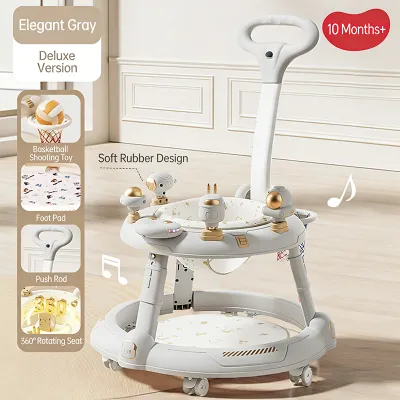

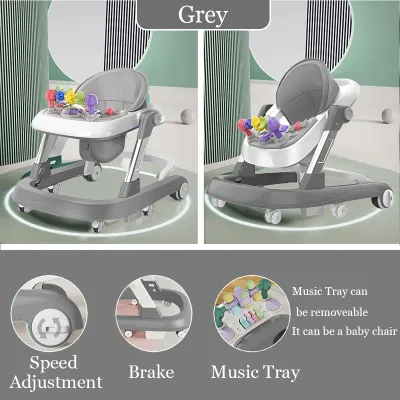
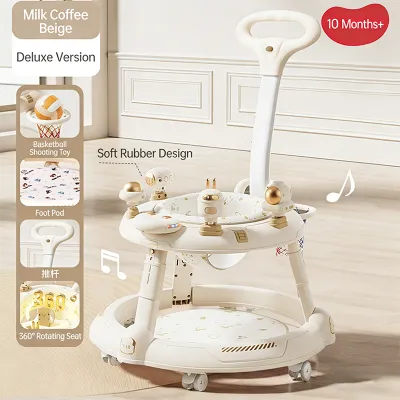
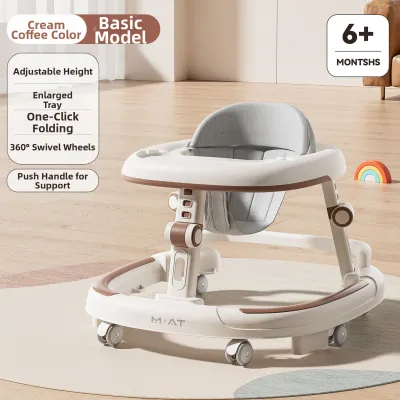
Prices are valid at publication and may change. Please refer to the product page for the latest price.
The elevated position of a baby in a walker also increases their reach. Infants can easily access objects on countertops, dining tables, or shelves that would normally be far out of their grasp. This height advantage exposes them to severe hazards, such as hot beverages, sharp kitchen utensils, heavy objects that can be pulled down, or toxic household plants and cleaning chemicals.
Falls down staircases or split-level flooring transitions represent the most common and severe injuries associated with mobile walkers. The momentum of a rolling walker can carry a baby over a threshold or down a step before they have any concept of the danger. Additionally, mobile walkers are highly prone to tipping over when they encounter small obstacles on the floor, such as the edge of a play mat, a toy, or the transition between tiled and carpeted areas.
Major pediatric and child safety associations worldwide strongly advise against the use of mobile baby walkers. Medical professionals point out that these devices do not help babies learn to walk any sooner. In fact, they can actively delay natural motor development by encouraging abnormal muscle use, such as toe-walking, and by bypassing the crucial crawling and pulling-up phases that build core strength and bilateral coordination.
It is a common misconception that constant adult supervision eliminates these risks. Studies and accident reports consistently show that injuries occur even when parents or caregivers are in the same room. Because a baby in a walker can move faster than an adult can react, physical safety features built directly into the product are critical if you choose to use one.
Essential Physical Design and Stability Features
When evaluating a baby walker, the structural design is your first line of defense against tipping and physical injury. A safe walker must feature a wide, heavy-duty wheelbase that is significantly larger than the top tray. This wide base creates a low center of gravity, making it highly resistant to tipping even when your baby leans over the edge to reach for a toy or pushes forcefully against a piece of furniture.

Frame width is another critical physical barrier to consider. The frame of the walker should ideally be wider than standard doorways and hallways in your home. In Singapore’s compact apartments and HDB flats, measuring your doorways before purchasing is a vital safety step. A walker frame that is wider than 90 centimeters physically prevents the baby from rolling into high-risk zones like kitchens, bathrooms, or balconies.
The design of the seat and harness plays a direct role in both safety and physical development. Look for a deep, padded seat with a high, rigid backrest to support your baby’s developing spine. The harness must be highly secure, adjustable, and constructed from durable materials to prevent the baby from slipping through the leg openings or attempting to climb out of the frame.
Proper height adjustment is essential to prevent long-term joint strain and developmental issues. When adjusting the walker’s height, consult the manufacturer’s manual to ensure correct alignment. Your baby’s feet should not rest completely flat on the floor, nor should they barely touch the ground. The ideal height allows the front part of the foot to touch the floor comfortably; if the baby is forced to stand constantly on their tiptoes, it can tighten the Achilles tendon and encourage a persistent toe-walking gait.
Finally, inspect the entire frame for potential entrapment hazards. Babies naturally explore their surroundings with their fingers and toes, making exposed hinges, folding joints, and springs highly dangerous. Ensure all folding mechanisms feature protective guards or locking sleeves that completely cover any gaps, preventing painful pinches or clothing entanglement.
Braking Systems and Stationary Lock Mechanisms
Modern, safety-compliant baby walkers incorporate specialized mechanical braking systems to mitigate the risk of falls. These systems typically consist of friction pads or rubber gripping strips mounted on the underside of the walker’s base. If a wheel rolls over an edge or a step, these pads immediately contact the floor surface, creating intense friction that stops the walker’s forward momentum.
While these stair-fall brakes are an invaluable safety feature, they must never be viewed as a guarantee of absolute safety. Friction strips rely on direct contact with a flat surface and can fail on highly polished, dusty, or uneven floors. Furthermore, they cannot completely overcome high momentum if a baby is moving at top speed. Therefore, physical safety gates installed securely at the top and bottom of any stairs remain mandatory.
Many high-quality walkers offer a dual-function design that includes a stationary mode. This feature allows you to convert the mobile walker into a fixed activity table by deploying robust, lockable legs or fold-out stoppers that lift the wheels completely off the ground. Utilizing the stationary mode keeps your baby safely in one spot while still allowing them to enjoy the interactive toys on the play tray.
Speed limiters or adjustable wheel resistance mechanisms are also highly beneficial, especially on smooth flooring common in Singapore homes, such as polished marble, ceramic tiles, or vinyl. By tightening the wheel tension, you can prevent the walker from rolling too freely. This ensures that the movement remains at a slow, manageable pace that matches your baby’s physical strength and control.
Verifying Safety Certifications and Compliance Labels
Never rely on vague marketing claims such as “safety approved” or “pediatrician recommended.” Instead, look for specific, recognized international safety standards printed directly on the product, packaging, or user manual. For infant walkers, the most prominent standards are ASTM F977 in the United States and EN 1273 in Europe. These certifications guarantee that the product has undergone rigorous testing for structural integrity, stability, and stair-fall resistance.
In Singapore, consumer products are subject to safety regulations monitored by the Consumer Product Safety Office (CPSO). When purchasing a baby walker, ensure it is sourced from a reputable retailer and complies with local safety guidelines. Be exceptionally cautious when buying from overseas sellers on online marketplaces, as these products may not meet the stringent safety benchmarks required for local distribution.
Before placing your baby in a walker, you must verify the manufacturer’s stated weight, height, and developmental limits. Walkers are generally designed for infants who can sit up unassisted but cannot yet walk independently. If your baby exceeds the maximum weight limit (typically between 11 and 15 kilograms) or is tall enough that their chest rises above the top of the frame, stop using the device immediately to prevent structural failure or tipping.
After purchasing a compliant baby walker, take a few minutes to register the product on the manufacturer’s official website. This simple step ensures that you will be contacted directly and immediately in the event of a safety recall. Additionally, always keep the user manual in a safe place and perform regular inspections to check for loose screws, worn friction pads, or cracked plastic.
Safer Alternatives to Support Baby Walking and Development
If the safety risks of mobile baby walkers cause concern, several excellent alternative product categories offer entertainment and support motor development without the associated mobility hazards. Stationary activity centers, often referred to as exersaucers or activity jumpers, are highly recommended. These devices feature a 360-degree rotating seat surrounded by interactive toys, providing the same upright play experience as a walker but with a stable, wheel-free base that completely eliminates the risk of rolling into danger.
For babies who are already pulling themselves up to a standing position and are ready to take steps, a push walker (or walk-behind toy) is a superior choice. These are sturdy, weighted toys with a handlebar that your baby pushes from behind. Because the baby’s feet are flat on the floor and they must actively balance themselves, push walkers promote a natural walking gait, strengthen core muscles, and build genuine balance. When selecting a push walker, look for a model with adjustable wheel resistance to prevent the toy from rolling away too quickly.
Ultimately, the safest and most effective way to support your baby’s physical development is unstructured, supervised floor play. Placing your baby on a clean, firm play mat encourages them to roll, crawl, sit, and eventually pull themselves up on stable furniture. This natural progression builds the exact muscle groups, coordination, and spatial awareness needed for independent walking, entirely free from the risks of mechanical devices.
Frequently Asked Questions (FAQ)
Are mobile baby walkers banned in any countries?
Yes, Canada implemented a complete ban on the sale, import, and advertisement of mobile baby walkers in 2004 due to the high rate of severe injuries associated with their use. In Singapore, while they are not banned, they are subject to strict safety regulations. Parents are strongly encouraged to verify compliance with international safety standards and carefully consider safer alternatives before making a purchase.
What is the maximum weight and age limit for using a baby walker?
Exact weight and age limits vary by manufacturer and must be verified directly on the specific product’s label or user manual. Generally, most walkers have a maximum weight limit of 11 to 15 kilograms and are intended for infants between 6 and 12 months of age. You must discontinue use immediately if your baby can walk independently, attempts to climb out of the seat, or exceeds the manufacturer’s specified height or weight thresholds.
Community discussion
Share your experience or ask a question. Comments are reviewed before publication.