
Are VTech walkers safe for your baby? The direct answer is yes, VTech push walkers are generally safe when used under active adult supervision, on flat surfaces, and once your baby has reached the appropriate developmental milestones. Unlike traditional sit-in walkers, which are widely discouraged by pediatricians due to high injury risks and developmental delays, VTech designs focus on “push walkers” (often marketed as sit-to-stand learning walkers). These toys require your baby to stand independently, allowing them to control their own pace, practice natural balance, and safely drop to the floor if they lose their footing.
However, no toy is entirely risk-free. A push walker’s safety depends heavily on the environment in which it is used and the caregiver’s vigilance. Understanding the design differences, key safety features, and essential precautions is crucial for every parent looking to support their baby’s first steps safely.
Understanding VTech Walkers: Push Walkers vs. Sit-In Walkers
To evaluate the safety of a VTech walker, it is first necessary to distinguish between the two main categories of baby walkers: traditional sit-in walkers and modern push walkers. The safety profiles of these two designs are vastly different, which is why pediatric health organizations have very different guidelines for each.
Products mentioned in this guide




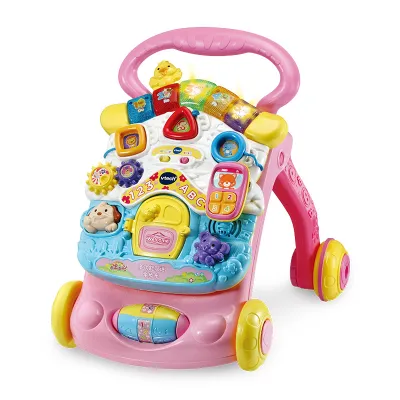
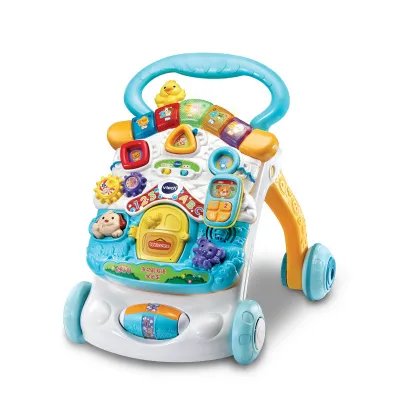
Prices are valid at publication and may change. Please refer to the product page for the latest price.
Traditional sit-in walkers feature a fabric seat suspended inside a large, wheeled metal or plastic frame. In these devices, the baby’s legs dangle through the seat, allowing them to propel themselves across the room before they are physically capable of standing or walking on their own. Pediatric associations worldwide, including the American Academy of Pediatrics and local healthcare authorities, have long warned against sit-in walkers. These devices allow babies to move at surprisingly high speeds—up to one meter per second—making it incredibly difficult for caregivers to react in time. Common accidents include tipping over on uneven surfaces, tumbling down stairs, and reaching hazardous items like hot liquids, household chemicals, or electrical cords that would otherwise be out of reach. Additionally, sit-in walkers can negatively impact physical development by promoting abnormal walking mechanics, such as toe-walking, and bypassing the crucial hip, pelvic, and core muscle strengthening that occurs during crawling and independent standing. In some countries, such as Canada, the sale and import of sit-in walkers are completely banned, while in Singapore, health professionals strongly discourage their use in favor of safer alternatives.
VTech does not manufacture traditional sit-in walkers. Instead, their product line centers on push walkers, such as the widely popular sit-to-stand learning walker series. With a push walker, your baby is not strapped into a seat. Instead, they stand upright behind the toy, hold onto a handlebar, and push the device forward as they walk.
This fundamental design difference makes push walkers a much safer alternative for developing infants. Because there is no harness holding them up, babies must actively engage their core, back, glutes, and leg muscles to remain upright, which naturally supports their physical development. If a baby loses their balance while using a push walker, they can simply let go of the handle and drop safely onto their bottom, which is a natural and necessary part of learning to balance. Furthermore, push walkers do not grant the artificial, high-speed mobility of sit-in models, meaning parents have more time to monitor and guide their baby’s movements. By requiring the baby to bear their own weight and maintain their balance, push walkers support natural gait development and help build genuine physical confidence.
Key Safety Features to Look for in VTech Push Walkers
When choosing or inspecting a VTech push walker, you should look for specific engineering details that contribute to its stability and safety. These physical features help mitigate the risks of falls, runaway toys, and structural failures.

- Adjustable Wheel Resistance: One of the most important safety features on a VTech push walker is the speed-control tension dial, typically located on the rear wheels. This mechanism allows you to adjust how easily the wheels turn. For early standers who are just learning to balance, setting the wheels to a higher resistance prevents the walker from rolling away too quickly on smooth flooring, such as the polished tile, marble, or vinyl common in Singapore homes. As your baby's strength and coordination improve, you can loosen the tension to let the wheels glide more freely.
- Sturdy Base and Anti-Tip Design: A safe push walker must have a wide, low-slung base that provides exceptional stability. When your baby pulls themselves up from a sitting position using the walker's handlebar, the device must stay firmly planted on the ground rather than flipping backward. VTech designs generally feature a broad, trapezoidal wheel track and weighted front panels to prevent tipping, but you should always physically verify that the walker feels stable and does not wobble when downward or backward pressure is applied to the handle.
- Ergonomic and Non-Slip Handle: The handlebar of the walker should be positioned at a height that allows your baby to maintain a natural, upright posture without slouching forward or reaching too high. The handle itself should feature a textured, non-slip grip that is easy for tiny hands to hold securely, reducing the risk of their hands slipping off during a sudden step.
- Smooth Edges and Secure Compartments: Because babies frequently bump into their toys, the walker should have rounded corners and smooth edges to prevent impact injuries. Additionally, since VTech walkers feature interactive electronic activity panels, the battery compartment must be securely locked with a screw. This design prevents curious hands from accessing the batteries, which pose severe choking and chemical burn hazards if swallowed.
Essential Precautions and Safe Usage Guidelines
Even the most well-designed toy cannot replace active parental oversight and a safe environment. Implementing strict precautions will help ensure your baby’s walking practice remains safe and beneficial.
First and foremost, constant adult supervision is non-negotiable. A push walker should be treated as an interactive play toy rather than a device to keep your baby occupied while you attend to other tasks. An adult must remain within arm’s reach at all times, ready to catch the baby if they lose balance or steer toward an obstacle.
Before allowing your baby to use the walker, you must conduct a thorough sweep of the play area to eliminate environmental hazards. Block off all access to stairways, steps, and balconies using securely installed safety gates. Remove loose rugs, mats, and trailing electrical cords that could catch on the walker’s wheels and cause a sudden stop or fall. Keep the play area far away from high-risk zones, such as kitchens, glass doors, sharp furniture corners, and low-lying shelves containing fragile or hazardous household items. Be especially mindful of transitions between different flooring types, such as moving from a smooth tile floor to a thick carpet, as this sudden change in friction can cause the walker to halt abruptly and tip forward.
Developmental readiness is far more important than chronological age. Avoid forcing your baby to use the walker simply because they have reached a certain month milestone. Your baby is ready for a push walker only when they can sit up completely unassisted and are actively pulling themselves up to a standing position using furniture. Introducing a walker too early, before your baby has developed the prerequisite core and leg strength, can strain their joints and lead to frequent, painful falls.
Finally, establish reasonable time limits and encourage varied movement throughout the day. Limit your baby’s walker sessions to short intervals of 15 to 20 minutes at a time. The majority of your baby’s active hours should be spent in unrestricted floor play, crawling, rolling, and cruising along stable furniture. These natural movements are critical for developing bilateral coordination, spatial awareness, and the deep core strength required for confident, independent walking.
How to Verify Safety Standards and Maintain the Walker
To ensure your baby’s walker remains a safe play tool over time, you must verify its manufacturing standards and perform regular maintenance checks.
When purchasing a VTech walker, look for official safety certification marks on the packaging or the product itself. In Singapore, consumer products are regulated to ensure they meet strict safety guidelines. Look for recognized international standards such as ASTM F963 (United States) or EN71 (Europe), which confirm the toy has undergone rigorous testing for physical stability, mechanical safety, and non-toxic materials. Avoid purchasing unbranded or suspiciously cheap lookalikes from online marketplaces, as these often bypass essential safety evaluations.
After purchasing the walker, take a moment to register the product on VTech’s official website using the serial number located on the toy. Product registration ensures that you will be contacted immediately in the rare event of a safety recall or product update, allowing you to take swift action to protect your child. If you are using a secondhand walker, double-check the model number against official recall databases to ensure it has not been flagged for safety issues.
Regularly inspect the physical condition of the walker to catch any wear and tear before it becomes a hazard. Check that the plastic frame remains free of cracks or sharp edges, and ensure all screws are tightly secured. Inspect the wheels to confirm they spin smoothly and that the rubberized traction strips have not worn thin, which could cause the walker to slide unpredictably on smooth floors. Whenever you replace the batteries in the interactive panel, double-check that the battery door is screwed shut tightly and cannot be pried open by hand.
Frequently Asked Questions (FAQ)
At what age can my baby start using a VTech push walker?
While VTech packaging often suggests a broad age range, such as 9 to 36 months, your baby’s physical development is the true indicator of readiness. Your baby should only use the push walker function once they can sit up completely unassisted and are naturally pulling themselves up to a standing position using furniture. If your baby is not yet standing, you can detach the interactive activity panel from the front of many VTech models and place it flat on the floor for safe, seated play, keeping the wheeled frame stored away until they are physically ready.
Do push walkers delay walking development?
Unlike traditional sit-in walkers, which can delay walking by promoting improper posture and toe-walking, push walkers generally do not hinder development when used in moderation. Because push walkers require your baby to support their own weight and actively balance, they support natural gait mechanics. However, they should not be used as a substitute for natural movement. Unrestricted floor time, crawling, and cruising along stable household furniture remain the most effective ways for your baby to build the muscle strength and balance needed to walk independently.
What should I do if the walker tips over or breaks?
If the walker tips over or sustains damage, immediately remove it from your baby’s play area to prevent further risk. Carefully inspect your baby for any signs of injury, and consult a pediatrician or medical professional if you notice swelling, persistent crying, or any other signs of physical distress. Do not attempt to repair cracked plastic, broken wheels, or loose structural parts using household glue or tape, as these DIY fixes can easily fail under pressure. Instead, contact VTech’s customer support to inquire about replacement parts or warranty options.
Community discussion
Share your experience or ask a question. Comments are reviewed before publication.