
When your baby begins pulling themselves up on furniture and taking tentative first steps, it is natural to look for tools that can support their newfound mobility. Among the various options on the market, “air walkers”—a term often used to describe push-along walkers equipped with air-filled pneumatic tires, suspension systems, or specialized shock-absorbing wheels—have gained attention. But are air walkers actually safe for babies?
To answer this directly: traditional sit-in baby walkers are widely discouraged by pediatricians and health organizations worldwide due to severe safety risks. However, modern push-along activity walkers (including those styled as air walkers with pneumatic tires) are generally considered much safer alternatives, provided they are used by developmentally ready babies under active adult supervision and feature robust safety designs.
Before purchasing any walking aid, parents must understand the critical distinction between these product types. Traditional sit-in walkers suspend a baby in a fabric seat inside a wheeled frame, allowing them to roll around before they can stand on their own. In contrast, push-along walkers require the baby to stand independently and actively push the toy forward, mimicking natural walking mechanics. If you are considering an air-wheeled push walker for outdoor paths or indoor play, verifying specific safety certifications, structural features, and environmental setups is essential to protect your child from injury.
Products mentioned in this guide
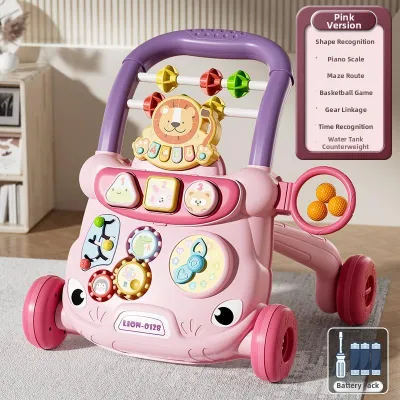
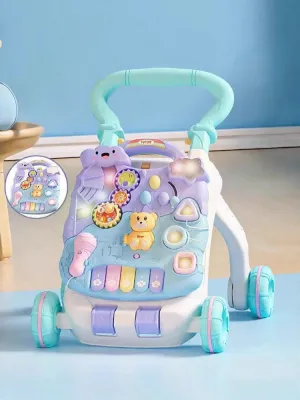
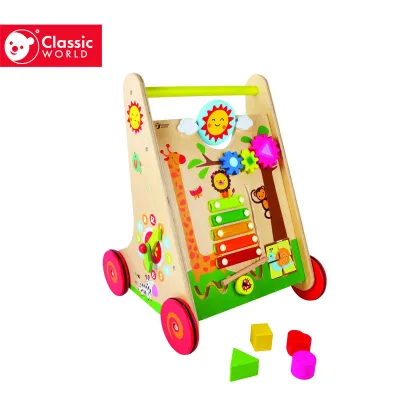
Prices are valid at publication and may change. Please refer to the product page for the latest price.
Understanding the Real Risks of Baby Walkers
To make an informed decision, parents must understand the physical hazards associated with mobile baby devices. While these toys are designed to entertain, they can quickly become dangerous if used in an environment that has not been properly secured, or if the device lacks basic physical safeguards.
Fall and Tip-Over Hazards
Babies using wheeled mobility devices can move at surprisingly high speeds, sometimes exceeding one meter per second. This rapid movement gives caregivers virtually zero reaction time if the baby heads toward a hazard. Tipping over on uneven transitions—such as moving from tile to carpet, crossing a door saddle, or hitting a loose rug—is a primary cause of head and neck trauma. If a device is used near steps or elevated thresholds, the momentum can easily carry the walker over the edge, resulting in severe falls.
Access to Household Dangers
Elevating a baby who cannot yet stand independently changes their reach and spatial awareness. When supported by a walker, a baby can suddenly reach objects on countertops, pull down tablecloths holding hot liquids, touch electrical outlets, or grab toxic cleaning products stored on low shelves. The combination of rapid mobility and increased height exposes infants to hazards that would normally be out of reach during supervised floor play.
Developmental Concerns
Medical professionals frequently warn against traditional sit-in walkers because they place the baby in an unnatural upright position before their musculoskeletal system is ready to support their full weight. This position often encourages “toe-walking,” which can tighten the Achilles tendons and alter normal gait patterns. Furthermore, relying on a device to stay upright bypasses the critical crawling phase, which is vital for bilateral coordination, shoulder girdle strength, and cognitive development. Push-along walkers avoid many of these issues by requiring the child to actively balance and bear their own weight, but they must still be introduced only when the baby is developmentally ready.
Key Safety Features to Verify Before You Buy
If you decide to purchase a push-along air walker or activity walker, you must carefully evaluate its physical construction. Do not rely solely on marketing claims; instead, perform a hands-on inspection or verify the specifications directly with the manufacturer’s documentation.

Wheel Stability and Speed Control
The wheels are the most critical component governing the speed and stability of the walker. Because babies are still developing their balance, a walker that rolls too quickly can easily slip out from under them, leading to face-forward falls.
- Lockable Wheels: Verify that the walker features a reliable locking mechanism. This allows you to lock the wheels completely, turning the walker into a stationary activity center while your baby plays with the front panel.
- Adjustable Speed Restrictors: Look for tension dials or friction pads on the wheels. These restrictors allow you to increase rolling resistance, ensuring the walker moves at a slow, controlled pace that matches your baby's slow steps.
- Pneumatic (Air-Filled) Tire Maintenance: If the walker features real air-filled tires, inspect the tread quality and puncture resistance. You must regularly check the tire pressure according to the manufacturer's instructions; under-inflated tires can cause uneven rolling or sudden dragging, while over-inflated tires can reduce traction on smooth indoor floors like polished marble or laminate.
Anti-Tip Base and Weight Distribution
A safe walker must resist tipping over when a baby leans heavily on the handlebar, pulls themselves up from the floor, or pushes sideways.
- Wide, Flared Base: The footprint of the walker's base should be significantly wider and longer than the handlebar assembly. A pyramid-like geometry ensures that the center of gravity remains low and centered, even when lateral force is applied.
- Weighted Chassis: High-quality push walkers often feature a weighted bottom compartment or a heavy-wheel design to keep the device firmly grounded on the floor. Some models allow parents to add weight (such as water or sand) to a dedicated compartment as the baby grows stronger.
- Rear Stabilizers: Look for extended rear axles or physical stoppers that project backward from the rear wheels. These stabilizers act as a lever to prevent the walker from flipping backward when the baby pulls on the handle to stand up.
- Safety Certifications: Always check the product packaging or manual to verify that the walker meets recognized international safety standards, such as ASTM F963 in the United States or EN 71 in Europe. These certifications indicate that the product has undergone physical testing for stability and structural integrity.
Non-Toxic Materials and Structural Integrity
Babies naturally explore their toys with their hands and mouths, making material safety and build quality paramount.
- Chemical Safety: Ensure the manufacturer explicitly certifies that all plastics, paints, and finishes are non-toxic, lead-free, BPA-free, and phthalate-free. Avoid products with strong chemical odors or peeling paint.
- Pinch Points and Edges: Run your hands along the entire frame to check for sharp edges, rough plastic seams, or narrow gaps where tiny fingers could get pinched. Foldable models must have secure locking hinges that cannot be accidentally released by a child.
- Secure Battery Compartments: If the walker features an electronic activity board, verify that the battery compartment is securely fastened with a metal screw. This prevents babies from accessing highly dangerous button cell or alkaline batteries. All wiring must be completely enclosed within the plastic housing.
Setting Up a Safe Environment for Walker Use
Even the safest push walker can become a hazard if used in an unprepared environment. Creating a dedicated, hazard-free zone is essential to protect your child during play.
- Clear the Floor: Before letting your baby use a push walker, clear the walking path of all tripping hazards. Remove loose area rugs, electrical cords, shoes, and small toys. Ensure the floor surface is dry and non-slip; smooth tiled or polished wood floors can cause wheels to slide too quickly if the speed restrictors are not properly engaged.
- Block Hazards with Safety Gates: Install hardware-mounted safety gates to block access to high-risk zones. This includes stairways, kitchens (where hot liquids and appliances pose a threat), bathrooms, and balconies. Avoid pressure-mounted gates at the top of stairs, as a baby pushing a walker can exert enough force to dislodge them.
- Maintain Direct Supervision: Never leave your baby unattended with a walker, even for a few seconds. Active supervision means staying in the same room, keeping the child within your line of sight, and remaining close enough to intervene instantly if they lose their balance.
- Enforce Strict Time Limits: Limit walker usage to short, supervised intervals of 15 to 20 minutes per session. This prevents physical fatigue, which can lead to poor walking posture and accidental falls. Balance walker play with plenty of unrestricted floor time, crawling, and independent standing practice to support natural motor development.
Frequently Asked Questions (FAQ)
At what age can a baby start using a push walker?
Most babies are developmentally ready to use a push walker between 9 and 12 months of age. Before introducing a push walker, your baby must be able to sit independently, pull themselves up to a standing position using furniture, and support their own weight on their legs. Do not force a baby to use a walker if they cannot stand or bear weight naturally. Always check and strictly follow the specific age, weight, and height limits printed on the product packaging by the manufacturer.
Do air-filled tires make a baby walker safer?
Air-filled pneumatic tires offer excellent shock absorption, a smoother ride, and superior traction when used on uneven outdoor surfaces, such as paved park connectors or garden paths. However, they do not inherently make a walker safer indoors, and they do not eliminate the fundamental risks of tipping or falling if the walker is used near stairs or on cluttered floors. Additionally, air-filled tires require regular maintenance, including checking for proper inflation and inspecting for punctures, to ensure the walker remains stable and easy for your baby to control.
Community discussion
Share your experience or ask a question. Comments are reviewed before publication.